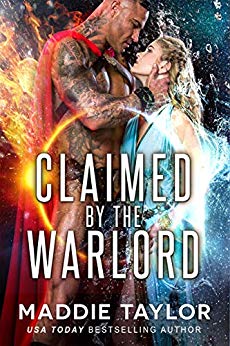
 Recently, I read a science-fiction/fantasy romance by Maddie Taylor. Overall, this novel was a good read, but some reviewers gave it a thumbs down due to the “discipline” used on the heroine. And, I totally get that, as the character didn’t really do much to warrant that behavior on the part of the alpha male. On the other hand, I read (some years ago) the science fiction series by Sharon Green wherein there is one heck of a lot of love/abuse in the tumultuous relationship between the heroine and her lover. I’d call this one “Sharon Green lite” in terms of spanking. There’s not much else for the “me, too” set to object to. However, this novel does have other, somewhat graphic, scenes associated with the precarious situation that sets the action of the novel in motion. Indeed, the author’s ability to describe the effects of terror inducing situations upon Princess Aurelia is the best part of the novel.
As many stories do, this one begins in medias res, where the Princess has been captured, auctioned to the highest bidder, and awaits her fate at his hands. There is intrigue and treachery aplenty, and the plot does have some twists and turns. Although this is more romance than science fiction or fantasy, it has enough suspense to keep readers swiping the electronic pages. The author does have a way of making the cold seem colder, the hot seem hotter, and the terror seem, well…I’m sure you get the picture.
For readers who like a blend of steamy hot romance, a dash of space opera, a good sprinkling of fantasy, and some scenes that are not necessarily comfortable (but totally fictional) then Claimed by the Warlord is a good read. For readers who are made of sterner stuff, Sharon Green’s Terrilian series is now available in eBook form, as well as in vintage paperback.


 I’ve enjoyed this series by H. Paul Honsinger, a trilogy that begins with To Honor You Call Us
 , as a space opera for fans of David Weber or others in that vein. Lots of authors try this sub-genre (and my Trinity on Tylos dabbles in it for a few chapters), but most such efforts don’t hold my interest. Honsinger’s universe and characters are well thought out, and therefore more entertaining than other authors.
 I was watching the grandkids play and perusing a shelf of older books. A title, Calico Captive by Elizabeth George Speare, caught my eye. Before long, I was reading and glancing over at the kids from time to time. When I taught middle grades (long, long ago) I used Speare’s The Witch of Blackbird Pond
 as one of my class novels. I’m not sure that all of the students liked it, but I did. Calico Captive, like “Witch” is an historical novel, with a young adult protagonist.
 to The Hunger Games (Book 1)to The Princess Diaries are squarely aimed at YA, but caught on with adults and movie audiences, too. Speare’s novels are very well written and could have a varied audience of entertained readers. Instead of re-cycling old television shows, maybe some film makers will decide to put Elizabeth George Speare’s tales into production. This novel would make a great movie!
 The title of this yarn isn’t particularly original, as it makes me think of Princess Leia, but the story doesn’t lean on Star Wars very much. As the book opens, with a war game going on, rather like Star Trek— The Wrath of Khan, I was wondering if the author was going to borrow heavily from that story, but not really. Actually, Bancroft uses lots of science fiction and fantasy elements, but this is theme and variation, then more variation. As a writer, a reader, and an occasional viewer of science fiction, I see this story as fairly original, and since there truly is “no new thing under the sun” that’s a complement.


 Having just read an article in Popular Science online about what a”
 Visions and Revisions