Rebel Princess by Blair Bancroft

The title of this yarn isn’t particularly original, as it makes me think of Princess Leia, but the story doesn’t lean on Star Wars very much. As the book opens, with a war game going on, rather like Star Trek— The Wrath of Khan, I was wondering if the author was going to borrow heavily from that story, but not really. Actually, Bancroft uses lots of science fiction and fantasy elements, but this is theme and variation, then more variation. As a writer, a reader, and an occasional viewer of science fiction, I see this story as fairly original, and since there truly is “no new thing under the sun” that’s a complement.

Oh, there are some aspects of the story that I don’t like. Most of the “alien” characters have an odd apostrophe in their names. I’ve come to view that artifice as trite, as so many science fiction and fantasy writers employ it. There are times when the narrative drags a bit, and the author tends to use too many sentence fragments. Especially. At times of high emotion. Oh wow. Get it? And, at least half of the main players have two names, because some are masquerading as someone else, which can get a bit confusing. Indeed, the author has a list of terms on her website, just to explain some of what’s going on in the story. Mostly, I didn’t need that, but it was nice to take a look at them all to see if I had guessed correctly.

Still, this story has lots to like, including a heroine (Kass Kiolani) who is brave but not at all prone to throwing caution to the winds. Since she was brought up as a royal heir, she thinks everything through. The hero (Tal Rigel) is mostly heroic and a lot less cautious than Kass, but vulnerable enough to be likable. Minor characters tend to be stereotypical, but there is some character building, especially the main character’s brother, who has some interesting “gifts.” The world building is better than some novels in the romantic science fiction genre, perhaps because this is the first in a series of novels set in this universe.

Lincoln— the film


I’m not sure why we didn’t watch it when it was new, but hubby and I were perusing a list of the best films available for streaming on Netflix, and we chose to view Steven Spielberg’s ode to the controversial president. Gosh, there’s been so much written about this man. Historians can easily demonstrate how controversial and even unpopular Abraham Lincoln was during his lifetime, but since then his stature has ridden the waves of popularity, sometimes to heroic heights and then again to be mostly forgotten.

I’ve read some of the books and articles on Lincoln, but there’s many, many more that I haven’t. Still, the film version has much to offer viewers, regardless of their prior knowledge of the civil war era leader. For the two hours plus of runtime, the film focuses on the struggle to pass the 13th amendment to the U.S. Constitution, the one which prohibits slavery, except as punishment for criminal behavior. Daniel Day-Lewis does a remarkable job of portraying the title character. Sally Field is also very good as the mercurial Mary Lincoln, and the supporting cast is peppered with famous and talented actors. When we paused the streaming version for a pantry raid, hubby and I commented that it was as if the script had been tailored to showcase some aging but remarkable players, including Tommy Lee Jones and David Spader.

Mostly, this is a really good film, but the beginning, although dramatically effective, leads a well-read viewer to question its authenticity. The soldiers who quote from Lincoln’s now famous address at Gettysburg seem so sincere, but it is quite unlikely that war weary soldiers would know by memory that speech, as it was not considered to be much good when it was delivered. History has given those words their significance.

Although I don’t remember the source of the recommendation to watch this film, I, too, endorse it. While the outcomes are not really suspenseful, the film holds the viewer’s interest. No biopic is entirely historically accurate, of course, but the spirit of truth is certainly present. Watch (or re-watch) and enjoy!

Some Science Behind My Science Fiction

Having just read an article in Popular Science online about what a”Generation Ship” might look like, I was gratified to see that some of the core concepts in my science fiction novel, Trinity on Tylos, are firmly rooted in science.

The article speculates about what challenges the multi-generation inhabitants of a colonizing venture (based on an extrapolation of current space technology) might face. Topics addressed include propulsion, medical issues, livestock, and robot workers.

In Trinity on Tylos, the alien captain of the Archeonite III has a big problem: his colony of survivors died out, but he has the ability to grow little Archeons from stored genetic material. He just needs some baby mamas, and my characters Venice Dylenski and Alathea Duke end up with the task. In the Popular Science article, We Could Move to Another Planet with a Spaceship Like This, the author mentions that “speculators say it’ll take 20,000 souls to start a healthy population on a new world. One space-­saving tip: Bring frozen embryos and people to diversify the gene pool upon arrival.” That’s right out of my novel, where Azareel and his android medical team design the embryos that Venice and Alathea gestate.

As in the Popular Science article, robots are probably going to be the grunt workers of the future. In my novel, the Archeons use robots (as they take the form of their makers, I call them androids) as workers. A limited but technologically proficient population would no doubt employ robotic workers, freeing the populace to supervise or take on  tasks that require a more creative mind.

Trinity on Tylos is a complex story, because it goes beyond being just a space opera and delves into human relationships, made more complicated by the limited number of people with whom the characters interact. Also, it is a story of surviving on a somewhat hostile planet, solving such issues as having enough water to irrigate crops. The Popular Science article mentions farming as one of the most necessary activities once the generation ship reaches a new planetary home. Indeed, when I wrote Trinity on Tylos, I remembered the words of William Bradford, a leader of the pilgrims who settled Massachusetts, who wrote “what could they see but a hideous and desolate wilderness, fall [sic] of wild beasts and wild men—and what multitudes there might be of them they knew not.” Survival is not easy, and the Popular Science article, although very positive in outlook, does not ignore the difficulties that might face the future generations of humans whose journey began with some adventuresome ancestors.

Technological progress and science fiction often go hand in hand, because what writers dream up, engineers can (sometimes) make happen. However, the reverse is also true— when creating a science fiction story, there must be some science blended in with the fiction. Trinity on Tylos is science based fiction, and it is available for your Kindle reader or Kindle enabled device; just click on the cover art.


The Sound of Music (on tour)

MusicMy sister, my daughter, and I saw a musical in our local theatre venue— The Sound of Music. I remember seeing the 1965 film version as a child (and I am telling how old I am by that admission) and absolutely loving it. The performance was part of what they term their “Broadway Entertainment” series. The auditorium there seats 2000, so it is actually larger than most theatres on Broadway. The seating is a bit more comfortable, however.

I told my daughter that I was wary of not liking the stage version, but it was really good. The sets worked well, and the actress playing the Reverend Mother has one heck of a set of pipes on her! The actor portraying the captain was a very good singer, too. I do not believe anyone could do a better job of singing the part of Maria than Julie Andrews did, but the actress who performed for us did a good job.

While many of the songs from the movie were used, this touring version is actually closer to the original stage play that the film was based upon. Although my daughter was upset that they left out one of her favorites, “Confidence” the Baroness and Max sing in the stage play!

Our girls night out was great fun, from our happy hour beverages, to our meal at a hip restaurant, and the heart warming musical, with nary a naughty word, finished the evening.

Not with a Whimper: Producers

D. A. Boulter was one of the first authors I read when I first downloaded the Kindle app for my (now passed on to a grandchild) iPad2. Gosh, I loved the app, the book, and that iPad. Fast forward a few years, and I have quite a few ebooks, a newer iPad, and more time to read.  I recently purchased Not With A Whimper: Producers. Despite the odd title, this novel fits into the “universe” that I first explored when I read Courtesan by Boulter.

I was prepared to love this book, as I have generally liked most of the books I’ve read by the author, and the description seemed interesting. However, as I slogged through the early parts, I wasn’t so sure. Somewhere around the 50% read portion I got seriously interested, but in the interest of not spoiling it, I won’t say why. The rest of the book was a quick read.

The main character of this story is a not quite 19 year old Larry Clement, and in many ways this story reminds me of the coming of age yarns that were the foundation of Robert Heinlein’s science fiction writing. Larry is a very unhappy young man, but a fundamentally good person, as the story opens. His girl, Sandra, and his fellow students are not fleshed out too well, but the relationship with his father is a main focus, so dear old dad, aka Robert Clement, is also a well thought out character. While I think that Courtesan is among this author’s best works, it isn’t necessary that readers read it first, as this novel stands alone quite well. However, the stories do share some characters, so I enjoyed the connections.

When I last reviewed a story by Boulter, I commented that his works don’t have many reviews and seem to have few readers. That’s a shame, because this guy has plenty of stories in him, good ones, and in a time when there is such a dearth of new material for readers, he deserves more reviews and the readers that write them. Indeed, anyone who likes science fiction or simply a good story should check out D. A. Boulter’s $2.99 Kindle books. Honestly, that’s cheap reading— less than a decent hamburger!

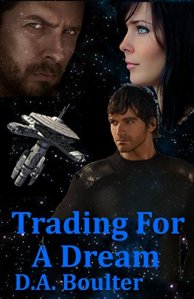
Trading for a Dream— review of book 2 in the Yrden Chronicles

TradingDreamcoverSince I first began reading eBooks on my iPad, I’ve used Amazon’s Kindle more than any other app, because it works well and the content is both plentiful and inexpensive. An early favorite author was D.A. Boulter, whose novel Courtesan impressed me quite a lot. I’ve revisited his work from time to time, and recently I read the latest entry in the series that began with Courtesan, Trading For A Dream (The Yrden Chronicles Book 2).

Boulter’s Yrden books are based upon the idea that somewhere in the future, Trading Families will own fleets of cargo ships that not only carry paid cargo, but that there would be trade representatives on board who scout for local merchandise at each port of call, buying and selling or bartering, providing new goods for their customers as well as adding profit to the Family. Of course, the Yrden Family is the core group, but Courtesan is a stand alone book which occurs some generations before the events in the two available Yrden Chronicles novels. Trading For The Stars (The Yrden Chronicles Book 1) recounts the story of Clay Yrden and Colleen Newborn who meet on a primitive planet, Erin.

Trading for a Dream continues their story, but the main point of view character is not one of the Family; instead, as the novel opens, the reader meets Adrian Telford, who is engaged in arranging an accident (i.e. he’s a hit man.) However, when the victim’s wife and son witness the “accident” Telford loses his taste for a life of crime. In an effort to clean up his act, Telford rides a shuttle to Liberty Station, a space station which is on the trade route of Blue Powder, a Yrden Family ship.

(spoiler alert)

When Blue Powder docks, Clay and Colleen soon meet Mr. Telford. Clay sees him as too risky due to his past association with criminals, but Colleen sees a desperate man in need of a hand up. Needless to say, the interactions between the Yrdens and Telford make up the rest of the novel. The yarn is suspenseful due to the efforts of the baddies to make Telford go back to his former profession, as well as an attempt to relieve the Yrdens of some of their goods.
While there are some mostly stereotypical characters, the author does a reasonable job of creating engaging characters, including the folks on the ship, the bad guys who used to be Telford’s business associates, and other folks who get involved, so there are quite a few of them for the reader to keep straight. Having read the other novels in the series helped me a bit in that regard.

I’ve enjoyed Doug Boulter’s stories, and I really liked this one, too. The only caveat I have in recommending these is if you want sex scenes, you’ll be disappointed, as these stories are remarkably clean without being intended for a young adult audience. These stories are reasonably priced on Amazon, and I encourage readers to discover this relatively unknown author. I am so glad I did.