Last Stand series by William Weber—review and commentary

Last Stand: The Complete Box Set

From time to time, I’m offered a “box set” of eBooks, which strikes me as funny as there is obviously no box, just a longer than normal eBook. While these often seem to be great values, I seldom read an entire series. Last Stand is different, because I did indeed read all four books, and while I enjoyed them, I liked each one a little less, but that’s just me and what I Prefer to read, rather than any flaws in the books themselves.

Book one, Surviving America’s Collapse, was so suspenseful that I read it in less than 24 hours. Apparently survivalist/prepper books are a sub-genre, but this is my first such book. Viewed simply as fiction, readers might be annoyed, as the narrative often becomes pedantic, teaching survivalist techniques to the reader, but I rather enjoyed those segments. In short, the story begins with the hero, former Army officer John Mack, being the only guy in his neighborhood who understands that the vehicles, phones, and other conveniences aren’t working because some entity set off an “EMP” device. Mack rescues his wife, then his children, thinking they will soon retreat to his survivalist hideaway cabin, but his wife convinces him to remain in their neighborhood, to assist their friends. This proves to be increasingly difficult, as resources dwindle and nefarious elements attempt to takeover their community.

Book two, Patriots, begins in the second setting, the Mack family hideaway. The canvas of conflict widens a bit in this book, as Mack realizes the scope of the attack upon America, and feels the need to take up arms not just to defend his family, but his country. Book three, Warlords, is a bit darker in tone, as the forces behind the attack upon America begin divvying up the country. Book four, Turning the Tide, is on a grander scale, as Mack is one cog in the military effort to fight back against the foreign powers that seem to have figured out how to conquer the United States.

Each of these books has a fictional story, but invariably the author uses his story to also instruct the reader. Those who like lots of details about the military and/or weaponry might like these books more than I did, but I did enjoy them. Some of the characterizations are fairly stereotypical, and sometimes the main characters are able to overcome situations which would probably be hopeless without the assistance of the author. So, suspending one’s disbelief a bit is a necessary skill for staying with the series. Still, the suspense is sufficient to keep the reader turning the pages.

Survivalists, military buffs, and those who enjoy suspense will all find something to like in Last Stand. As of this post, the price for the eBook set is three bucks, which is a down payment on a hamburger! I can’t think of anything as entertaining as these books for that price, so take a look. These books are also available in paperback and as audio books, and all have hundreds of ratings on Goodreads, mostly 4-5 stars.
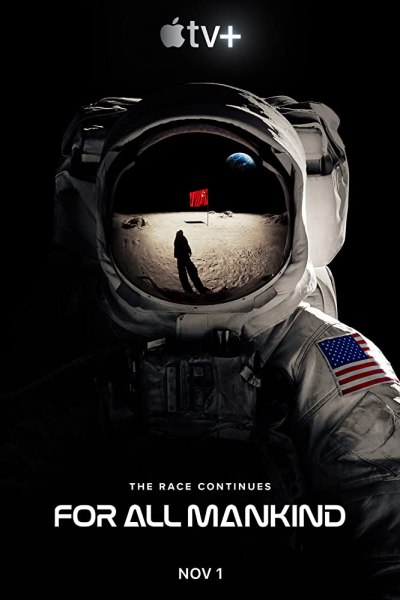
For All Mankind—on Apple TV

MankindWith the purchase of a new device from Apple comes a free subscription to their relatively new paid streaming platform. As hubby and I are often seeking a new television series to binge watch, we just finished For All Mankind on the Apple platform, and overall, we liked it quite a lot. However, I read several reviews, with criticisms being at least as numerous as the accolades, and often both are well deserved. The series was developed in part by Ronald D. Moore, who has a stellar (pun intended) reputation for writing and producing excellent science fiction, from Star Trek the Next Generation to Outlander, and with the simply superb reboot of Battlestar Galactica in between.
The scenario is quite promising: In an alternate history, the Soviet Union beats the United States to be the first nation to put a man on the moon, and the growing rivalry between nations causes the space program of the United States to flourish, rather than founder. Neither our citizens nor our politicians like being second best, so the need to catch up and surpass drives the plot. As an alternate history, many of the characters are based upon real people, but quite a few characters are inventions. Even those who are based upon real people have different adventures (or mis-adventures) due to the fictional nature of the series. The acting is good, as is the writing. The effects are very good, also. The sets, props, and costumes are really amazing—it’s truly a back to the 60s look. So far, so good.

But, as many negative reviewers have noted, the series is typical of our “social justice” modern agenda. Immigration, same sex relationships, race relations, and feminism are more than just sub-plots in this re-imagining of the space race. Each of these social justice themes has a story arc devoted to it, and these themes are every bit as strong as the “what if America had continued to send people to the moon?” theme that is the advertised plot line.

Alas, any subtle use of themes is no more. This alternate history is very good, but the social justice warriors are using a sledge hammer to right perceived wrongs. For All Mankind is just like many modern day productions in that regard. What could have been A+ for Apple’s streaming service is instead closer to a B-.

If you have Apple TV, check it out. If you don’t, I wouldn’t buy it for this series alone.

The Future of Learning for K-12

ChromebookNews organizations have truly embraced the old adage, “never let a crisis go to waste.” With every new pronouncement regarding the COVID-19 virus, the sky gets a bit closer to falling. Many of the public schools in my area have closed, but most of them are posting assignments online. Indeed, one of them has offered Chromebooks for check out if the family lacks a computer. This strikes me as a leap into the future of K-12 education.
Having taught both web enhanced and hybrid classes for the Technical College System of Georgia, I fully understand how to teach from my couch. In those classes, students had access to an online learning suite (either Blackboard or Angel, depending on the flavor of the year) wherein I listed assignments or offered online assessments. For those readers who are not chronologically gifted, the idea of closing schools seems unthinkable, but for anyone who has attended a post secondary school in the past decade, these fortnight long closures are no big deal. Indeed, I used to make jokes (during face-to-face class sessions at school) about teaching in my pajamas!

For younger students, such as those in K-12, however, quite a few of them have little experience with online learning, and some of their parents may not have experienced it at all. With a bit of coaching, both students and parents will come to see that much of what happens in a classroom can happen at home. In fact, in some cases, it is better to have online content. Forgot what happened to that important handout? Just print another one. Want to check the due date for an assignment? Just look at the online lesson plan. Need extra help? Email the teacher with your questions and concerns and you should get a prompt, personalized answer. Missed a class? Watch a recorded video session. In my experience, most college students eventually came to appreciate online resources, even if they didn’t embrace them. There is a learning curve, of course, as anything new requires some learning. Parents around here are about to embark on a new way of helping their kids with homework.

Who knows if the COVID-19 will actually be a serious threat to public health? Only the perspective of time will let us know that. However, this unprecedented interruption of business as usual in public education will demonstrate the power of online instruction. No doubt there will be some kinks in it, as this is new for some folks. But, the future of K-12 will be online, and this is just a preview of how it will work.

The book of the year?

The price we pay book cover
Lots of books are published each year, and I can only read a few of them. But, when a really important general interest book comes along, I often put it on the top of my “to be read” pile. In September, Dr. Marty Makary, a surgeon associated with Johns Hopkins, released a book entitled The Price We Pay: What Book American Healthcare—And How to Fix ItSince most people in America eventually get sick or have an accident, and only a few of us are fifty rich, this is the ultimate general interest book.

In Part I, entitled “Gold Rush” Makary doesn’t have to travel far—he visits “health fairs” at local churches, where salespeople disguised as medical professionals do screening tests and scare participants, mostly those on Medicare, into unnecessary and rather expensive procedures, such as placing stents into leg veins. In the second chapter, he discusses the lack of transparency in hospital pricing, as well as the astronomical rise in common procedures. For instance, a medical center in New Jersey offers joint replacement surgery for $135,400.00, which rose a mere 76.8% in a single year. BTW, Medicare only pays 13K for that procedure. For his third chapter, Makary travels to Carlsbad, NM, where the medical center seems to have overcharged and then sued almost everyone in town. Back in Virginia, Makary visits the courthouse to learn more about similar shenanigans at Mary Washington Hospital in Fredericksburg. Sadly, this hospital is supposed to be a “not for profit” hospital, and thus receives favored tax status, too. Also in this section, Makary provides an analysis of the proliferation of for profit helicopter ambulance services, which charge somewhere between $40K and $60K for a ride that I could make in an hour in my Toyota.

In the second portion of the book, Makary delves into some medical practices that can be improved by focusing on individual physicians. One OB doctor in Florida had a reasonable rate of C-sections, until figuring in Fridays, when the rate rose 80%. Why? The good doctor didn’t want to be bothered on the weekend, so moms who were in labor on Friday got the surgery. This section of the book also discusses the opioid crisis, and Makary admits that he had to learn to write fewer prescriptions for pain pills, after learning about the misuse of all those pills.

Part III of the book is about “Redesigning Healthcare” and it does offer several solutions to problems, but one chapter in this section explains how drug prices are affected by middle men (pharmacy benefits managers) who don’t supply anything other than a big bill for their services. Here’s an example: A pharmacy is paid $34.94 for 90 40mg doses of Zocor, but the employer is charged $442.85–and the PBM gets over $400 on that one transaction. Another chapter discusses problems in health insurance, which less and less helpful except in catastrophic circumstances, and there is even a chapter on “wellness” and how those well meaning programs are far too costly, especially as they often mean an invasion of privacy, or worse, over-treatment for minor issues.

Makary doesn’t make the mistake of only discussing problems without discussing solutions. Several positive programs are mentioned throughout the text, including websites such as ImprovingWisely.com, and the last chapter is a bit of a call to arms. In short, legislators and employers need to be educated on these matters, and healthcare consumers should do everything possible to demand transparent pricing for upcoming procedures.

The Price We Pay is a very important book. This should be the topic of your next book club, a gift for your friends and/or family, or even a holiday gift for your doctor or your legislator. Please buy this book, read it, and pass it on. Knowledge is power, and as this text has lots of information for Americans, this may well be the most important book you will read this year.

How much for a flu shot?

Mostly, I write about books, or maybe films. No doubt, I will do that again soon, but recently I have been experiencing various forms of health care, and my latest such visit was for the annual flu shot, so I’ll write a bit about that. For some years, I opted out of having this injection, but after hubby lost a week of work and felt terrible for even longer, I went back to getting the shot. After all, the couple of times I had influenza it was no fun at all.

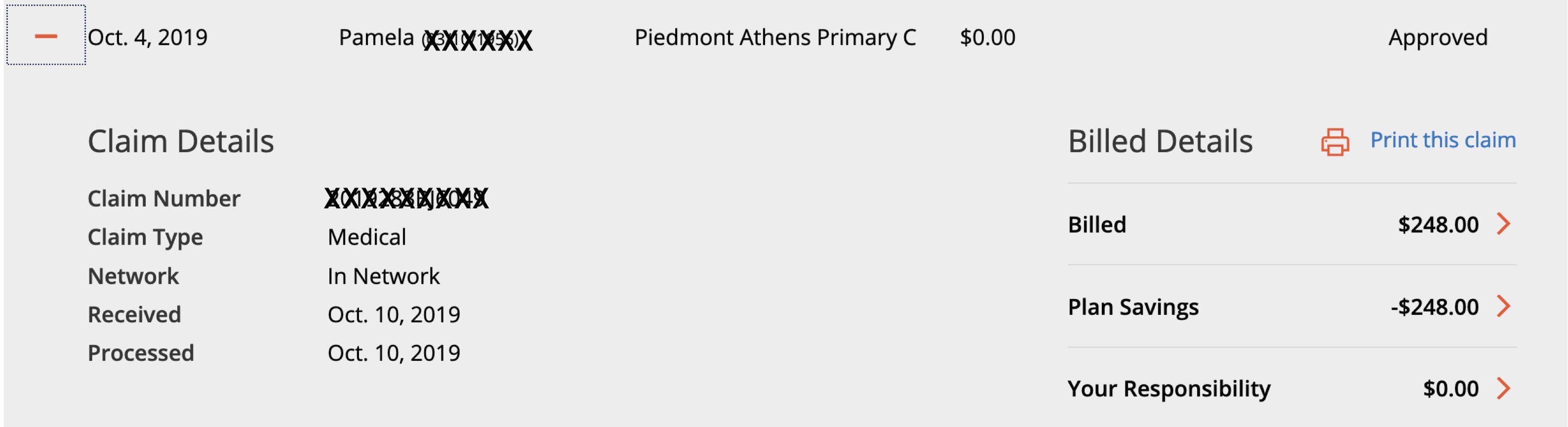
Current United States policy (via the Affordable Care Act) requires that insurance cover the flu shot as a preventative measure, without any co-pay from the patient. So, my doctor’s office has made a business decision to “stick it” to the insurance company—pun intended. See the attached screen shot of the EOB for this procedure:

Flu Shot

Now, thinking that $248 is a bit steep for this, I just looked at GoodRx (a nifty site if you have never used it) and it tells me that the estimated cost for the shot is $32 at Walmart.

GoodRx

Now, going to my doctor’s office was convenient and fast, but I’ve had flu shots at the grocery store or at a mini clinic, and neither of those were inconvenient. Bottom line, the doctor’s office knows that they can charge whatever for preventive procedures, and my insurance has to pay for it, so they are taking advantage of this. Kudos to Walmart for making this injection available for regular folks. If you don’t have insurance, or if you want to keep it real, just go to the GoodRx site and put in your zip code. The site automatically offers several locations and price points. BTW, the average when I looked was $32.

As for Piedmont Athens Primary Care, they’ve made me think, yet again, that when insurance premiums go up again, and they will, their approach to business is one reason for those hefty increases.


Earth Day

planetI have mixed emotions about this day, but I do like some of the promotions associated with it. There is a nifty kids’ consignment store over in Buford that is having a big sale today, urging their customers to buy used. For kids, that’s generally a win-win, as children’s clothing is often not worn out before it is out-grown, and as kids are hard on their clothes, cheaper options are better for play clothes. I noticed some emails from an online clothing vendor, which is offering sale prices and promotional buttons which say “used.” I’m not going so far as to wear one of those, regardless of how good buying and wearing pre-owned items is for the planet.

One of my friends works with elderly folk, doing both house-keeping and care-giving, and she recently brought me some bags of fairly nice clothing from a client who is downsizing. I’ve been going through those, listing some items on eBay, and setting aside some for charity. She was told to “get rid of them” by the client, so my friend had the choice of trash or wholesale charity, but she is a thrifty sort, as I am, so she went through them first. Some readers are going to say, “Yuck, I can’t imagine being that poor.” But, the truth is that neither of us is especially impoverished, but we do realize that the planet is better off when things are re-purposed or re-used.

In my kitchen, I have a compost bin, and I take it out regularly, adding to my compost pile in the back of my property. When I set out plants, I use the composted material for fertilizer, instead of using chemicals that aren’t good for me or the planet. When I’m away from home, I generally take a water bottle, rather than buying those. I use rags and towels when cleaning, rather than always using paper towels (which I can’t get hubby to do.) And, I’ve learned that Dawn+vinegar+water trumps most pricey cleaning products.

As a reader, I enjoy new and old books and magazines. These days, most of the content I read is in digital form, which sometimes saves significant amounts of cash, but it also prevents the waste associated with old or remaindered books. If you haven’t tried eBooks, this is a great time to take the plunge, as there is plenty of free and inexpensive content. Try the “Nook” app from Barnes and Noble, as it works quite well.

Earth Day is a chance to think or re-think consumption.