Shaken (Quake Runner Book 1) by Kevin Tumlinson— brief review and commentary

This is a pretty good novel. The main character, Alex Kayne, is sassy, super smart, and just vulnerable enough to avoid the “heroine can’t die” syndrome that afflicts almost all comic book super hero characters, or Lara Croft (heroine of the Tomb Raider games/films). Alex is a fugitive computer whiz who needs something to do as she hides from all the forces who want to either kill her or “bring her to justice”, so she kinda does her version of “The Equalizer” in that she helps people who have a specific need. The needy person in Shaken is a surfer/marine biologist named Abbey, who lost an arm to an encounter with a shark. Abbey received a prototype bionic arm, in part due to her high profile injury, and someone stole it. The arm and it’s charger, gone. Who the heck steals a limb from an amputee? (Literate folks might respond with another story, “Good Country People” by Flannery O’Conner, but I digress.)

So, we have Alex Kayne, who manages to change her appearance, her lodging, her cell phone, and her method of transportation more frequently than anyone in any spy novel I’ve ever read. In this book, she is mostly hiding out in Disney World. Other characters include Eric Symon, the FBI agent who nearly nabs fugitive Alex, Abbey who needs her arm back, and a cast of suspects or villains, depending on how the mystery unfolds. The action in this novel is well told, and not quite believable, but that’s part of the fun of it all.

Readers who enjoy puzzles and/or action heroines and want to be entertained for an evening (or two) should try Shaken (Quake Runner Book 1.)

Now, for the commentary. This was my first book by Kevin Tumlinson, but I certainly intend to try another. At the end of this book there’s a note wherein the author explains that he didn’t plan to self-publish this novel, intending to put it in the hands of an agent. However, he thought better of it and put it into his self-publishing stable of products. For many authors (yours truly included) self-publishing is better, due to control of the process and potential financial gain. That decision is understandable, but when the author said he wrote the book in roughly 15 days, I was shocked. Shocked.

Y’all, fifteen days is like two weeks. I can’t edit a book in two weeks, much less go from beginning to end. Wow. I had a whole new perspective on the novel after that. I thought it was a good, if not spectacular read, with very few errors. However, the very idea that such a book could be dreamed up and written in such a short time is simply hard to believe. However, as the author of Ecclesiastes says, “There is no new thing under the sun.” Shaken is a bit like that, in that the elements in the story have been used before, but perhaps not in precisely this manner. The author’s website is a feast for those who want to know more about marketing and branding, especially marketing self-published novels. Clearly, Tumlinson is not just prolific, but also understands how to get the product to customers, too.

Inside Marine One by Colonel Ray L’Heureux

While I seldom read biography, when I do, I usually really enjoy it. Marine One: Four U.S. Presidents, One Proud Marine, and the World’s Most Amazing Helicopter is a really good read. The author, a retired Marine, knows his subject matter, of course, but the book’s organization, which is both linear yet focused, helps make it an engaging read.

After an opening which describes the “victory lap” circling Washington on Inauguration Day, which is a taste of one of the final “missions” that the author participated in, the usual chronological approach takes the reader back to the time when the author’s love of flying helped him choose a career path. Lacking the funds to pursue a private education in aviation, Ray L’Heureux (call sign “Frenchy”) decides to join the Marine Corps as a pilot. During his very successful training, he decides to fly helicopters rather than jet aircraft, which most of his fellow Marines sought as their specialty. While on duty in California, Frenchy is in the audience gathered to see President Reagan land at his base. As he is impressed with this unit, Frenchy decided that he wanted a tour of duty with HMX-1, which is the name of the part of the Marine Corps which provides helicopter transportation for the President.

L’Heureux actually served in HMX-1 twice during his thirty year career in the Marines, hence the “Four Presidents” in the sub-title. He was a junior officer during the Bush 41 and Clinton administrations, meaning that he was part of the group that planned the helicopter trips (called “lifts”) and occasionally flew as co-pilot for dignitaries. L’Heureux returned as commander of HMX-1 during the presidency of George W. Bush, with whom Frenchy became friends. When Bush 44’s term was over, the author was still the commander of HMX-1, thus he flew the Obamas for a few months before his assignment ended and the reins of HMX-1 went to another Marine pilot.

While not overly technical, L’Heureux lets the reader know quite a lot about how helicopters work. The focus of the book is on HMX-1 and their two sorts of helicopters, all painted dark green with white on the top, but the author also flew in other types of helicopters with other missions, and that’s of interest. However, the “inside” view is largely about how the military goes to great lengths to insure both the safety, comfort, and efficiency in providing transportation for the President, the Vice President, and heads of state of visiting nations. Whether the reader knows much about helicopters, the military, or just recent history, or not, there’s something for everyone in Frenchy’s book. According to the author, President Eisenhower was the first U.S. President to use helicopters for day to day transportation, as it was faster and far more convenient for everyone. Motorcades require a number of security measures, which, of course, takes time and impacts traffic. When the President boards one of the “white top” helicopters, he can be where he needs to be more quickly, and traffic is unimpeded. So, since Eisenhower, most Presidents have relied upon Marine One for quite a lot of their transportation, whether going to Andrews to board Air Force One, or just a short trip to the Presidential retreat, Camp David.

One of the aspects that I found quite interesting were the stories about Camp David, which is a 45 minute ride from the White House via helicopter. The author describes playing “Wallyball” with Bush 41. Later, L’Heureux, both an athletic guy and a Marine, was invited to ride mountain bikes with Bush 44, and that experience began their friendship. During his time of flying George W. Bush, the author was frequently at the ranch in Crawford, Texas, and helped build a bike trail on the ranch.

Another interesting aspect of the book is that when the U.S. President travels abroad, the helicopters go over first, so that the President is always flown by Marine pilots. The effort necessary to dismantle, load, unload, and reassemble and then test the helicopters before the arrival of the President is a bit mind boggling. In his memoir, L’Heureux describes flying Marine One over Normandy for D-Day anniversaries, landing in Germany so the President could meet with Angela Merkle, and even landing at Windsor Castle, so the President could have tea with Queen Elizabeth.

For readers who enjoy history, insider information, or just an entertaining read, do check out Inside Marine One.

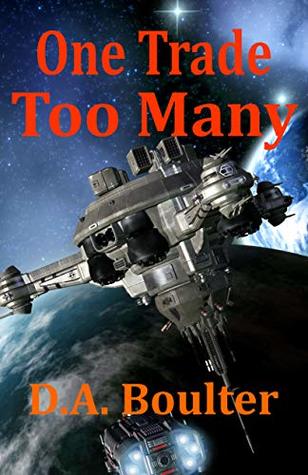
More from D.A. Boulter— One Trade Too Many and Trading for War

Some years ago, I discovered D.A. Boulter’s ebook series about a family of traders who traveled via space going vessels to various ports of call. Recently, I bought a couple more entries in the series, books 3 and 4, with the respective titles above.

As I previously touched upon earlier books in the series, here are links to Courtesan, Trading for the Stars, and Trading for a Dream. I’ve also read some of his stand alone books and other series, but the Yrden Chronicles remain my favorites in his growing booklist.

In One Trade Too Many, the Clay and Colleen Yrden are doing what their family does, traveling, trading, and raising their kids onboard one of the combo passenger and cargo ships, Blue Powder. During this entry, the Captain of Blue Powder (Clay Yrden) asks the head of security, Adrian Telford, to play passenger in an attempt to ferret out a possible saboteur, and one of the passengers, a widow, begins stalking Mr. Telford. While not boring, the story takes a while to build, but there is significant suspense toward the end of this third volume of the Trading series, and it has a cliff hanger ending. Some folks hate such endings, but as I purchased books 3 and 4 at the same time, I just swiped on over and read Trading for War. The latter is largely about warfare, and focuses on Colleen Yrden, who has a host of problems: her husband is missing, her son is growing into manhood with revenge on his mind, her family’s business is being disrupted by pirates and mercenaries, and her two mothers hate each other’s guts.

Nowadays, authors tend to follow other forms of media and rely upon bad language, sensuality, and inorganic plot twists to entertain readers. D.A. Boulter’s stories do not have any of those characteristics. Indeed, while not written for kids, or even young adults, these stories are entertaining but almost squeaky clean. Honestly, it is quite refreshing to read Boulter’s stories, which rely more upon world building, character evolution, and wholesome themes than anything shocking.

Fans of science fiction and multi volume stories should take a look at the works of D. A. Boulter. He’s one of the first eBook authors I ever read, and he remains a favorite a decade after I discovered his work.

Re-Reading, The Quantum Rose by Catherine Asaro

My recent visit to a used bookstore netted me a couple of relics from my past reading, including a paperback of Catherine Asaro’s The Quantum Rose. For those who have not read any of Asaro’s Skolian saga, this book might make a good starting point, but it is probably a better read for those who are already familiar with this rather involved science fiction/fantasy/romance series.

The Quantum Rose won the 2001 Nebula Award

Asaro’s bio is almost as mind-boggling as her stories: She holds a doctorate in chemical physics, and she is a former ballerina, jazz dancer, and sometime singer. Her books include near future science fiction, such as The Veiled Web and the Phoenix Code, the 14 (or so) volume Skolian saga, which begins with Primary Inversion, The Lost Continent series, The Uplift Saga series, and more.

For me, this book is really hard to quantify. One tag line is that it is a re-telling of Beauty and the Beast. Uh, not really. Another is that it is a physics allegory, and the author ‘s note at the end makes every effort to explain the book via that lens, and while interesting, I kinda got lost in her description of particle physics after a while. Certainly this book is a romantic science fiction story, and there’s really not much high brow competition in that sub-genre. While readable, Asaro is never simplistic.

This story does fill in some gaps in the Skolian saga, which generally tells the story of members of the Ruby Dynasty in a book (or two.) Interestingly, the point of view character in The Quantum Rose is Kamoj Argali, a young ruler of an impoverished province on a backward planet, and not a member of the Ruby Dynasty. Kamoj does end up entangled in their saga, because she becomes involved with Vyrl, one of the Ruby Dynasty, who is sojourning on her planet for a while, and they end up falling in love.

The first part of the book is all about Kamoj, Vyrl, and the complications of her previous engagement to a local leader of questionable morals, Jax Ironbridge. This first half is more romance than sci-fi, although sci-fi elements are present. The second half is mostly set off of that world, filling in certain backstory aspects of the Skolian saga, with more science fiction and a heavy dose of fantasy. At this point, the romance takes a back seat to the political machinations that are part and parcel of the Skolian yarn.

While I enjoyed The Quantum Rose once again, I have trouble understanding why it won the Nebula award, which goes to the best science fiction novel of the year (via a vote of the SFWA). Yes, it is skillfully written and the quantum part of the title is justified, at least in the author’s notes after the novel, as “playing with quantum scattering theory.” Still, I have to wonder if it was really the very best science fiction novel of 2000. I like most of the Asaro novels I have read, and I think some of the others are better than The Quantum Rose. Hum, maybe it was the lack of competition.

Re-reading, Goddess by Mistake

Recently, I got my hands on a used copy of a book I loaned and lost, Goddess by Mistake by P.C. Cast. Often, books are so similar that I don’t remember them well enough to write a decent review a week or two after I have finished them. Goddess by Mistake was memorable for me, so much so that I remembered it almost two decades after my first reading of it, so when I scored a used one on eBay, I put it at the top of to be read pile. The story still seems fresh, but the sassy narrator is the main reason I liked it then, and why I still like it. For those who want to know more, here’s a link to my “old” blog.

http://pamspages.blogspot.com/2007/08/

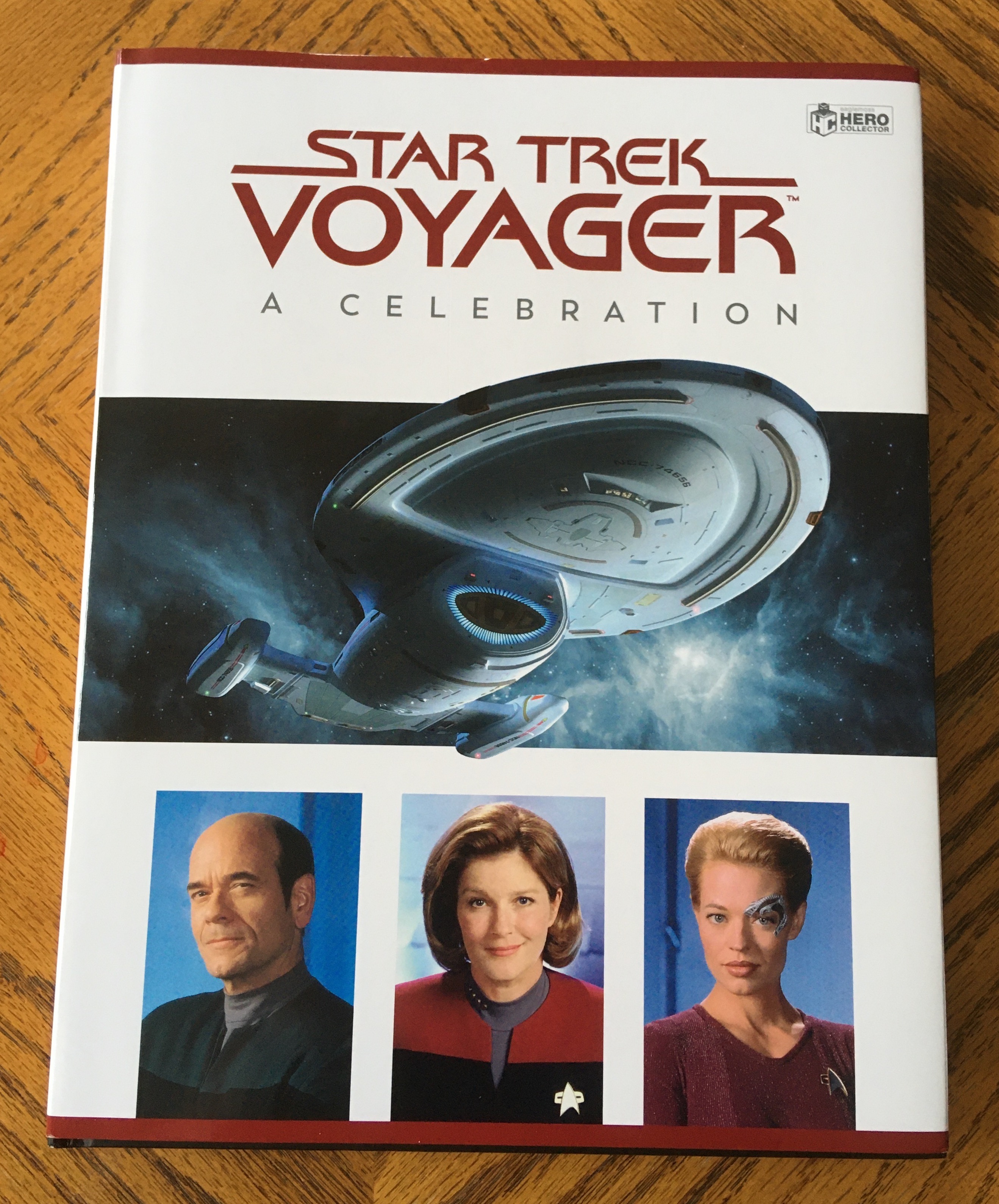
Star Trek Voyager: A Celebration

While all Star Trek series are worthy, some are just more interesting than others. Deep Space Nine has some great characters and acting, but initially suffered from being “stationary” rather than zipping around like the Star Trek ( the original series) or Star Trek: The Next Generation. As Roddenberry’s vision had sharpened and the syndication model freed him from many constraints, probably TNG is the overall best series. Certainly, the acting is amazing and the scrips are often really great, too. But, as special effects have become better and better, TNG suffers a bit in that area. Enter Star Trek: Voyager, which had a seriously huge void to fill, as it debut was a mere six months after TNG ended its seven year run. I also reviewed a book, Star Trek Voyager, A Vision of the Future, written during Voyager’s run, which is good, but last year, this volume, written as an anniversary edition, does a much better job of explaining the series as a whole, from development to the two part ending episode, “End Game.”

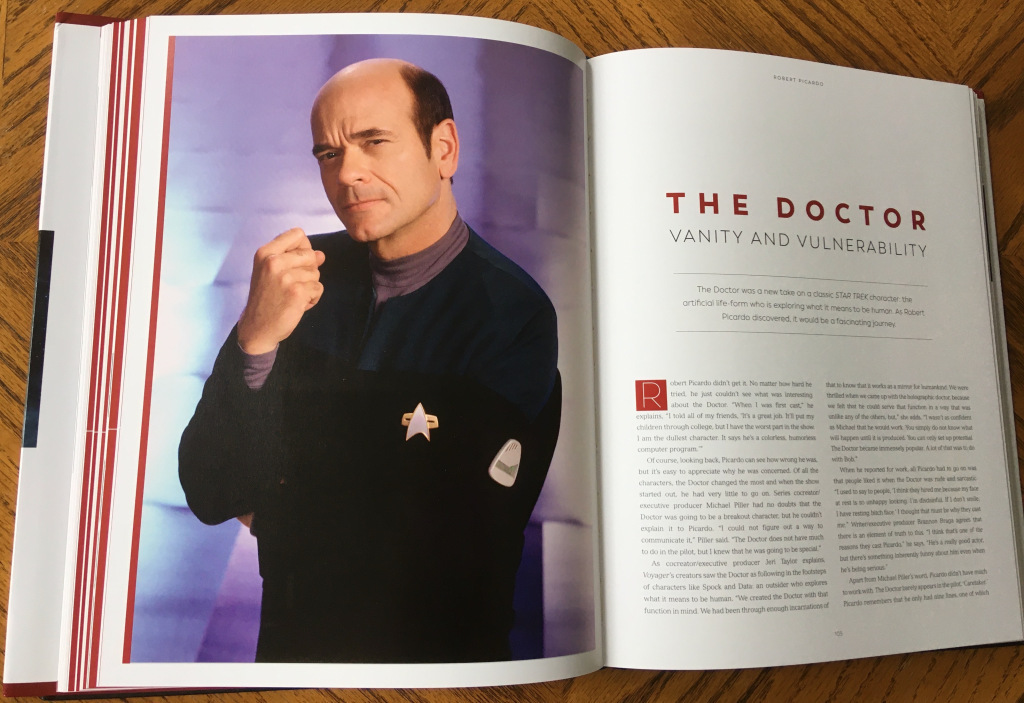
Upon receiving the book, I thought it would be one of those “coffee table” books, long on pictures and short on words. Nope, although there are many pictures. Indeed, the use of now decades old still pictures from the series is sometimes a weak point. However, there are drawings, pictures of behind the scenes contributors, and plenty of text. Overall, I really enjoyed the book, which is written in short segments which can be quickly read, but there are many sections, and these don’t necessarily need to be read in any fixed order.

The book begins, logically, with series development, and then there’s a short (two page) section devoted to the title sequence. I had no idea that this part (often “skipped” while streaming) was nominated for an Emmy award. Interspersed with the more technical aspects of the series are longer passages about the characters, beginning, of course, with Captain Janeway. The authors (two principal and two others, along with a general editor and a sub-editor) rely upon previously published material as well as newly conducted interviews with some cast members, as well as writers, producers, artist, and a host of others. Kate Mulgrew, who played Janeway, is among those who share memories in this book, and she discusses how much pressure was upon her as the first female captain of a Star Trek series, and how she approached the character as well as learning the scientific language necessary in this sort of show.

As there were many episodes (16 the first season, and 26 in each of the following six seasons) not all of them are featured, but sections devoted what are termed “key” episodes are mixed in with the other segments. The first, “Caretaker” is the two part pilot, and some of the other key episodes include “Tuvix” a character created by a transporter accident in which Neelix and Tuvok are blended into one individual. Each character gets a section, and most of multi episode villains do also. There are a couple of segments about the ship, one about the Delta Flyer, which is a smaller ship built by the Voyager crew about halfway through their journey, as well as segments about the special effects department, the makeup artists, the costumers, the writers, and the directors. As a fan of Voyager since it originally was broadcast, I knew quite a bit about the series, but there’s a lot of new material. For instance, I knew that some of the actors directed certain episodes, but I did not know that Star Trek actually fostered this by holding a “director in training” program. Roxann Dawson, who played Lt. Torres, directed a couple of episodes of Voyager, but went on to become a sought after director. She states that the program changed her life.

Bob Picardo took advantage of the DIT program and directed episodes of Voyager, but he also gets a writing credit, as he pitched a story line which was used, and he co-wrote the script. Robbie McNeil, who played Tom Paris, also directed multiple episodes of Voyager and went on to direct other projects.

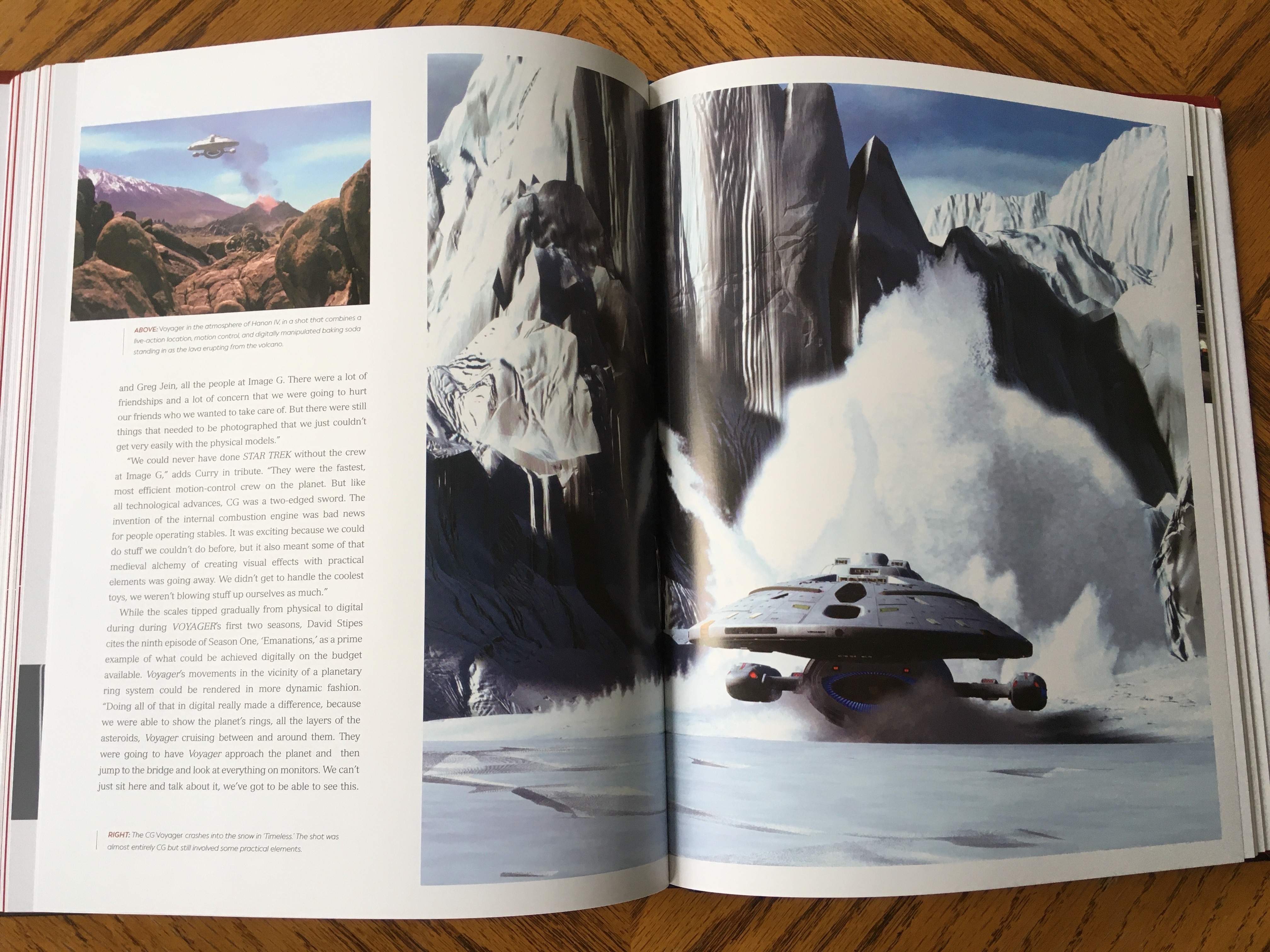
When TNG was in production, many of the special effects were done with models, but by the time Voyager was being produced, digital graphics were beginning to be more cost effective, as well as allowing more creative shots, so as the seven seasons went by, more and more VFX were done digitally. However, in the show’s 100th episode, “Timeless”, the ship is depicted as crashing into a snow and ice covered planet. The visual effects crew found that digital snow wasn’t working, so they ended up doing a practical shot with a model crashing into a tray of baking soda. I’ve seen that episode several times, and I am amazed by how good it looks on the screen.

For fans of Star Trek Voyager, this book is a real treat. For readers interested in television, particularly directing, writing, and special effects, it is worthy. Casual readers or those who just “look at the pictures” might be a tad disappointed in this book, but I read it cover to cover, with a couple sections earning a second reading. For now, it has a spot on my “keeper” shelf, too.