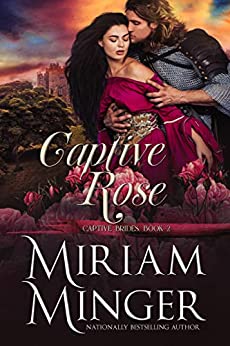
Captive Rose by Miriam Minger

As I continue on my quest to read the eBooks that have been lingering in my “library” of such items, I ran across a trilogy entitled Captive Brides. What was I thinking when I acquired it? I don’t know, but apparently I either read or abandoned the first novel in the series. So, I began (again) with book two, Captive Rose. Warning: I don’t care about modern sensibilities, and that includes having slaves as minor characters. When this book was set, lots and lots of folks were slaves. Now, I have dealt with that, okay?

The title character has been reared as a Christian in Damascus, in the middle ages. She is summoned to assist her physician step-father to help care for a captured Crusader, who has been severely injured in battle. Her mother had been widowed when her husband died on a trip to the Holy Lands, and she ends up married to the best doctor in Damascus. Through out the novel, her daughter, Laila, is associated with the rose, from her perfume to her favorite plant in the gardens in the main settings.

The Crusader, Guy de Warenne, escapes custody, and he is grateful to the young woman who assisted in his care. Through medicine that would be unknown in his homeland, he not only lives, but is restored to health. He is also confused, because he believed her to be a Christian slave amongst the pagans, and he wants to pay her back by taking her home to England away from the infidels in Damascus. Unfortunately, she is not too happy about that, and much of the conflict between the characters falls back upon that misunderstanding.

Minger seems to have done quite a bit of meticulous research to bring each setting and the each of the main characters to life. This one has it all, y’all, from dungeons to jousting matches. While this book was not written recently (couldn’t have been, actually) I really, really enjoyed it. So, if you enjoy bodice rippers, you just might like Captive Rose.
Burned by Greta Rose West

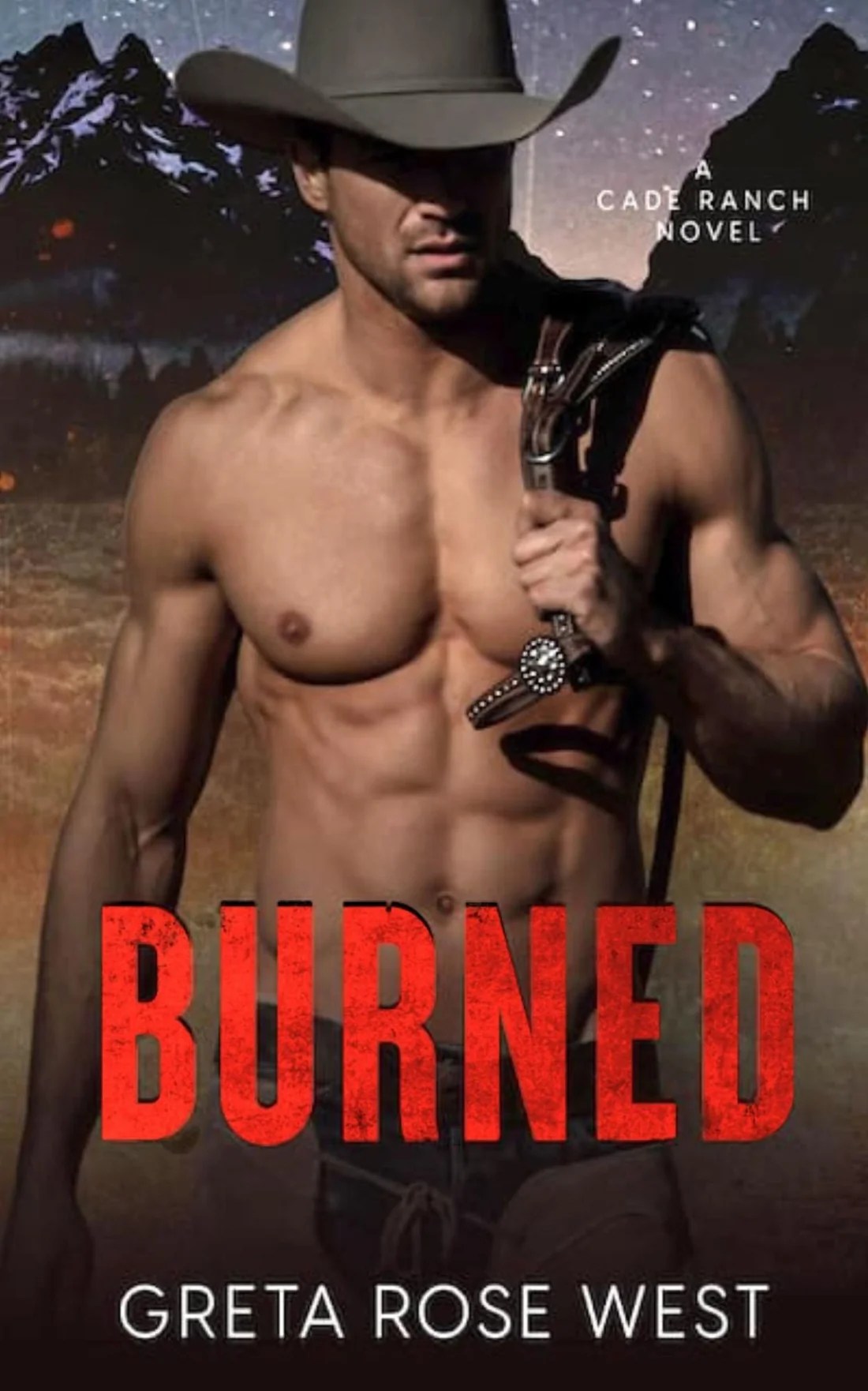
Burned cover art

First off, let me say that my favorite sub-genre of romance would be those set in the American West, while my second favorite is sci-fi romance. And, while I enjoy period pieces, I also enjoy modern westerns. Whether the romantic lead saddles up a Quarter Horse or a Ford F-150 doesn’t much matter to me. What matters in a romance is that the formula is there, but with some innovation or at least a bit of surprise here and there. Gotta keep things interesting, you know!

Burned, by Greta Rose West, entertained me until the last swipe of the page. In some ways, the book is standard fare: the romantic lead is a busy guy, with lots of problems, and he isn’t looking for love. The lady isn’t much of a lady, and she has a serious aversion to getting emotionally close to anyone. The point of view shifts with each chapter change, and the reader gets to know each party fairly quickly, which is necessary nowadays. Modern readers are not patient when it comes to character building or world building, for that matter.

In Burned, our male lead is Jackson Cade, the eldest brother and owner of a horse breeding operation. Yes, he is busy, and no, he isn’t wealthy, at least not in a monetary sense. He does have plenty of good company, as he lives with his four brothers, and he is the person on call for an elderly neighbor, Mrs. Mitchum. When she needs him to help her as she embarks on yet another course of cancer treatments, he responds to the call, despite his lack of time.

The female lead is Everlea, a volunteer at the local hospital, who has been tasked with assisting an elderly cancer patient. When Eve (short for Everlea) literally stumbles into Mrs. M’s room, giving herself a cut forehead and a concussion, Jackson ends up with two patients, Mrs. M, and her young helper, who isn’t to stay alone as she recovers from her concussion.

However, Everlea has secrets associated with a dark past, so she spends most of her waking moments trying to keep her lies straight. Perhaps this would be easy in a city situation, but the Cade ranch is on the fringe of the tiny town of Wisper, Wyoming, where everyone tends to know everyone else’s business. Before long, Jack realizes two things: Everlea isn’t what she seems, and he is falling in lust with her.

Since this is a western as well as a romance, there are horses to be born and named, there are scenic vistas to behold, and local decor is sometimes made of elk antlers. Everlea seems to enjoy it all, but she is ready to move on, with a packed “go bag” in her rented cottage. And, since this is also a mystery, there is a villain waiting to ruin Everlea, and he will enjoy killing anyone unfortunate enough to befriend her.

In hopes some of my readers will become West’s readers, I’ll skip the rest of the plot points and any spoilers. But it’s good, y’all.

After the epilogue, the author requests reviews. As an author, I get that. I’m not inclined to beg for those, but if more satisfied customers had written reviews, I would have been encouraged to write more books. So, Greta Rose West, here is a review by a very satisfied reader! Keep writing, please.

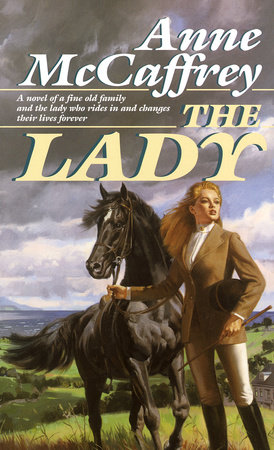
The Lady by Anne McCaffrey

Quite a while back, I decided to avoid writing reviews of living authors’ books, unless the author was either very famous (too famous to care what I thought) or dead. Anne McCaffrey is both super famous and dead. I’ve read several of her books, including some co-authored, but generally in her typical genre: science fiction. However, my daughter found this novel in her quest to find nifty vintage books, so she’s the reason I read The Lady.

I rather liked the retro feel of the novel, from the cover art to the characterizations to the plot. The novel is set in 1970, but according to the flyleaf, this book was originally published in 1987. The style seems more 70s than 80s, and that might be “off-putting” for modern readers. This is more of a “saga” than a typical novel, which was popular in the days of the mini-series on television.

Another aspect of the story is that it is about people who are seriously into horses. McCaffrey helps the reader with a glossary in the beginning of the book, which covers some Irish terms and some horse related terms, which helps a bit. The cast of characters (both human and horses) is sweeping, along with the names of the various horse shows. There’s a lot to keep up with, but the reader is rewarded with being able to escape into another time, when the telly was only briefly mentioned, and phones were attached to a wire.

The point of view character is Catriona Carradyne, a thirteen year old girl, who loves horses, which is both a blessing, because her father breeds, shows, and trains horses; and a curse, because her mother loathes horses and wants Catriona to grow up into a young lady. The setting, as I mentioned previously, is Ireland in 1970. One of the clients that boards her horse with the Caradynes, is Selena Healey, a stylish younger woman, who befriends Catriona, and mentors her through a very eventful time in her young life.

No spoilers here, I hope, but this novel is not just about horses, or about coming of age, although both of those are central to the story. There’s also loveless marriages and expectations of society and family. Some of the characters are well drawn, while others are mostly stereotypes, and the novel doesn’t move swiftly, nor is it filled with twists and turns. Nope, it is fairly predictable. The reader can figure out what will happen fairly early, so it is more “how” is the plot going to turn out rather than “what” will happen.

I can’t say this is the best book I’ve read lately, but it certainly kept me turning the pages. And, there’s that nice vintage feel about it, like listening to music from the 70s and 80s.

Re-reading, Goddess by Mistake

Recently, I got my hands on a used copy of a book I loaned and lost, Goddess by Mistake by P.C. Cast. Often, books are so similar that I don’t remember them well enough to write a decent review a week or two after I have finished them. Goddess by Mistake was memorable for me, so much so that I remembered it almost two decades after my first reading of it, so when I scored a used one on eBay, I put it at the top of to be read pile. The story still seems fresh, but the sassy narrator is the main reason I liked it then, and why I still like it. For those who want to know more, here’s a link to my “old” blog.

http://pamspages.blogspot.com/2007/08/

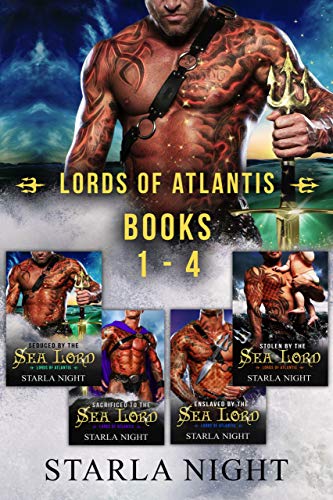
Seduced by the Sea Lord by Starla Night—brief review

A while back, I purchased (at a reduced price) the box set entitled Lords of Atlantis books 1-4, but the review is for Seduced by the Sea Lord, as that was the only novel I read. Quite frankly, it took me a while to read it, because it wasn’t very good.

Here’s the book blurb: “Determined warlord Torun cannot wait to claim Lucy, who mistook him for a shipwreck survivor and pulled his injured body from the ocean. All his instincts tell him she is his soul mate. Now she must join with him and give him a child. 

Lucy can’t believe the words coming out of this dominant male. He insists her destiny is to become a mermaid queen and mother to his future children. The one thing “destiny” forgot to mention was that Lucy’s a broke divorcee who can’t even have a child. 

It’s really too bad, because his gorgeous lips are all too kissable, and she’d love to see his iridescent gold tattoos moving as he flexed those broad, hard pectorals under the water…”

This cover image is for the set; I am reviewing book 1

There are a bunch of five star reviews for this set, by Starla Night, and one reviewer who rated the set at one star accused the others of being “paid reviewers.” Darn, I wish I could afford to pay some of those reviewers to put up five star reviews of my novels. Maybe I’d make some bank, but I’m too honest. Or poor.

Anyway, back to the review. The point of view character, Lucy, is chick-lit cute in her narrative. The alpha male hero is appropriately madly in love with Lucy. The bad guy is Lucy’s ex, and he is cardboard cut out bad. Many gals dislike their ex, but Lucy’s guy stole her money, her ideas, and her dignity. Yep, he’s bad, all right, but some how I didn’t hate him. Nor did Lucy’s grousing about him endear her to me.

The trappings of “mer” vs “human” seemed alternately implausible or just plain silly, which didn’t help the novel at all. In a word, this novel seems phony. I have three more books in the set, but unless I am stranded on a desert island with nothing else to read, I rather doubt I will re-visit the Lords of Atlantis.

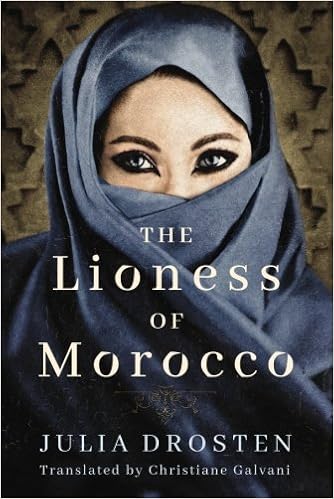
The Lioness of Morocco— review

The Lioness of Morocco is quite a saga. I mean that in a positive way, but some readers may not be ready for a yarn that covers this many years. I, on the other hand, relished it, like a home cooked meal after a long stint of eating fast food.

This story reminds me of the “mini-series” that were once a staple of television networks: a multi-part yarn that covers much of the adult life of an interesting main character, often with a lengthy list of co-stars. Such sagas usually combined romance, suspense, and mystery, and The Lioness of Morocco does that fairly well. The protagonist, Sibylla Spencer, is a good (if not fabulous) character, sufficiently well developed that readers should want to follow along with her travels and travails. Although the story begins in England, before long her adventuresome nature, combined with her father’s shipping business, leads her and her new husband to Mogador, Morocco, where she grows into an even more bold woman, sometimes called “The Lioness” in part due to her mane of golden hair.

< a few spoilers follow>

As an Englishwoman, Sibylla could either cling to all things British, from her clothing and her companions, to her language. Or, she could learn more about the Moorish population, learn their language, and (perhaps) do a bit of business with them. She follows the second course of action, which does cause her more straight-laced neighbors to be a bit put out with her. However, she is well-mannered and well-bred and manages to keep both sides of her world reasonably happy with her most of the time.

The novel is set in a tumultuous time, so there are plenty of plot twists, but the reader is never rushed, as this story happens over a number of years. Much of the Moroccan culture is revealed via detailed descriptions, which I genuinely enjoyed. Several crises occur, from the time her husband is accused of trafficking slaves to being the family being involved in trade wars and political wars. However, Sibylla and her children seem to rise to the occasion, whatever comes their way.

I did find this to be a very satisfying novel, rich in history and culture, if not a compelling read. For anyone who hasn’t enjoyed a saga recently, I suggest this novel. It is available as a paperback and in eBook form.