Missing Author?

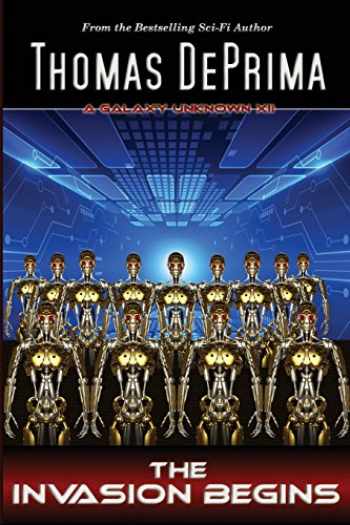
Recently, I re-read the Thomas DePrima novels I had purchased as eBooks, namely, the first nine of twelve titles in the A Galaxy Unknown” series. Gosh, I had forgotten much of the detail, but I remembered that I really enjoyed them. As certain television series benefit from “binge watching”, such as Breaking Bad, I realized that reading those nine novels back to back was great fun, so I sought the other books in the series and found them on Apple’s reading app. I just finished the 12th book, which, darn it, ends with a cliff-hanger. Thus, I have two mysteries. First, how do Jenetta and Space Command once again save the known galaxy, and, second, what happened to Thomas DePrima? According to the end of book 12, The Invasion Begins, the adventure will continue, but that book was published almost a decade ago. According to my web research (thank you AI) DePrima hasn’t published anything since 2019.

For those who haven’t read this nifty space opera series, I reviewed some of these novels when I first read them, and those entries are summarized earlier in this blog.

Thomas DePrima’s A Galaxy Unknown series is a classic space opera infused with modern indie flair. Spanning twelve main novels (plus spin-offs like the Border Patrol and Colton James sub-series), it follows the meteoric rise of Jenetta Carver, a sharp, disciplined young Space Command officer whose destiny is nothing short of galactic. The series has an action packed beginning, with a few flaws in the writing, but nothing that keeps most readers from swiping those electronic pages to find out what will happen next. There’s enough science fiction to keep fans of that genre entertained, but the writing is not so technical that every day readers who enjoy a strong female character can’t enjoy each book. As the series goes on DePrima’s universe is ever more expansive and detailed. From the political tensions between Galactic Alliance sectors to the looming threats of alien species and interstellar crime syndicates, the author builds a rich backdrop for military intrigue and diplomacy.

The series isn’t without some minor imperfections, especially as the series progresses: some plotlines feel recycled—Jenetta foils yet another plot, saves the day, and gets another promotion. Her near-infallibility can reduce the suspense. Not since the video game version of Lara Croft has a female lead seemed so invincible. However, if you’re a fan of David Weber’s Honor Harrington, any early iteration of Star Trek, or any tale of righteous command in deep space, A Galaxy Unknown and its eleven sequels offers a satisfying and immersive experience. 

That said, I wonder what happened to Thomas DePrima. According to Goodreads, he has over 20 books available, and most of them rate above 4 (out of 5) stars, with thousands of reviews of the earlier books, and hundreds for the later titles, which is amazing for an indie author. Various sources speculate that DePrima is a pen name (not so unusual) so maybe he has passed. Or, maybe he got tired of writing. Maybe he pivoted to another name and a new set of books. I have no idea, but I do wish that the series had some sort of denouement. Jenetta Carver and company are too cool to just leave hanging.

Where are you, Thomas DePrima?
Star Trek Picard—review and commentary


Ryan in Trek

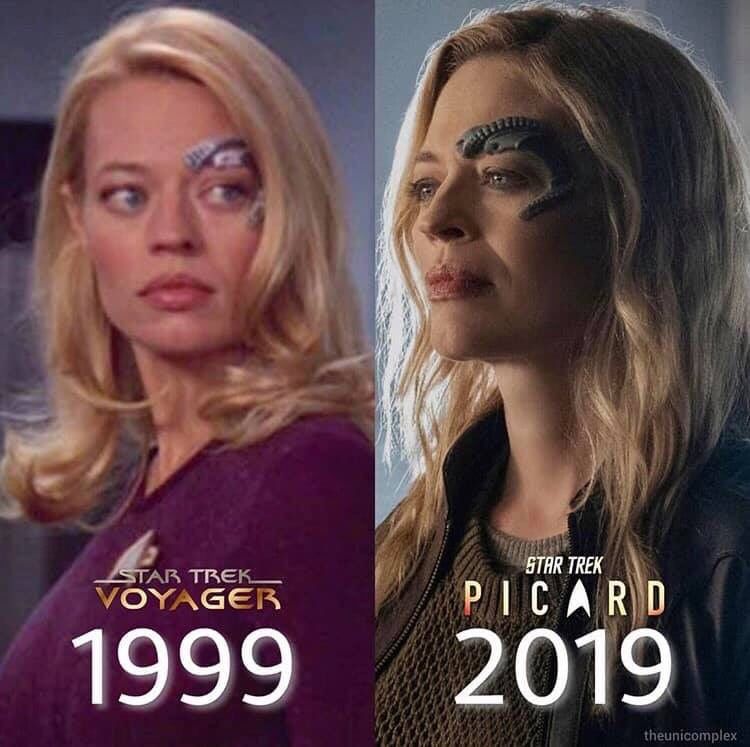
Then and now— Seven of Nine


Star Trek
is an integral part of American culture
and a controversial view of the future of humanity. It began with Gene Roddenberry’s concept for a serious science fiction television series, a novel idea in the early 60s, and it has continued to evolve for fifty years. As America has changed, as science fiction has changed, as television has changed, Star Trek has changed, too.

Picard is set two decades after the feature film, Nemesis, and is based upon the series Star Trek The Next Generation, which ran for seven years on television. Later, four of the feature films were based upon the characters from TNG series. Picard has ten episodes in season one, but the second and third seasons are planned for CBS All Access, which is how hubby and I watched the first season.

This made for the web series has very high production values—the sets and effects rival feature films. Sir Patrick Stewart is still an amazing actor, although the pace of the series (slow!) seems to be partially dictated by the age of its principal character. Viewers who prefer space battles and fisticuffs will probably be a bit disappointed. Casual viewers may also find the editing, with its rapid cuts from scene to scene, confusing. Honestly, I don’t like that aspect at all, but this is apparently in line with Picard‘s sister show, Star Trek Discovery.

Spoiler alert—

We both thought the first few episodes were confusing and lacking in characters, apart from Jean Luc Picard himself, with whom we could empathize. The writers made a good decision in embracing the age of the main character. Anything else would insult the viewer, as Patrick Stewart looks and sounds old. For us, as fans of Star Trek Voyager, the show got better when Jeri Ryan pops in, as an older and less “Borg” version of Seven of Nine. Ryan is still riveting to watch, even without the cat suit that made her fodder for lots of magazine pictures in the late 1990s. In the seventeen years since her character graced the small screen, Seven has become much more human—in her speech pattern, in her attire, and in part due to suffering losses associated with years of living in a deteriorating society.

A key word here is suffering. One of the better aspects of Trek in its first few decades was  its optimistic view of the future of humanity. Although Roddenberry sought to put serious science fiction onto television, and therefore into lots of living rooms, his vision was seldom dark. However, much of serious science fiction—in print, in film, in gaming, and even in graphic forms—has embraced the dystopian view of the future of humanity. A utopia is an idealized society in which social and technical advances serve to make all things better for humanity. Yes, I did say it was idealistic! A dystopia is the polar opposite, in which “advances” in society and technology make things worse. For some examples of dystopian literature/film, think of Orwell’s 1984 or the film Blade Runner, based upon the work of Phillip K. Dick.

Alas, Picard‘s greatest weakness isn’t its slow pace or its rather confusing editing. Nor is it the “flashbacks” in which the characters look just as old as they do in the current timeline, no doubt due to the unforgiving nature of high def photography. Nope, the core problem for many fans of Star Trek will undoubtedly be the dark vision of the future embraced by the writers. Picard is a dystopia. Beloved characters from the previous Trek series will suffer, and some will die. New characters suffer and some of them die, too. And, by and large, those deaths may very well be without purpose, meaning, and certainly without honor.

Star Trek Picard has some strengths, including dazzling cinematography, a rich background of material from which the writers can draw inspiration, and an aging but talented main character. Guest stars include characters from TNG and Voyager, and the development of Seven of Nine, the former Borg, works well. Enjoy the series, but temper your expectations. This is post-modern Star Trek.


Rebel Princess by Blair Bancroft

The title of this yarn isn’t particularly original, as it makes me think of Princess Leia, but the story doesn’t lean on Star Wars very much. As the book opens, with a war game going on, rather like Star Trek— The Wrath of Khan, I was wondering if the author was going to borrow heavily from that story, but not really. Actually, Bancroft uses lots of science fiction and fantasy elements, but this is theme and variation, then more variation. As a writer, a reader, and an occasional viewer of science fiction, I see this story as fairly original, and since there truly is “no new thing under the sun” that’s a complement.

Oh, there are some aspects of the story that I don’t like. Most of the “alien” characters have an odd apostrophe in their names. I’ve come to view that artifice as trite, as so many science fiction and fantasy writers employ it. There are times when the narrative drags a bit, and the author tends to use too many sentence fragments. Especially. At times of high emotion. Oh wow. Get it? And, at least half of the main players have two names, because some are masquerading as someone else, which can get a bit confusing. Indeed, the author has a list of terms on her website, just to explain some of what’s going on in the story. Mostly, I didn’t need that, but it was nice to take a look at them all to see if I had guessed correctly.

Still, this story has lots to like, including a heroine (Kass Kiolani) who is brave but not at all prone to throwing caution to the winds. Since she was brought up as a royal heir, she thinks everything through. The hero (Tal Rigel) is mostly heroic and a lot less cautious than Kass, but vulnerable enough to be likable. Minor characters tend to be stereotypical, but there is some character building, especially the main character’s brother, who has some interesting “gifts.” The world building is better than some novels in the romantic science fiction genre, perhaps because this is the first in a series of novels set in this universe.