Received this today via email. From the same entity that said my account would be terminated in 7 days. What’s up with this? Taunting me? What do you think?
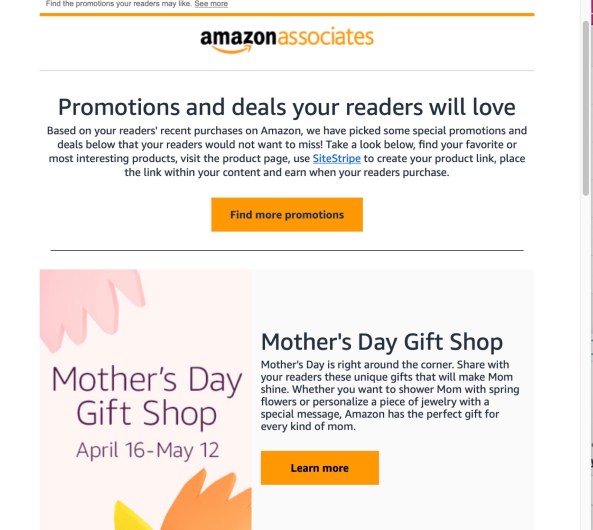
Received this today via email. From the same entity that said my account would be terminated in 7 days. What’s up with this? Taunting me? What do you think?
 And lots and lots of links are gone. Five years’ worth of links to the 800 pound gorilla publishing company that recently declared war on my site. Oh, and I’ve just deleted half of the stuff in my shopping cart (the other half was placed by my hubby, who is more swayed by convenience than I am.) So… let’s see what new weirdness will be coming my way.
BTW, here’s a couple of emails I got recently regarding my “seller” account with the 800 pound gorilla. This April has been filled with foolishness.
On April 8 I got this lengthy missive. BTW, I sell books, not pesticides!
Dear Seller,
As part of our ongoing efforts to protect our customers and enhance the customer experience, we are updating the requirements to offer products that qualify as pesticides or pesticide devices. Pesticides and pesticide devices include a broad set of products, and it can be hard to identify which products qualify and why. You are offering, or have previously offered, products that are affected, including for example:
0967197929
To continue your current offers on affected products after June 7, 2019, you will need to complete a brief online training and pass the associated test. You will not be able to create new offers on any affected products until you receive approval. You are required to take the training and pass the test only once, even if you have offers on multiple products. This training will help you understand your obligations under EPA regulations as a seller of pesticides and pesticide devices.
To avoid interruption of your offers, you may either click this link to Seller Central to start the approval process using a sample ASIN: https://sellercentral.amazon.com/hz/approvalrequest/restrictions/approve?asin=B0002YP612, or request approval using any of your ASINs listed above.
Frequently asked questions:
1. Why am I receiving this message?
You are receiving this message because you are offering, or have previously offered, one or more pesticides or pesticide devices. EPA regulations define pesticides and pesticide devices to include a broad set of products, including many that you might not expect. For example, they can include:
• Ultraviolet lights;
• Air treatment units or filters;
• Water treatment units or filters;
• Sound generators;
• Insect traps; or
• Products that make pesticidal claims, such as “disinfects” or “sanitizes”.
For additional information, see EPA guidance on what a pesticide is: https://www.epa.gov/minimum-risk-pesticides/what-pesticide and what a pesticide device is: https://www.epa.gov/safepestcontrol/pesticide-devices-guide-consumers#2.
You can also see Amazon’s Pesticides and Pesticide Devices policy for more information: https://sellercentral.amazon.com/gp/help/202115120.
2. What does this mean for me?
To create a new offer on any pesticide or pesticide device, or to avoid removal of your existing offers of these products after June 7, 2019, you must obtain approval by completing an online training and passing the associated test. You need to take the training and pass the test only once, even if you have offers on multiple products.
3. How do I seek approval to sell the affected products?
There are two ways to request approval. You can click on this link https://sellercentral.amazon.com/hz/approvalrequest/restrictions/approve?asin=B0002YP612 to start the approval process using a sample ASIN (you are under no obligation to list against this ASIN, but can use it to trigger an approval request).
Alternatively, you can use one of your affected products as follows:
• Login to Seller Central, click Inventory, and select Add a Product.
• Input one of your pesticide or pesticide device ASINs from the list provided above.
• In the search results, click the “Listing limitations apply” link next to the ASIN.
• Click the Request Approval button to start the approval process.
4. What does the approval process consist of?
You will be required to complete a brief online training and achieve a passing score of at least 80% on the associated test. Only U.S. sellers are permitted to request approval.
5. Can I still use FBA?
Effective June 7, 2019, only sellers approved to sell the affected products may send shipments of those products to fulfillment centers.
6. How will this affect my existing FBA inventory?
If you have remaining inventory of qualifying products in Amazon fulfillment centers, you can continue selling your remaining inventory until June 7, 2019. After June 7, you either need to (i) obtain approval to continue to sell the affected products or (ii) create a Removal Order for return or disposal of your remaining FBA inventory. For assistance creating a Removal Order, please visit our How to Create Removal Orders page: https://sellercentral.amazon.com/gp/help/external/200280650.
Thank you,
Amazon Services
Then on April 11, I received this email:
Dear Seller,
You recently received an email from us regarding listing requirements for pesticides and pesticide devices. Our email incorrectly stated that your offers on media products would be affected by these requirements. However, these requirements do not apply to media products such as books, video-games, DVDs, music, magazines, software, and videos. None of the products you are currently offering have been identified as pesticides or pesticide devices and no action is necessary to avoid removal of your current offers.
We apologize for any confusion caused to you by our email. If you have any further questions, please contact Selling Partner Support.
Regards,
Amazon Services
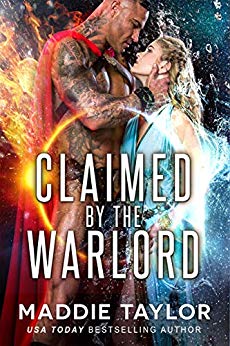 Recently, I read a science-fiction/fantasy romance by Maddie Taylor. Overall, this novel was a good read, but some reviewers gave it a thumbs down due to the “discipline” used on the heroine. And, I totally get that, as the character didn’t really do much to warrant that behavior on the part of the alpha male. On the other hand, I read (some years ago) the science fiction series by Sharon Green wherein there is one heck of a lot of love/abuse in the tumultuous relationship between the heroine and her lover. I’d call this one “Sharon Green lite” in terms of spanking. There’s not much else for the “me, too” set to object to. However, this novel does have other, somewhat graphic, scenes associated with the precarious situation that sets the action of the novel in motion. Indeed, the author’s ability to describe the effects of terror inducing situations upon Princess Aurelia is the best part of the novel.
As many stories do, this one begins in medias res, where the Princess has been captured, auctioned to the highest bidder, and awaits her fate at his hands. There is intrigue and treachery aplenty, and the plot does have some twists and turns. Although this is more romance than science fiction or fantasy, it has enough suspense to keep readers swiping the electronic pages. The author does have a way of making the cold seem colder, the hot seem hotter, and the terror seem, well…I’m sure you get the picture.
For readers who like a blend of steamy hot romance, a dash of space opera, a good sprinkling of fantasy, and some scenes that are not necessarily comfortable (but totally fictional) then Claimed by the Warlord is a good read. For readers who are made of sterner stuff, Sharon Green’s Terrilian series is now available in eBook form, as well as in vintage paperback.
 I’ve enjoyed this series by H. Paul Honsinger, a trilogy that begins with To Honor You Call Us
His villains (the Krag) are truly obnoxious, and his hero, Captain Max Robichaux, has the right stuff to be a hero, but isn’t perfect, which is an unfortunate side-effect of being too heroic. Authors much achieve some balance, and Honsinger does that quite nicely. The captain’s side kick is Doctor Sahin, who is a bit like Dr. Watson’s being a sounding board for Sherlock Holmes. The situation is dire, for the enemy and the lengthy war have affected the human race in negative ways, such that surrender is unthinkable and victory an uncertain quest.
For Honor We Stand is the middle book in the series, so I hope to read the final book soon, and I’ll try to post a more through review of the trilogy.
Okay, this book is seriously vintage as it was published in 1995, but my hubby is recently retired, so he wants to do some traveling. But, when and where should we travel? A friend mentioned that a CBS news feature reporter who spent much of his career “on the road” discussed his favorite places to be in Charles Kuralt’s America, and the narrative relates his first year of retirement, where he spent time visiting them, at the best time of year to be in those spots. Despite the passage of time, the weather and scenery is no doubt much as it was in Kuralt’s retirement year, so the book is still relevant.
What’s special about this book is the magical prose that Kuralt employs to describe his series of destinations. In January, he spent time in New Orleans. As he is riding from the airport to his hotel in the French Quarter, he says, “I could have closed my eyes in the backseat of the taxi and known where I was purely by the pungent accent washing over me from up front.” I once worked with a lady from Louisiana, and the accent is unique, for sure. Kuralt further states that there are ” three main themes of the city: family, music, and food.” All three are the subject of his discourse, and apart from not actually tasting the jambalaya and crawfish étouffée, the reader feels as if he, too, had visited New Orleans. In February, Kuralt visited Key West, and again, he makes the reader feel like a participant in the trip. March’s destination was Charleston, a city that I’ve visited, but Kuralt stayed longer, met more natives, and has some interesting stories to share. In April, Kuralt ended up enjoying the emerging sign of spring, daffodils, which sounds incredibly boring, but it is not when Kuralt describes them.
In May, he is traveling again, and his destination is again in the south—Grandfather Mountain. His discussion of this scenic area of North Carolina includes everything from what makes the best barbecue to why one should make the drum of a banjo from squirrel skin. Kuralt packs more information into each chapter than I’ve read in several guide books for the area. June he spends in Ketchikan, Alaska; July in Ely, Minnesota; and August in Boothbay Harbor, Maine. Kuralt’s love of boating and fishing is apparent in all of these destinations, as it is in his September destination of Twin Bridges, Montana. For local color in October, Kuralt visits Woodstock, Vermont. As the weather in the north chills, he goes to Rio Grande Valley, New Mexico, soaking up history along with the sunshine. For December, he returns to the place where he made his home for many years, New York City. However, as Kuralt explains, people don’t live in New York; rather, they live in a neighborhood within the city. Again, he gives the reader several examples of people and places in the city, which is decorated for the holidays in his prose.
Charles Kuralt’s “On the Road” feature stories for CBS news on television were a part of my youth. His voice rings true in this rambling, but never unfocused, narrative. For those who remember him, this is a nostalgic read. For those who don’t know his work, the book could serve as an introduction to a time when people didn’t spend time on their smart phones and computers, but spent leisure time in scenic places, learning from the people who inhabit those places. I’m glad that my friend recommended this book so highly, because I certainly enjoyed savoring it.
A friend told me how much she is enjoying her study of Max Lucado’s book, Anxious for Nothing, so I bought an eBook version. Quite frankly, her comments were so positive that I did not want to wait to pick up the physical book. I’ve read several of Lucado’s Christian living texts, and they have all been easy to read and helpful, and this book fits that mold.
The title says quite a lot. Modern people have too much information coming at them, much of it negative, so being anxious is almost a modern plague. This plays out in all sorts of ways: addiction, suicide, failed relationships, etc. Lucado discusses the whys, and then gives some very good solutions to our problem thinking. One of my favorite passages says this: “There is a reason the windshield is bigger than the rearview mirror. Your future matters more than your past.”From my own experience, over thinking the past— the coulda, woulda, shoulda— is very damaging. When I counsel students, who almost always want me to allow them to “make up work” or “try again” I tell them to do better going forward. I even use the windshield analogy. But I like Lucado’s take on it.
Okay, his writing lacks sophistication; but not substance. Anxious for Nothing can be a quick read, but there is sufficient food for thought for study, too.


 Visions and Revisions