Resources for writers

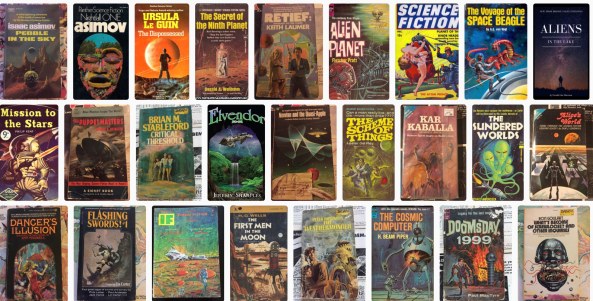
Book Covers SFOver my almost two decades of writing and (occasionally) publishing, I’ve learned some stuff. Lots of stuff, actually. Some of what I learned (such as a great place to buy a box for a manuscript) is out of date. However, there are some resources that budding writers should utilize that are still quite relevant, so here goes—

While a novel (or a short story or screen play) is still in the drafting stage, consider getting editorial help. Informally, there are many writer’s groups which offer support and critiques. If you live close enough, consider that as a first source of assistance and career development. I was once privileged to judge a short fiction contest held by the Northeast Georgia Writer’s Group, and all of the entries were quite worthy. The group is active, with contests and guest speakers. Many libraries sponsor such groups. There’s a great list of writer’s groups in Georgia at ReadersUnbound.com.

Depending on genre, there just may be a writer’s conference waiting for you. Such conferences usually feature guest speakers, workshops, and opportunities to meet with literary agents, who are the typical conduits between writers and publishers. I was fortunate to attend a few in nearby Athens (at the UGA campus) which was sponsored by the Mystery Writers of America, but there are a number of conferences, either general or targeting specific types of writing.

When the work is more or less complete, if there is no conventional publisher in the picture paying for it, an author seeking to self-publish or polish a manuscript for possible submission should really consider a paid editor. The Writer’s Digest magazine folks have an entire “store” devoted to such services. When I was working on my first novel, a publisher recommended that I go through a course with Writer’s Digest, and the experience taught me quite a lot about the value of editorial assistance.

Whether self-publishing a novel or developing a website and/or a social media publicity campaign, hiring a professional graphic artist is really important. For a web only publication, such as Kindle Direct, I might try the do it yourself method, but even then, it is good to use a site such as Canva.com. However, if there is any serious money going into the project, such as self-publishing in print or multiple platforms, then a cover artist is very helpful. Both The Gift Horse and the second edition of Trinity on Tylos have covers designed by an independent artist. There’s a list of cover artists over at The Creative Penn. By the way, I’d steer clear of Fiver. I tried that, and got nothing, not even a refund for my initial payment.

Once a book is in print or available as an eBook, most writers will want to help with marketing. This can be rather daunting for many writers. The publisher of The Gift Horse (Booklocker) has a companion site, Writer’s Weekly, which has some links to paying markets for shorter works, as well as articles about writing and marketing.

There are a lot of companies that offer “services” to authors. Be very careful to choose wisely, or money that should have been spent on editing and cover design will be frittered away on something else. While some of these resources have costs, others are cheap or even free. Regardless of how much money you spend, for a novelist the two most important resources are editing and cover design—in that order.

 

So you want to be a successful author—

book and moneyWhile I am pretty sure I don’t qualify as successful in the author department, I made enough mistakes to write (or rant) about the topic. Here are some tips, in no certain order, for those who are writing with the intent to publish a book, or for those who have published but are lacking in sales.
First, write the best book you possibly can. Yes, that should go without saying, but writing is like photography or cooking in that no matter how good you have done it, you can get better. There is no such thing as perfect in any of those endeavors. However, don’t publish unless it is really ready. Mistakes in print are embarrassing!

Next, find a real publisher if you can. Not necessarily one of the big companies (although if that happens for you, whoo hoo!) There are a lot of small and micro presses that can get a book into print and into at least some distribution channels, which leaves more time for the author to help with promotional activities and keep writing. A small company, Whiskey Creek Press, published my second novel, and while my sales were low, any money I spent on promotion was voluntary. My debut novel was initially accepted by a micro press, but when it failed, I ended up using a self-publisher called Booklocker.

Third, if you end up self-publishing, do so at minimal cost. Many authors have published via the Amazon Kindle Direct program, which is free. Yep, that’s right, free. I published the second edition of Trinity on Tylos via KDP, and my only expense was a fancy new cover by Dawn Seewer (which was entirely optional.) I disliked the first cover, which was done by an artist at Whiskey Creek Press, and I thought the book deserved a better effort, and Dawn did a great job for me. Another self publishing program that I am considering is Smashwords, which offers many free services. For most self published authors, the distribution channels associated with Smashwords are fantastic.

Fourth, once the book is ready to debut, get the marketing plan in motion. There are lots of books on this topic, as well as a gazillion websites. I’ve had some success with using Facebook groups, such as Ebook Rave, Kindle Book Authors, and Sci Fi and Fantasy Authors . Those have worked well in conjunction with sales and freebie promos, but bear in mind that I have low cost Kindle titles. Under “links of interest” on this site I have a few other spots that I’ve used for promotion, including “Book Goodies” and “Goodreads.” Having an author page on such sites is not necessary, of course, but doing so usually offers links for anyone who “googles” your author name.

Finally, the most important pillar in promotion is reviews, and lots of them.  If friends and family will write a review on a vendor site, such as Amazon or Barnes and Noble, that’s great, but most of us don’t have that many friends. Also, such reviews don’t carry as much cashé as a professional or semi-professional site. Do send your books to as many of those as you can find and afford. Don’t ever pay for a review, beyond giving a copy of the book. Paying for reviews is wrong on both sides of the equation. If the author pays for a review, then there’s a bias that makes the review worthless for the reader. Unless the book is an eBook only, then there is some expense in distribution of the ARC (that’s advanced reading copy) or published book, so it is best to send the book(s) to appropriate sites, because some sites only review certain genres. There are any number of review sites, and these do come and go fairly frequently. My first novel, The Gift Horse, had several reviews online within a year or two of publication, but apart from those on Amazon and one archived on The Midwest Book Review, they are gone! Therefore, if you get an online review, don’t just save the link, but archive the content, too!

When I first published The Gift Horse, I was invited to do some speeches to local clubs, and I sold a few books via that avenue, but as publishing and self-publishing became more common place, those opportunities dried up faster than blackberries in late August. I also got a book signing at a book store after Trinity on Tylos came out, but it was a very lonely afternoon. If those opportunities come your way, enjoy them, but books and eBooks must be purchased via online vendors in order to make any real money, and that means social media marketing. If you are here, clearly you know what a blog is, of course, and having an author website is usually a good idea. Marketing is an ever changing field, but as of this post, you must get to know Twitter, Instagram, Facebook, and other modern means of communication in order to build an audience for your books.

Oh, and as footnote to “finally” when readers like a book, they usually look for another book by the same author, so you’d best be writing another book, too.


A few books on marketing:

How to Market a Book

Guerrilla Marketing for Writers

The Frugal Book Promoter

Book Marketing 411 for Authors

And a couple on having a book worth the effort:

Don’t Sabotage Your Submission

Writing the Breakout Novel

Jersey Boys on Netflix

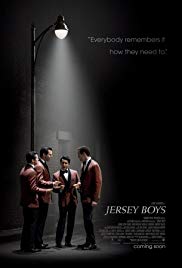
Jersey BoysLike many of you, we use services such as Netflix rather than having a traditional cable subscription. At times, we miss the old TV Guide magazine, which would guide the viewing experience. Instead, with Netflix, there is some algorithm that knows my husband likes shoot ’em up flix, so I am not always happy with the suggestions. However, a couple of days ago, I noticed “Jersey Boys”as an option in our feed. I’m embarrassed to say that hubby actually, “What’s that?” I simply said, “Click on it and you’ll see.”
Anyway, fortunately for me, hubby likes music, especially vintage pop, so he was eager to take a look at the movie version of this musical, which had a great run on Broadway, and is still touring around the country. Jersey Boys tells the story the Four Seasons, featuring the fabulous Frankie Valli. Surprisingly, the film version is directed by Clint Eastwood. The cast is really great, with Christopher Walken in a small but pivotal role, and it also has the original Valli from Broadway, John Lloyd Young as well as Erich Bergen, who has a supporting role in another show we’ve watched on Netflix, Madame Secretary.

There is much to like about this film, which is actually a 2014 release, but I was most impressed with the sound track. And, as is possible when watching a film in the comfort of home, I paused it and did some research, finding that the cast sang, rather than having it dubbed by either the original band or by hired musicians. Many of the hits from the Four Seasons are present, including “Sherry”, “December 63 (Oh What a Night)”, “Walk Like a Man”, and “Big Girls Don’t Cry.” Valli’s solo, “My Eyes Adored You” is also in the film, as are other familiar tunes.

Although not entirely happy, for this film follows the rise and the ultimate fall of The Four Seasons, we enjoyed this film quite a lot. If you are a Netflix subscriber, the movie version of Jersey Boys is a great way to spend an evening. Toe tapping is optional, but recommended!

The book of the year?

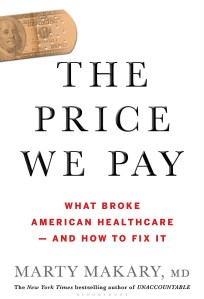
The price we pay book cover
Lots of books are published each year, and I can only read a few of them. But, when a really important general interest book comes along, I often put it on the top of my “to be read” pile. In September, Dr. Marty Makary, a surgeon associated with Johns Hopkins, released a book entitled The Price We Pay: What Book American Healthcare—And How to Fix ItSince most people in America eventually get sick or have an accident, and only a few of us are fifty rich, this is the ultimate general interest book.

In Part I, entitled “Gold Rush” Makary doesn’t have to travel far—he visits “health fairs” at local churches, where salespeople disguised as medical professionals do screening tests and scare participants, mostly those on Medicare, into unnecessary and rather expensive procedures, such as placing stents into leg veins. In the second chapter, he discusses the lack of transparency in hospital pricing, as well as the astronomical rise in common procedures. For instance, a medical center in New Jersey offers joint replacement surgery for $135,400.00, which rose a mere 76.8% in a single year. BTW, Medicare only pays 13K for that procedure. For his third chapter, Makary travels to Carlsbad, NM, where the medical center seems to have overcharged and then sued almost everyone in town. Back in Virginia, Makary visits the courthouse to learn more about similar shenanigans at Mary Washington Hospital in Fredericksburg. Sadly, this hospital is supposed to be a “not for profit” hospital, and thus receives favored tax status, too. Also in this section, Makary provides an analysis of the proliferation of for profit helicopter ambulance services, which charge somewhere between $40K and $60K for a ride that I could make in an hour in my Toyota.

In the second portion of the book, Makary delves into some medical practices that can be improved by focusing on individual physicians. One OB doctor in Florida had a reasonable rate of C-sections, until figuring in Fridays, when the rate rose 80%. Why? The good doctor didn’t want to be bothered on the weekend, so moms who were in labor on Friday got the surgery. This section of the book also discusses the opioid crisis, and Makary admits that he had to learn to write fewer prescriptions for pain pills, after learning about the misuse of all those pills.

Part III of the book is about “Redesigning Healthcare” and it does offer several solutions to problems, but one chapter in this section explains how drug prices are affected by middle men (pharmacy benefits managers) who don’t supply anything other than a big bill for their services. Here’s an example: A pharmacy is paid $34.94 for 90 40mg doses of Zocor, but the employer is charged $442.85–and the PBM gets over $400 on that one transaction. Another chapter discusses problems in health insurance, which less and less helpful except in catastrophic circumstances, and there is even a chapter on “wellness” and how those well meaning programs are far too costly, especially as they often mean an invasion of privacy, or worse, over-treatment for minor issues.

Makary doesn’t make the mistake of only discussing problems without discussing solutions. Several positive programs are mentioned throughout the text, including websites such as ImprovingWisely.com, and the last chapter is a bit of a call to arms. In short, legislators and employers need to be educated on these matters, and healthcare consumers should do everything possible to demand transparent pricing for upcoming procedures.

The Price We Pay is a very important book. This should be the topic of your next book club, a gift for your friends and/or family, or even a holiday gift for your doctor or your legislator. Please buy this book, read it, and pass it on. Knowledge is power, and as this text has lots of information for Americans, this may well be the most important book you will read this year.

Book selling for negative profit?

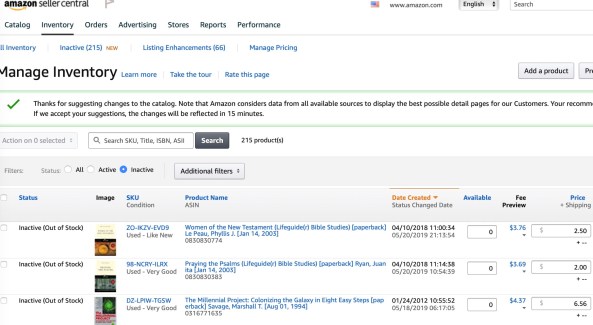
I’ve sold books online via Amazon (and I’ve listed on eBay also) for several years. Unless I got very, very lucky, I seldom made much money on those books. However, recently, I’ve seen negative profits. That’s right— the fees and postage are so high that Amazon is getting all the profit.

See this screen shot:

Amazon fees

Basically, the math isn’t in the seller’s favor here. For a $2.00 book sale, Amazon charged me $3.69 in fees, and for a $2.50 book sale, Amazon charged me $3.76. Even with the actual shipping cost being slightly less than the customer paid, I lost money, as I had to provide shipping materials and get the item to a post office. The only reason I got paid at all was the $6.56 book had a fee of $4.37. Sadly, since my state (Georgia) insists that Amazon collect sales tax on these used book sales, the buyer is not getting good value either. That book cost the buyer nearly $7, which is not a good deal for a used pamphlet.

Clearly, Amazon is not the best solution for book selling any more, so I removed all listings wherein the “fee” was as much or more than the book. Those will either be listed on eBay, or donated.

While I really love putting books into the hands of readers who will enjoy them, there is no sense in losing money to this relentless corporation.

Where do you buy your car “farkles”?

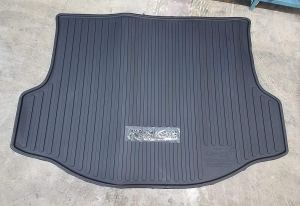
cargo trayMy oh my, WordPress didn’t like the spelling of “farkles.” That’s more of a motorcycle term, I suppose, but it basically means shiny stuff that might actually do something to help the vehicle. My rather limited research indicates that this is a portmanteau word, based on sparkle and function. When hubby gets a new ride, he often wants to invest in some farkles.

Having bought (perhaps I should say perpetrated, based on its performance thus far) a new-to-us ride, I shopped online for some accessories. I began on eBay, but ended up purchasing via a site that insists I remove all links to its site. Anyway,  I wanted genuine Toyota items, and our local dealership isn’t known for giving big discounts on much of anything. Via a relentless online vendor, I got some All Weather Floor Liners (deeper and more sturdy than floor mats) and a Genuine Toyota Cargo Tray, which is also deeper than a mat, if not quite as heavy. While not exactly “shiny” these items are handsome and quite functional.

The car looks a bit better with these accessories. Now, if I could just buy a cushier ride….