When Good Ideas Go Bad

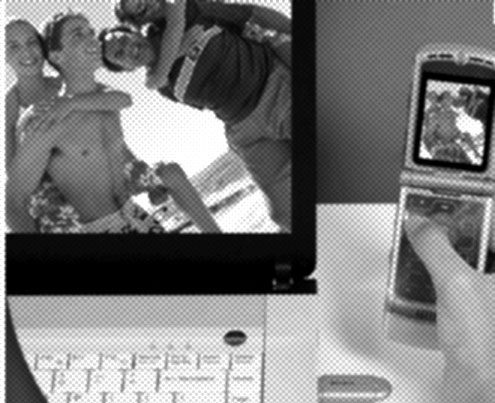
News sources report “invasion of privacy” situations quite frequently these days. Ironically, their reporting exacerbates the situation. A firefighter in my home state is under the gun for distributing a video, made by his personal cell phone, of an accident victim who was deceased. She won’t see the footage, of course, but her family did, because the person who shot it used electronic means to distribute it. Most of us would see that as a clear cut case of invading the privacy of the victim’s family. Yet, I would never have known about the gruesome video if the local news media had not put excerpts online. Should the family have made their plea for privacy so publicly? No doubt some journalism class is debating it right now.

As a writer, I have attended seminar sessions on how to write realistic crime scenes. A few years ago, I was sitting in a hotel meeting room while a forensic detective showed a video of a murder scene, with the sound muted, because he said that he did not want us to hear what the officers were saying about the situation. Instead, he talked about the process of collecting evidence and the nature of the crime. However, shooting a video at a crime scene is standard operating procedure, but what happens to the file later is not so clear.

Traffic stops are routinely video-taped, and there is a presentation about distracted drivers, featuring videos of local traffic stops, going around to schools in this area. The mission is well-meaning, of course. Having a camera on the dashboard should protect both the officer and the citizen, but again, sometimes good ideas aren’t good ideas, if one values privacy.

Beyond the realm of public safety, modern technology rivals Superman’s “x-ray vision.” Going into a dressing room at a department store may mean being featured on a security video. Stores have reasons to believe that some “customers” are actually thieves, hence the cameras. Flying on a commercial airliner means a trip through airport security, and the scanners they have can render a pretty good nude. Yet, as terrorism is still a concern, most people submit to the scans. With the ease of electronic transfer, such images may be circulated and recirculated. Once posted online, a photo can be “stolen” and the person depicted has lost any control of what happens to the image.

According to news sources, a school in Pennsylvania recently settled two lawsuits, for more than $600K, over using webcams on school issued laptop computers to spy on students. Some 56,000 images were recorded by the laptops, which were issued to over 2000 students. If you don’t remember the story, this situation came to light after an administrator accused a student of taking drugs. It turned out the the student was eating candy (something like Good ‘N Plenty) at home, and the computer was recording images of the student, snacking on something that looked like pills.

Some years ago, an acquaintance was told by her employer that she could not use her work computer after hours to type up a “prayer bulletin” because listing names of people with their medical conditions was a breach of ethics. Prayer is an essential part of spiritual life, and at the time, I thought that was a strong reaction on the part of the employer. Since then I have come to agree with that manager, because the file could read by anyone with access to that computer. If the file is transmitted via email, then it could go anywhere. More than ever before, it is better to avoid naming names and displaying images, because privacy is like reputation. Once damaged, it is hard to restore.
By Pamela/Pilar • Posted in writing

Scardown, a review

Elizabeth Bear is a powerful writer, and her Jenny Casey trilogy is entertaining, if a bit complicated for pleasure reading. The first novel, Hammered, got my attention. I do wish I had read this mid-trilogy yarn earlier, because I had to review some of Hammered to get reoriented for Scardown. The politics and “who’s who” backstory is not rehashed, for the most part, in this second novel, which is actually a good thing, since too much backstory slows down even a rapid paced techno-thriller such as this.

At times the narrative shifts from character to character, but when Jenny Casey is center-stage, this novel shines. I especially liked the scene where Jenny is faced with a would be assassin, and she manages to pluck a killer bullet out of the air. Unfortunately she can’t really enjoy the feat, since she is wounded will soon be on the way to a hospital. Okay, Jenny isn’t a superhero, but she has the right stuff to be heroic.

This futuristic vision is gritty and troubled, but throughout most of human history, the planet has had problem upon problem. Certainly, much of what is happening now, with politics and science, inspires readers to believe that Utopia won’t happen, but the Canada vs. China for world and solar system domination which sets the stage for this trilogy just might.

Scardown is a worthy read for fans of hard science fiction, but the characters have enough dimension to reward those of us who like the human elements as well.

Elizabeth Bear has a website and a blog, and from a cursory reading of those, I learned that we have very little in common, other than a love of cats and speculative fiction.

Gone

Recently, during a session of blog and website housecleaning, where I was looking for dead links, a trend emerged. Some of my fellow authors, especially the younger ones, have deleted their blogs. Christina Barber’s “The Writer’s Crypt” seems to be history. Susan Grant ended her “Come Fly with Me” blog in favor of a news section on her website. A particularly good one, “Faster Than Kudzu“has also moved. Other blogs are on hiatus. No doubt more blogs will go away, because the online audience is moving toward different web addresses. For a time, My Space was popular, but no more. Right now, Facebook is the most important medium for many who want an online presence, but I suspect that it, too, will be supplanted by another form of communication.

Groups, such as the ones on Yahoo and Google, were big news a decade ago. While I am still connected to some of these “list/serve” sites, I’ve left a number of the groups I where I was once a member, and for most of the others, the “daily digest” is no longer in my inbox. Online forums are also fading away, albeit more slowly. I was once fairly active on the SFReader boards, but if I spend a lot of time doing online promotion and/or writing, I don’t do any real writing, and that is a problem. Other authors have mentioned that online promotion, although cheap, is expensive in terms of time.

My goal, at the beginning of”Pam’s Pages,” was to promote my writing, to connect with people as a “real person” with ideas and opinions beyond what I express in my fiction writing, and to have a place to float concepts before I put a great deal of time into writing more formally about them. In 2005, when I began this blog, publicity experts were touting frequent updates, perhaps daily, to keep a blog at the top of search results on Google. While I didn’t think daily would ever be realistic, I thought could manage once a week, and I have averaged that. But once a week, or even once a day, can’t compete with Twitter.

Lately, due to time constraints and social constraints, “Pam’s Pages” has leaned more toward book reviews, which is fairly easy for me, since would be unusual for my reading to amount to less than a book a week.

How ironic; thus, this blog an out-of-date means of communicating about an out-of-date hobby, reading.

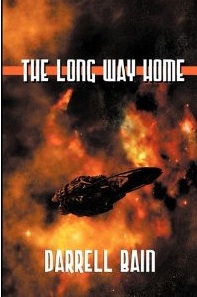
The Long Way Home

One of my favorite eBook authors is Darrell Bain. I think of him as the master of plots. Oh, there are some problems with his writing, primarily in the “show don’t tell” category, but this guy writes the most amazing yarns.

In the dedication of The Long Way Home, Bain recognizes three important Baen Books authors— David Weber, John Ringo, and Travis Taylor. And fans of their brand of science fiction will no doubt see that these authors influenced Bain in this space-based tale. Weber writes military science fiction on a grand scale; Ringo puts the grunt into military fiction, and Taylor is a rocket scientist who can also spin a good space opera. Bain doesn’t do any of those quite as well as these guys, but he does blend the elements quite well.

The plot is not unusual, with opening scenes of an exploratory vessel far from home, and a first contact mission gone awry. But instead of one or two explorers meeting a premature end, as happens in James Alan Gardner’s Expendable series, there is a massive loss of life and starship, and a small “longboat” known as “The Hurricane Jack” is left to ferry the survivors home. And it isn’t a short journey, hence the title. There are many obstacles, and the conflict is almost non-stop, between the “monkeyclaw” ship following the survivors, and the internal debates over matters in the tightly packed small ship. The mission is now to save the survivors and warn the human population about the vicious species they wished they had left behind. As a small vessel, the longboat must stop to scavenge material, and every stop has some built-in danger. Unlike some writers, Bain is not afraid to kill off his characters, which ramps up the peril factor.

Fans of space exploration stories should enjoy the action-packed suspenseful voyage of “The Hurricane Jack” in Darrell Bain’s The Long Way Home.

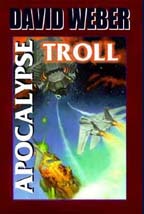
The Apocalypse Troll and other stories

I really like David Weber’s military science fiction. A few thousand fans of this sub-genre seem to like it as well; his books, even the ones which are ridiculously swollen with unnecessary and/or undesirable content, sell well. He has also partnered with other authors, including Eric Flint and Steve White, which helps lengthen his list of published novels.

My introduction to his work was a rough go, however. The science fiction book club was touting his In Enemy Hands, which is fairly far into the Honor Harrington series, but I began with that one, not realizing that I had to catch up. There were several times I nearly abandoned it; but about three quarters of the way in, I realized this was indeed a fascinating tale; albeit one which could have been told without quite so much detail. Intrigued, I read a couple of his stand-alone novels, The Path of the Fury and The Apocalypse Troll. While featuring hardware and propulsion concepts, more than characterization, these yarns did not require any backstory, and that helped. After I finished those, I read the Honor Harrington series, from the beginning. The first book is not particularly interesting, being mostly a set up for the series, but the series hits a good stride with books two through six. The seventh book, Echos of Honor also has its moments, but the page counts grow and the synopsis gets shorter with each successive installment. I read most of the series, but I think I have been reading on At All Costs, which may or may not be book twelve, for a couple of years and I have yet to finish it. Instead, I go back and re-read earlier titles.

Some of Baen’s earlier Weber titles, including The Apocalypse Troll, are available as eBooks, and I have been re-reading it. Yes, it is perhaps less polished than some of his more recent offerings, but it is also far less bulky than his newer work. No, he still doesn’t really write many multi-dimensional characters. Still, I enjoyed it. No one else seems to have the ability to write large scale battle scenes, but Weber does. He also has a firm grasp of the problems and possibilities of technologically driven warfare. Too many writers of space opera write about conflict one-on-one, because that is easier. In Star Wars, there may have been a lot of blasts, but the camera follows Luke and Han, and everything else is a backdrop. That is both cheaper and easier. However, any civilization which moves to the stars will have multiple ships, weapons, and drive mechanisms. Weber writes about those situations, and when Weber is finished with a battle, the casualties are in the thousands. That is what real war is, and it will be in the future.

So, the bottom line is that fans of futuristic writing may or may not like Weber, but most fans of military science fiction do, because he delivers large scale entertainment. Readers should sample the early stories, like The Apocalypse Troll or Path of the Fury, or at the beginning of one of his many series, rather than diving in the middle, however.

Troll is the story of a twenty-fifth century monster unleashed on our current earth, with only one surviving warrior from the future to tackle it. When researching the published reviews, I read that this novel was the first David Weber wrote, but it was published long after he had become established as a writer. So, while still Weber, the complexity is not so vast, and there are not so many references to politics, which is a major flaw in some his Honorverse works. But not everyone agrees that The Apocalypse Troll is a winner, so here is a link to a differing opinion of this novel over at RPG.net.

Online, Typos Never Die

I’ve been an English teacher for more than thirty years. That’s scary. And, during most of those years, I have tried to help students make their writing better. Or, as my current supervisor says of her own career, “For years I thought I was combating ignorance; then I realized I was just documenting it.” Yes, we English teachers spend a great deal of time looking for mistakes.

Whenever I do web design, one of the wonderful things about it is that electrons are ephemeral. I can correct mistakes and the problems go to some cyber-heaven. However, once words are online, other entities copy those words, usually without credit or permission, and typos just keep on turning up.

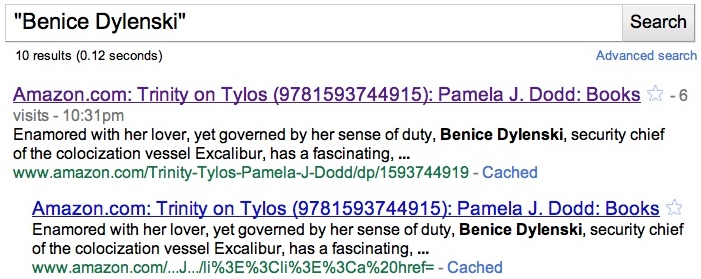
Periodically, I use a search engine to keep me abreast of online use of my novel titles. Seldom does any reference to “The Gift Horse” have anything to do with me, since the phrase is widely used. “Trinity on Tylos” seems to be unique, however, so any use of those three words in that order should refer back to my science fiction novel. Recently, a Google search for “Trinity on Tylos” led me to a site called Vampire Raves. Someone posted my novel’s back cover blurb on the site, but the source was apparently Amazon, rather than the book itself. How do I know that? Here’s the story—

When the publisher’s printing partner, Paw Prints POD, first posted it on Amazon, the title was Trinity on Trylos. It took me quite a while to correct that. But the description, which is that back cover blurb, misspells the main character’s name. One of my teacher friends from long ago often mentioned a colleague, Venice. I wanted an exotic, yet human name for my futuristic character, so I swiped it. Quite frankly, I stole the last name from the social pages of the Athens, Georgia newspaper, so the main character is Venice Dylenski. However, Amazon’s page, which was created in part by someone from PawPrints, called the character Benice Dylenski.

Indeed, a search for that name yielded ten results, and none of them are Vampire Raves, so there are undoubtedly other sites which have this same error. Just how many sites have posted this incorrect copy from Amazon? I have no idea, but it does illustrate that one mistake can go a very long way online.

There is something even more scary about that.