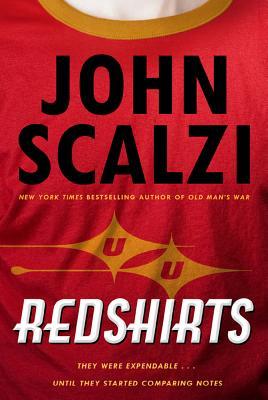
Redshirts by John Scalzi—a brief review and commentary

Fans of Star Trek, the original series, will immediately understand the premise of this very humorous novel. For the few folks who aren’t familiar with the show, there were a handful of officers who were the “stars” of Star Trek. In the show, the starship ventured from planet to planet. Often, one or more officers left the ship on “away” missions, and they were almost always dangerous. Those bridge officers were usually accompanied by security officers, and in the color scheme of the original series, security staff wore red shirts. As the show couldn’t lose any main cast members, the extras, playing security staff, would invariably be the ones to be maimed or killed.

In Redshirts, the author follows a young officer assigned to the Intrepid, the flagship of the Universal Union. Ensign Dahl is thrilled to be onboard, but soon becomes apprehensive, because he quickly realizes that when lowly crew members accompany the captain, its chief science officer, or its chief engineer, those lowly crew members would bear the brunt of any dangerous action. In other words, Ensign Dahl is a “red shirt” without actually wearing a red uniform. So, as a very intelligent young officer, Dahl must navigate the command structure of the Intrepid and learn how to stay alive. Quickly, he figures out that it is best to be anywhere other than on an “Away Mission.”

At times, Redshirts is laugh out loud funny. For instance, any attack on the ship will take out the lower decks, but the bridge always remains unscathed. And one young lieutenant has so many close calls, but he never dies, as he is a “main character.” Soon it becomes apparent that only a few characters will always survive. More experienced crew members seem to have figured out how to dodge being tapped for away missions, thus newbies like Ensign Dahl are more likely to end up dead. Rather than explain what they do and what the manage to figure out, I will simply say that the novel goes where the reader might not expect. And, while the novel really is funny, it is also a bit challenging.

Not since Galaxy Quest have I seen such a good parody of television space opera. Fans of the genre will certainly find something to like in Redshirts. And, for those few folks who have never seen Star Trek in any of its various iterations, this novel is still funny, but probably won’t resonate quite so well. However, the novel is rather, well, novel in that it doesn’t end at the end. Instead there are three sections after the end, called Codas. Some reviewers liked them, some did not. Hopefully, some of my readers will take up the challenge and try this book.

Science fiction fans tend to be smart, and it takes some smarts to appreciate this novel. That said, it is quite creative.

Shaken (Quake Runner Book 1) by Kevin Tumlinson— brief review and commentary

This is a pretty good novel. The main character, Alex Kayne, is sassy, super smart, and just vulnerable enough to avoid the “heroine can’t die” syndrome that afflicts almost all comic book super hero characters, or Lara Croft (heroine of the Tomb Raider games/films). Alex is a fugitive computer whiz who needs something to do as she hides from all the forces who want to either kill her or “bring her to justice”, so she kinda does her version of “The Equalizer” in that she helps people who have a specific need. The needy person in Shaken is a surfer/marine biologist named Abbey, who lost an arm to an encounter with a shark. Abbey received a prototype bionic arm, in part due to her high profile injury, and someone stole it. The arm and it’s charger, gone. Who the heck steals a limb from an amputee? (Literate folks might respond with another story, “Good Country People” by Flannery O’Conner, but I digress.)

So, we have Alex Kayne, who manages to change her appearance, her lodging, her cell phone, and her method of transportation more frequently than anyone in any spy novel I’ve ever read. In this book, she is mostly hiding out in Disney World. Other characters include Eric Symon, the FBI agent who nearly nabs fugitive Alex, Abbey who needs her arm back, and a cast of suspects or villains, depending on how the mystery unfolds. The action in this novel is well told, and not quite believable, but that’s part of the fun of it all.

Readers who enjoy puzzles and/or action heroines and want to be entertained for an evening (or two) should try Shaken (Quake Runner Book 1.)

Now, for the commentary. This was my first book by Kevin Tumlinson, but I certainly intend to try another. At the end of this book there’s a note wherein the author explains that he didn’t plan to self-publish this novel, intending to put it in the hands of an agent. However, he thought better of it and put it into his self-publishing stable of products. For many authors (yours truly included) self-publishing is better, due to control of the process and potential financial gain. That decision is understandable, but when the author said he wrote the book in roughly 15 days, I was shocked. Shocked.

Y’all, fifteen days is like two weeks. I can’t edit a book in two weeks, much less go from beginning to end. Wow. I had a whole new perspective on the novel after that. I thought it was a good, if not spectacular read, with very few errors. However, the very idea that such a book could be dreamed up and written in such a short time is simply hard to believe. However, as the author of Ecclesiastes says, “There is no new thing under the sun.” Shaken is a bit like that, in that the elements in the story have been used before, but perhaps not in precisely this manner. The author’s website is a feast for those who want to know more about marketing and branding, especially marketing self-published novels. Clearly, Tumlinson is not just prolific, but also understands how to get the product to customers, too.

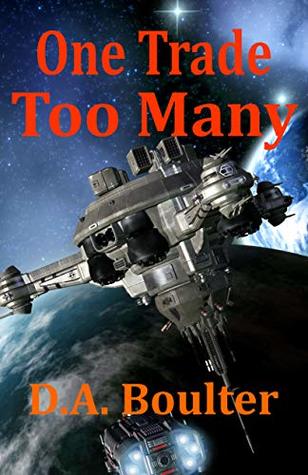
More from D.A. Boulter— One Trade Too Many and Trading for War

Some years ago, I discovered D.A. Boulter’s ebook series about a family of traders who traveled via space going vessels to various ports of call. Recently, I bought a couple more entries in the series, books 3 and 4, with the respective titles above.

As I previously touched upon earlier books in the series, here are links to Courtesan, Trading for the Stars, and Trading for a Dream. I’ve also read some of his stand alone books and other series, but the Yrden Chronicles remain my favorites in his growing booklist.

In One Trade Too Many, the Clay and Colleen Yrden are doing what their family does, traveling, trading, and raising their kids onboard one of the combo passenger and cargo ships, Blue Powder. During this entry, the Captain of Blue Powder (Clay Yrden) asks the head of security, Adrian Telford, to play passenger in an attempt to ferret out a possible saboteur, and one of the passengers, a widow, begins stalking Mr. Telford. While not boring, the story takes a while to build, but there is significant suspense toward the end of this third volume of the Trading series, and it has a cliff hanger ending. Some folks hate such endings, but as I purchased books 3 and 4 at the same time, I just swiped on over and read Trading for War. The latter is largely about warfare, and focuses on Colleen Yrden, who has a host of problems: her husband is missing, her son is growing into manhood with revenge on his mind, her family’s business is being disrupted by pirates and mercenaries, and her two mothers hate each other’s guts.

Nowadays, authors tend to follow other forms of media and rely upon bad language, sensuality, and inorganic plot twists to entertain readers. D.A. Boulter’s stories do not have any of those characteristics. Indeed, while not written for kids, or even young adults, these stories are entertaining but almost squeaky clean. Honestly, it is quite refreshing to read Boulter’s stories, which rely more upon world building, character evolution, and wholesome themes than anything shocking.

Fans of science fiction and multi volume stories should take a look at the works of D. A. Boulter. He’s one of the first eBook authors I ever read, and he remains a favorite a decade after I discovered his work.

Re-Reading, The Quantum Rose by Catherine Asaro

My recent visit to a used bookstore netted me a couple of relics from my past reading, including a paperback of Catherine Asaro’s The Quantum Rose. For those who have not read any of Asaro’s Skolian saga, this book might make a good starting point, but it is probably a better read for those who are already familiar with this rather involved science fiction/fantasy/romance series.

The Quantum Rose won the 2001 Nebula Award

Asaro’s bio is almost as mind-boggling as her stories: She holds a doctorate in chemical physics, and she is a former ballerina, jazz dancer, and sometime singer. Her books include near future science fiction, such as The Veiled Web and the Phoenix Code, the 14 (or so) volume Skolian saga, which begins with Primary Inversion, The Lost Continent series, The Uplift Saga series, and more.

For me, this book is really hard to quantify. One tag line is that it is a re-telling of Beauty and the Beast. Uh, not really. Another is that it is a physics allegory, and the author ‘s note at the end makes every effort to explain the book via that lens, and while interesting, I kinda got lost in her description of particle physics after a while. Certainly this book is a romantic science fiction story, and there’s really not much high brow competition in that sub-genre. While readable, Asaro is never simplistic.

This story does fill in some gaps in the Skolian saga, which generally tells the story of members of the Ruby Dynasty in a book (or two.) Interestingly, the point of view character in The Quantum Rose is Kamoj Argali, a young ruler of an impoverished province on a backward planet, and not a member of the Ruby Dynasty. Kamoj does end up entangled in their saga, because she becomes involved with Vyrl, one of the Ruby Dynasty, who is sojourning on her planet for a while, and they end up falling in love.

The first part of the book is all about Kamoj, Vyrl, and the complications of her previous engagement to a local leader of questionable morals, Jax Ironbridge. This first half is more romance than sci-fi, although sci-fi elements are present. The second half is mostly set off of that world, filling in certain backstory aspects of the Skolian saga, with more science fiction and a heavy dose of fantasy. At this point, the romance takes a back seat to the political machinations that are part and parcel of the Skolian yarn.

While I enjoyed The Quantum Rose once again, I have trouble understanding why it won the Nebula award, which goes to the best science fiction novel of the year (via a vote of the SFWA). Yes, it is skillfully written and the quantum part of the title is justified, at least in the author’s notes after the novel, as “playing with quantum scattering theory.” Still, I have to wonder if it was really the very best science fiction novel of 2000. I like most of the Asaro novels I have read, and I think some of the others are better than The Quantum Rose. Hum, maybe it was the lack of competition.

Re-reading, Goddess by Mistake

Recently, I got my hands on a used copy of a book I loaned and lost, Goddess by Mistake by P.C. Cast. Often, books are so similar that I don’t remember them well enough to write a decent review a week or two after I have finished them. Goddess by Mistake was memorable for me, so much so that I remembered it almost two decades after my first reading of it, so when I scored a used one on eBay, I put it at the top of to be read pile. The story still seems fresh, but the sassy narrator is the main reason I liked it then, and why I still like it. For those who want to know more, here’s a link to my “old” blog.

http://pamspages.blogspot.com/2007/08/

Searching for Shelter: Aftermath Book 1—a brief review

In short, this is a disaster upon disaster yarn.

Searching for Shelter is actually a pretty good book. I was a bit surprised that it holds together as well as it does, with three authors listed. While I haven’t done a collaboration novel, most of them involve a “big name” author lending a helping hand to a newbie, or one author does an outline while another does the grunt work. I have no idea how these three folks did it, but Searching for Shelter gets better as it goes along, and it goes along at a good pace.

As a southerner, and one who has travelled in Mississippi, I appreciated the setting and the types of characters that populate the novel. Or maybe I liked it because I grew up in the era when “disaster movies” such as The Poseidon Adventure and The Andromeda Strain were blockbusters at the theatre. Anyway, this novel is in the genre of “you need to be a prepper to survive into the next book” that seems to be growing in popularity. While not as pedantic as the last “prepper” novel I read, this one does have some instruction interwoven into the plot.

A rather large cast of characters, in the Mississippi delta region, are introduced in the early chapters. They include a young couple (Edward and Maria) and their midwife (April), as their first child is about to be born in the midst of the biggest hurricane anyone in that hurricane prone area has ever seen. Indeed, the storm is labeled a category six (and there are only cat 1-5 storms now, so that lets the reader know just how bad this rascal is going to be for the landscape and its citizens.) Another main character is Rita Sloan, a young lady with a very troubled past, desperate to get home, who ultimately seeks shelter in a mechanic’s garage, along with the owner of the shop and his nephew. Other important characters include prisoners at the state penitentiary, as those are invariably built in rural areas. The storm first knocks down almost every building, then the storm surge floods all but the highest ground. In short, this is a disaster upon disaster yarn. As this is a novel about being prepared, or not, most characters have a skill or a stash, or want to take something from someone else. For instance, Edward and Maria have lots of food stores, as they are farmers, while April desperately wants to get home to her stash, which includes a good supply of medical items, from medicine to bandages. Even Rita has her “go bag” in the car and manages to hang onto it through the entire book.

Like the Johnny Cash song, eventually all of these characters, and a slew of others, are goin’ to Jackson. However, each one’s journey is fraught with peril, from ne’er do wells looting and stealing to gators looking for their next meal. And, once the characters reach the city, the devastation is so great and the population so ill prepared, that the shelter they are seeking remains elusive. Thus, while some plot lines are resolved, many are left for the successive novels to explore.

I haven’t decided to purchase books 2 and 3, but they are definitely on my “maybe” list.

Nowadays, there’s just so much free and cheap reading available. And, I’m a total reading glutton. For real!