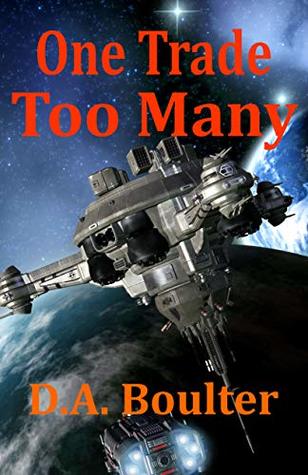
More from D.A. Boulter— One Trade Too Many and Trading for War

Some years ago, I discovered D.A. Boulter’s ebook series about a family of traders who traveled via space going vessels to various ports of call. Recently, I bought a couple more entries in the series, books 3 and 4, with the respective titles above.

As I previously touched upon earlier books in the series, here are links to Courtesan, Trading for the Stars, and Trading for a Dream. I’ve also read some of his stand alone books and other series, but the Yrden Chronicles remain my favorites in his growing booklist.

In One Trade Too Many, the Clay and Colleen Yrden are doing what their family does, traveling, trading, and raising their kids onboard one of the combo passenger and cargo ships, Blue Powder. During this entry, the Captain of Blue Powder (Clay Yrden) asks the head of security, Adrian Telford, to play passenger in an attempt to ferret out a possible saboteur, and one of the passengers, a widow, begins stalking Mr. Telford. While not boring, the story takes a while to build, but there is significant suspense toward the end of this third volume of the Trading series, and it has a cliff hanger ending. Some folks hate such endings, but as I purchased books 3 and 4 at the same time, I just swiped on over and read Trading for War. The latter is largely about warfare, and focuses on Colleen Yrden, who has a host of problems: her husband is missing, her son is growing into manhood with revenge on his mind, her family’s business is being disrupted by pirates and mercenaries, and her two mothers hate each other’s guts.

Nowadays, authors tend to follow other forms of media and rely upon bad language, sensuality, and inorganic plot twists to entertain readers. D.A. Boulter’s stories do not have any of those characteristics. Indeed, while not written for kids, or even young adults, these stories are entertaining but almost squeaky clean. Honestly, it is quite refreshing to read Boulter’s stories, which rely more upon world building, character evolution, and wholesome themes than anything shocking.

Fans of science fiction and multi volume stories should take a look at the works of D. A. Boulter. He’s one of the first eBook authors I ever read, and he remains a favorite a decade after I discovered his work.
Re-Reading, The Quantum Rose by Catherine Asaro

My recent visit to a used bookstore netted me a couple of relics from my past reading, including a paperback of Catherine Asaro’s The Quantum Rose. For those who have not read any of Asaro’s Skolian saga, this book might make a good starting point, but it is probably a better read for those who are already familiar with this rather involved science fiction/fantasy/romance series.

The Quantum Rose won the 2001 Nebula Award

Asaro’s bio is almost as mind-boggling as her stories: She holds a doctorate in chemical physics, and she is a former ballerina, jazz dancer, and sometime singer. Her books include near future science fiction, such as The Veiled Web and the Phoenix Code, the 14 (or so) volume Skolian saga, which begins with Primary Inversion, The Lost Continent series, The Uplift Saga series, and more.

For me, this book is really hard to quantify. One tag line is that it is a re-telling of Beauty and the Beast. Uh, not really. Another is that it is a physics allegory, and the author ‘s note at the end makes every effort to explain the book via that lens, and while interesting, I kinda got lost in her description of particle physics after a while. Certainly this book is a romantic science fiction story, and there’s really not much high brow competition in that sub-genre. While readable, Asaro is never simplistic.

This story does fill in some gaps in the Skolian saga, which generally tells the story of members of the Ruby Dynasty in a book (or two.) Interestingly, the point of view character in The Quantum Rose is Kamoj Argali, a young ruler of an impoverished province on a backward planet, and not a member of the Ruby Dynasty. Kamoj does end up entangled in their saga, because she becomes involved with Vyrl, one of the Ruby Dynasty, who is sojourning on her planet for a while, and they end up falling in love.

The first part of the book is all about Kamoj, Vyrl, and the complications of her previous engagement to a local leader of questionable morals, Jax Ironbridge. This first half is more romance than sci-fi, although sci-fi elements are present. The second half is mostly set off of that world, filling in certain backstory aspects of the Skolian saga, with more science fiction and a heavy dose of fantasy. At this point, the romance takes a back seat to the political machinations that are part and parcel of the Skolian yarn.

While I enjoyed The Quantum Rose once again, I have trouble understanding why it won the Nebula award, which goes to the best science fiction novel of the year (via a vote of the SFWA). Yes, it is skillfully written and the quantum part of the title is justified, at least in the author’s notes after the novel, as “playing with quantum scattering theory.” Still, I have to wonder if it was really the very best science fiction novel of 2000. I like most of the Asaro novels I have read, and I think some of the others are better than The Quantum Rose. Hum, maybe it was the lack of competition.

Re-reading, Goddess by Mistake

Recently, I got my hands on a used copy of a book I loaned and lost, Goddess by Mistake by P.C. Cast. Often, books are so similar that I don’t remember them well enough to write a decent review a week or two after I have finished them. Goddess by Mistake was memorable for me, so much so that I remembered it almost two decades after my first reading of it, so when I scored a used one on eBay, I put it at the top of to be read pile. The story still seems fresh, but the sassy narrator is the main reason I liked it then, and why I still like it. For those who want to know more, here’s a link to my “old” blog.

http://pamspages.blogspot.com/2007/08/

Searching for Shelter: Aftermath Book 1—a brief review

In short, this is a disaster upon disaster yarn.

Searching for Shelter is actually a pretty good book. I was a bit surprised that it holds together as well as it does, with three authors listed. While I haven’t done a collaboration novel, most of them involve a “big name” author lending a helping hand to a newbie, or one author does an outline while another does the grunt work. I have no idea how these three folks did it, but Searching for Shelter gets better as it goes along, and it goes along at a good pace.

As a southerner, and one who has travelled in Mississippi, I appreciated the setting and the types of characters that populate the novel. Or maybe I liked it because I grew up in the era when “disaster movies” such as The Poseidon Adventure and The Andromeda Strain were blockbusters at the theatre. Anyway, this novel is in the genre of “you need to be a prepper to survive into the next book” that seems to be growing in popularity. While not as pedantic as the last “prepper” novel I read, this one does have some instruction interwoven into the plot.

A rather large cast of characters, in the Mississippi delta region, are introduced in the early chapters. They include a young couple (Edward and Maria) and their midwife (April), as their first child is about to be born in the midst of the biggest hurricane anyone in that hurricane prone area has ever seen. Indeed, the storm is labeled a category six (and there are only cat 1-5 storms now, so that lets the reader know just how bad this rascal is going to be for the landscape and its citizens.) Another main character is Rita Sloan, a young lady with a very troubled past, desperate to get home, who ultimately seeks shelter in a mechanic’s garage, along with the owner of the shop and his nephew. Other important characters include prisoners at the state penitentiary, as those are invariably built in rural areas. The storm first knocks down almost every building, then the storm surge floods all but the highest ground. In short, this is a disaster upon disaster yarn. As this is a novel about being prepared, or not, most characters have a skill or a stash, or want to take something from someone else. For instance, Edward and Maria have lots of food stores, as they are farmers, while April desperately wants to get home to her stash, which includes a good supply of medical items, from medicine to bandages. Even Rita has her “go bag” in the car and manages to hang onto it through the entire book.

Like the Johnny Cash song, eventually all of these characters, and a slew of others, are goin’ to Jackson. However, each one’s journey is fraught with peril, from ne’er do wells looting and stealing to gators looking for their next meal. And, once the characters reach the city, the devastation is so great and the population so ill prepared, that the shelter they are seeking remains elusive. Thus, while some plot lines are resolved, many are left for the successive novels to explore.

I haven’t decided to purchase books 2 and 3, but they are definitely on my “maybe” list.

Nowadays, there’s just so much free and cheap reading available. And, I’m a total reading glutton. For real!

Time for Dystopian Science Fiction?

Reader’s Alley, a nifty site for bargain eBook lovers, divides their science fiction offerings into sub-genres: sci-fi romance, sci-fi thriller, and science fiction, dystopian. While those first two descriptors would seem self-evident, the dystopian flavor is considered by some (mostly jaded members of academia) as the only serious science fiction. Typically, I avoid reading dystopias because they tend to be so darned depressing. But, with all that is happening in the news, which I also try to avoid, perhaps it is time to take a look at the genre.

One of the finest books about the history of science fiction is Brian Aldiss’ Trillion Year Spree, which covers science fiction literature from its beginnings to the early 1980s. Aldiss does discuss many sub-genres, but the thread of dystopia runs strongly throughout his encyclopedia of science fiction in printed form. The term, dystopia, is applicable to “a world in which everything is imperfect, and everything goes terribly wrong. Dystopian literature shows us a nightmarish image about what might happen to the world in the near future. Usually the main themes of dystopian works are rebellion, oppression, revolutions, wars, overpopulation, and disasters. On the other hand, Utopia is a perfect world – exactly opposite of dystopia.”

Science has, until recently, been viewed as a two edged sword; while it can make life much better, mis-use of science has been the root of all sorts of evils. Frankenstein, by Mary Shelley, is often considered to be the first science fiction novel, and the dark side of science is clearly the central theme of the novel. Dr. Heidegger’s Experiment and Rappacini’s Daughter, short stories by Nathaniel Hawthorne, also feature mis-use of science as their main themes. When teaching those stories, which used to be in many American Lit anthologies, one way to make it simple for students is to say, “Hawthorne is basically telling his readers, ‘don’t mess around with Mother Nature’.”

Later novelists fine tuned dystopian themes, with societies becoming more and more restrictive upon the populace. Aldous Huxley’s Brave New World and George Orwell’s 1984 share these themes, “including the consequences of totalitarianism, mass surveillance, and repressive regimentation of persons and behaviours within society.” Kurt Vonnegut’s short story, Harrison Burgeron is one of the most widely read dystopian stories, due to its inclusion in anthologies for students, and I recently read a news story liking our current government policies to Vonnegut’s didactic work. Y’all, it is scary when dystopia becomes reality.

Of course, many fans of science fiction today seldom, if ever, read it. Instead, what they know of utopia and dystopia is presented via video. Early episodes of Star Trek explored both sides of the scientific divide. The Ultimate Computer, rather dated today, explored the man vs. machine conflict, using future war games as a setting for its rather disturbing premise. Various dystopian novels have been adapted to long form (movies) video, including everything from 1984 to Planet of the Apes. There are literally dozens of dystopian sci fi films. Some are rather laughable now (Mad Max?) but others are quite troubling.

My own fiction, which has many conflicts for characters to attempt to resolve, certainly isn’t “happily ever after, ” but it isn’t as dark as some of these works, and that’s because my outlook on life is more pragmatic. Hopefully, there will be some gravitation away from the totalitarian policies of modern politicians and administrators. But, when I consider what I am seeing when I do go out and about, I wonder. I really do. Remember this: In each fictional dystopia, the goal was to make things better for certain segments of the population, and bad outcomes are unhappy accidents. Be careful what you wish for—

Trish Milburn’s “Her Cowboy Prince” review

For readers who want an up to date romance about courtship, then this book merits your attention.

Modern romances are often more about sex than the “getting to know you” that dominated romances in previous decades. Nowadays, it is not uncommon for the first kiss to be followed by sexual fulfillment, and that often happens a third of the way through the narrative. Thus, many modern romances are about the sexual relationship, not about courtship. Her Cowboy Prince is old fashioned, but it is a recent publication, and I liked it very much for that reason. Another reviewer called it “clean” and that’s fair, I suppose. All too often, I’ve downloaded a romance with a recent publication date, only to find references to commonalities from decades ago, such as cassette tapes or pay phones. It may be fun to read an author’s backlist, but please don’t re-release books that are decades old and pretend they are new! In Her Cowboy Prince, the neighbor disturbs Melody by playing video games at all hours; the heroine up cycles items she purchases at thrift stores using techniques she garnered from watching HGTV; the resort uses its website to attract customers for their newest events, and so forth. Yep, this story’s not recycled material, which is refreshing.

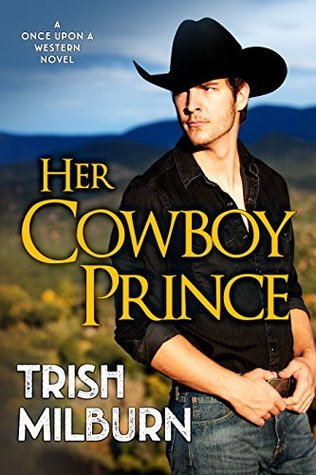
Her Cowboy Prince has a cute title and stock cover cute guy on the cover, but the plot is a bit more serious. Melody Shaw is a housekeeper at a spa/resort in Montana, but she is there because she has had to go into witness protection after she testified against her stepmother, who had her father killed and managed to deprive Melody of ownership of the pharmaceutical company that he founded. Oh, and for good measure, Melody’s step-sister tried to have her murdered, so Melody has reasons to keep a very low profile. The housekeeper job across the country from her former home in Atlanta should be safe, but Melody can’t quite keep from looking over her shoulder at everyone.

Justin McQueen, a newly eligible bachelor since he figured out that his latest fiancée was a gold digger out to get everything he owned, runs the resort where Melody works. Before long, the attractive and way too smart for her job housekeeper attracts his attention. The author could have them jump each other’s bones in one of the guest rooms, but she restrains her characters. They plan events for the resort. They run into each other at a local cafe. She rescues his dad from a highway accident. As he takes her home from work, he stops to show her the stars. In short, they develop a romantic relationship. However, Justin is aware that there’s something mysterious in her reluctance to enjoy his company, while Melody is continually afraid of breaking her cover and inviting her troubled past into her new digs in Montana.

Author Trish Milburn does a better than average job using her settings, scenic Montana and metro Atlanta, to help create an interesting story. While the plot is somewhat predictable, there are no jarring moments when the reader just can’t suspend disbelief. The characters are mostly engaging, from the ever suspicious heroine and the diligent hero, to the displaced southern thrift shop owner and the poor but proud video game playing neighbor whom Melody befriends. The villains are mostly off stage, but the threat is sufficient to provide suspense for the reader, along with Melody and Justin.

For readers who want to experience vicarious sex, this book would not be appropriate, but for readers who want an up to date romance, about courtship, then this book merits your attention.

BTW, I am reviewing the book because I liked it, not because I got a free copy for review purposes.