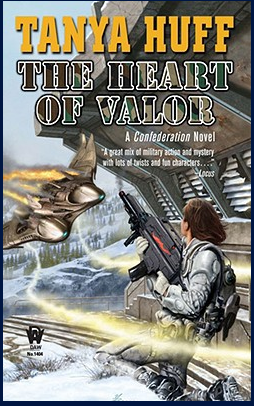
Book Review— The Heart of Valor

Tanya Huff’s “Confederation” series has a fabulous heroine, Torin Kerr. As the series begins, in Valor’s Choice, Kerr is a Staff Sergeant in some futuristic Marine Corps. In this opening yarn, Huff demonstrates good character development, better world building, and a wonderful flair for dialogue. While I really like other heroines of military sci-fi yarns such as David Weber’s Honor Harrington and Elizabeth Moon’s Esmay Suiza, those characters are officers. Huff’s non-com is gritty and more realistic than either of those officer-characters.
Recently, I purchased The Heart of Valor, the third installment in the series. Kerr has been promoted to Gunnery Sergeant after her exploits in books one and two of the series. Her new found fame is unwelcome, so she jumps at the chance to accompany a platoon and some observers to Crucible, a frozen planet where recruits complete their training. Kerr is there mostly to watch, but once the training platoon arrives on Crucible, there is a series of unfortunate events. A longtime drill sergeant becomes ill, the training drones are out to kill rather than test the recruits, and something odd is happening with the the single officer in their midst. Of course, Kerr works overtime to save her comrades, by using all of the knowledge she has accumulated in her career.

While not boring, this third installment seems rather predictable, until Kerr figures out why things have come unglued, and the plot becomes much more interesting. Unfortunately, that happens about two thirds of the way through the book. The suspense ramps up along with the action, and a three star book becomes a five star read.

I enjoyed The Heart of Valor, but I can’t say it lives up to the first two novels. Readers who like feisty heroines, humor, and lots of action should enjoy it, and the series continues with two more installments. I’m reading the next one now.

By Pamela/Pilar Posted in writing

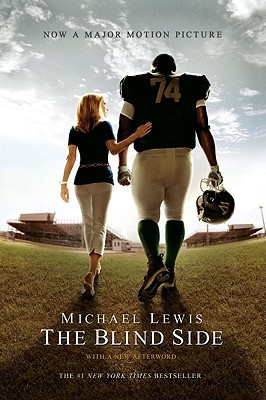
Book Review: The Blind Side

Last Christmas, the movie version of The Blind Side opened in theatres. Although I seldom watch television, hubby and I were in Charleston for our anniversary (what a great place for a romantic trip!) and he had turned on the telly one evening while we were getting ready for dinner. A reviewer proclaimed that Sandra Bullock should get an Oscar for her role in this movie, and the movie poster shot zoomed to the screen. At the time, we were more interested in she-crab soup and touring the battery, but after Bullock won an Academy Award and the DVD became available on Netflix, we watched the film. Great movie, but I wanted to know what they left out.

As anyone who both reads books and views movies knows, rarely is a movie made without leaving plenty of material on the page. Just as the news is less satisfying on television than in a newspaper, a movie, while entertaining, is less satisfying than a book. Quite simply, pages contain more information, and anyone who is even moderately literate can read faster than a film can unfold. So, I picked up a second edition of the paperback, the movie tie-in version with an afterward which contains some interesting observations by the author about reactions to the first edition.

Michael Lewis’ book, The Blind Side, has a subtitle, Evolution of a Game. And the book contains much more information about football than the film does. The book opens with a gripping account of Laurence Taylor’s tackle of Joe Theisman, the one that ended the quarterback’s career. As the pages turn, The Blind Side alternates between discussions of the business of football, significant players and coaches, and the story of Michael Oher. Fans of football might be inclined to skim the passages which inspired the movie script, but fans of the film might skim the intricate treatment of the evolution of football.

Actually, I liked both parts, although they don’t always blend together easily. Indeed, the Oher story is not told in a precisely linear fashion, and the football treatise has sections devoted to players, to coaches, and to others who have shaped the game. Lewis does a remarkable job of explaining how the game of football moved from a running game to a passing game, and it is fascinating. Of course, some readers will take far more from this book than others will. Even the title has multiple interpretations. Literally, it refers to the left side of the offensive line, because a right-handed quarterback turns his back to it as he scans the field. But, the phrase is also a tribute to the Tuohy family’s attitude toward Michael, and toward the friends and family members who could not understand why a rich, white, politically conservative family would bring a homeless black boy into their lives and ultimately, into their home. Of course, the film begins and ends with football, but it is primarily the story of how Michael Oher came to live with Sean, Leah Ann, Collins, and SJ Tuohy, and his voyage to becoming a left tackle at Ole Miss, and later, a highly paid NFL player.

After I finished the book, I looked for videos of the real people who inspired both the book and the film, and YouTube has plenty of material. Interested readers will find interviews with Michael and the Tuohy family. My favorite one is with Mike Huckabee, and he calls The Blind Side a wonderful story for the holidays. And it is. Christmas stories fall into categories— religious, sloppily sentimental, and fairy tales. The Blind Side isn’t any of those, but it is quite appropriate for the season of giving. Both the film and the book are worthy, because the film is emotionally satisfying, but the book satisfies on several levels.

By Pamela/Pilar Posted in writing

When Good Ideas Go Bad

News sources report “invasion of privacy” situations quite frequently these days. Ironically, their reporting exacerbates the situation. A firefighter in my home state is under the gun for distributing a video, made by his personal cell phone, of an accident victim who was deceased. She won’t see the footage, of course, but her family did, because the person who shot it used electronic means to distribute it. Most of us would see that as a clear cut case of invading the privacy of the victim’s family. Yet, I would never have known about the gruesome video if the local news media had not put excerpts online. Should the family have made their plea for privacy so publicly? No doubt some journalism class is debating it right now.

As a writer, I have attended seminar sessions on how to write realistic crime scenes. A few years ago, I was sitting in a hotel meeting room while a forensic detective showed a video of a murder scene, with the sound muted, because he said that he did not want us to hear what the officers were saying about the situation. Instead, he talked about the process of collecting evidence and the nature of the crime. However, shooting a video at a crime scene is standard operating procedure, but what happens to the file later is not so clear.

Traffic stops are routinely video-taped, and there is a presentation about distracted drivers, featuring videos of local traffic stops, going around to schools in this area. The mission is well-meaning, of course. Having a camera on the dashboard should protect both the officer and the citizen, but again, sometimes good ideas aren’t good ideas, if one values privacy.

Beyond the realm of public safety, modern technology rivals Superman’s “x-ray vision.” Going into a dressing room at a department store may mean being featured on a security video. Stores have reasons to believe that some “customers” are actually thieves, hence the cameras. Flying on a commercial airliner means a trip through airport security, and the scanners they have can render a pretty good nude. Yet, as terrorism is still a concern, most people submit to the scans. With the ease of electronic transfer, such images may be circulated and recirculated. Once posted online, a photo can be “stolen” and the person depicted has lost any control of what happens to the image.

According to news sources, a school in Pennsylvania recently settled two lawsuits, for more than $600K, over using webcams on school issued laptop computers to spy on students. Some 56,000 images were recorded by the laptops, which were issued to over 2000 students. If you don’t remember the story, this situation came to light after an administrator accused a student of taking drugs. It turned out the the student was eating candy (something like Good ‘N Plenty) at home, and the computer was recording images of the student, snacking on something that looked like pills.

Some years ago, an acquaintance was told by her employer that she could not use her work computer after hours to type up a “prayer bulletin” because listing names of people with their medical conditions was a breach of ethics. Prayer is an essential part of spiritual life, and at the time, I thought that was a strong reaction on the part of the employer. Since then I have come to agree with that manager, because the file could read by anyone with access to that computer. If the file is transmitted via email, then it could go anywhere. More than ever before, it is better to avoid naming names and displaying images, because privacy is like reputation. Once damaged, it is hard to restore.

By Pamela/Pilar Posted in writing

Gone

Recently, during a session of blog and website housecleaning, where I was looking for dead links, a trend emerged. Some of my fellow authors, especially the younger ones, have deleted their blogs. Christina Barber’s “The Writer’s Crypt” seems to be history. Susan Grant ended her “Come Fly with Me” blog in favor of a news section on her website. A particularly good one, “Faster Than Kudzu“has also moved. Other blogs are on hiatus. No doubt more blogs will go away, because the online audience is moving toward different web addresses. For a time, My Space was popular, but no more. Right now, Facebook is the most important medium for many who want an online presence, but I suspect that it, too, will be supplanted by another form of communication.

Groups, such as the ones on Yahoo and Google, were big news a decade ago. While I am still connected to some of these “list/serve” sites, I’ve left a number of the groups I where I was once a member, and for most of the others, the “daily digest” is no longer in my inbox. Online forums are also fading away, albeit more slowly. I was once fairly active on the SFReader boards, but if I spend a lot of time doing online promotion and/or writing, I don’t do any real writing, and that is a problem. Other authors have mentioned that online promotion, although cheap, is expensive in terms of time.

My goal, at the beginning of”Pam’s Pages,” was to promote my writing, to connect with people as a “real person” with ideas and opinions beyond what I express in my fiction writing, and to have a place to float concepts before I put a great deal of time into writing more formally about them. In 2005, when I began this blog, publicity experts were touting frequent updates, perhaps daily, to keep a blog at the top of search results on Google. While I didn’t think daily would ever be realistic, I thought could manage once a week, and I have averaged that. But once a week, or even once a day, can’t compete with Twitter.

Lately, due to time constraints and social constraints, “Pam’s Pages” has leaned more toward book reviews, which is fairly easy for me, since would be unusual for my reading to amount to less than a book a week.

How ironic; thus, this blog an out-of-date means of communicating about an out-of-date hobby, reading.

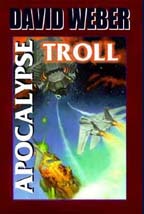
The Apocalypse Troll and other stories

I really like David Weber’s military science fiction. A few thousand fans of this sub-genre seem to like it as well; his books, even the ones which are ridiculously swollen with unnecessary and/or undesirable content, sell well. He has also partnered with other authors, including Eric Flint and Steve White, which helps lengthen his list of published novels.

My introduction to his work was a rough go, however. The science fiction book club was touting his In Enemy Hands, which is fairly far into the Honor Harrington series, but I began with that one, not realizing that I had to catch up. There were several times I nearly abandoned it; but about three quarters of the way in, I realized this was indeed a fascinating tale; albeit one which could have been told without quite so much detail. Intrigued, I read a couple of his stand-alone novels, The Path of the Fury and The Apocalypse Troll. While featuring hardware and propulsion concepts, more than characterization, these yarns did not require any backstory, and that helped. After I finished those, I read the Honor Harrington series, from the beginning. The first book is not particularly interesting, being mostly a set up for the series, but the series hits a good stride with books two through six. The seventh book, Echos of Honor also has its moments, but the page counts grow and the synopsis gets shorter with each successive installment. I read most of the series, but I think I have been reading on At All Costs, which may or may not be book twelve, for a couple of years and I have yet to finish it. Instead, I go back and re-read earlier titles.

Some of Baen’s earlier Weber titles, including The Apocalypse Troll, are available as eBooks, and I have been re-reading it. Yes, it is perhaps less polished than some of his more recent offerings, but it is also far less bulky than his newer work. No, he still doesn’t really write many multi-dimensional characters. Still, I enjoyed it. No one else seems to have the ability to write large scale battle scenes, but Weber does. He also has a firm grasp of the problems and possibilities of technologically driven warfare. Too many writers of space opera write about conflict one-on-one, because that is easier. In Star Wars, there may have been a lot of blasts, but the camera follows Luke and Han, and everything else is a backdrop. That is both cheaper and easier. However, any civilization which moves to the stars will have multiple ships, weapons, and drive mechanisms. Weber writes about those situations, and when Weber is finished with a battle, the casualties are in the thousands. That is what real war is, and it will be in the future.

So, the bottom line is that fans of futuristic writing may or may not like Weber, but most fans of military science fiction do, because he delivers large scale entertainment. Readers should sample the early stories, like The Apocalypse Troll or Path of the Fury, or at the beginning of one of his many series, rather than diving in the middle, however.

Troll is the story of a twenty-fifth century monster unleashed on our current earth, with only one surviving warrior from the future to tackle it. When researching the published reviews, I read that this novel was the first David Weber wrote, but it was published long after he had become established as a writer. So, while still Weber, the complexity is not so vast, and there are not so many references to politics, which is a major flaw in some his Honorverse works. But not everyone agrees that The Apocalypse Troll is a winner, so here is a link to a differing opinion of this novel over at RPG.net.

Where are all the science fiction readers?

I recently read a post on SFReader/SFWatcher stating that there are only 20,000 regular readers of science fiction. That’s fewer folks than live in my home county here in Georgia, making this a really astonishing statistic. The webmaster at SFR/SFW is now paying for movie reviews, in hopes of growing the website. No compensation is offered to reviewers of novels, of course.

When I was taking Mythology in Literature during grad school, one of our texts was by Joseph Campbell, who says that science fiction is mythology for modern people. If science fiction is so important culturally, why aren’t more people reading it, and what might attract a larger readership?

In 2004, Business Week ran an article entitled ScFi: Novel Inspiration which lists four valid reasons for reading science fiction. They include looking for new inventions, understanding the social consequences of invention, learning the lexicon of the future, and inspiring young minds. As America stagnates, and it really is doing just that, I wonder if our lack of wonder is at fault.

While science fiction does more than explore invention, that is one important aspect of it. A website called Technovelgy.com lists almost two thousand ideas which began within the pages of science fiction. Most people know that Captain Nemo’s ship beneath the sea predates the submarine, but how many folks know that Verne also predicted live news conferences, retro-rockets, and was the first to postulate that space travelers would have to deal with being weightless?

One of my favorite SF authors, Robert A. Heinlein, employs 3-D television, exoskeletons for the military, and smart lanes on the highway. All of these are in the later stages of development, and will be as much a part of our future as the “pocket phone” (which he used in “Assignment in Eternity” in 1953) is today.

Recently Fortune magazine published an article about the dearth of math and science students in the United States. Of the 8,000 students who graduated from U. S. colleges with a Ph.D in engineering  this spring, two-thirds were foreign nationals. Just a few years ago, most of those students might have stayed in America, but today, the majority will return to their home countries, because the opportunities to use the skills they just learned are there, and not here.

The fastest-growing college majors in America as of 2007, says the U.S. Education Department, were parks, recreation, leisure, and fitness studies, as well as security and protective services.” (Fortune, July 29, 2010) As Americans turn their collective backs on science (and science fiction) our nation will continue down the road to economic ruin.

In my research on why readers don’t enjoy science fiction, a number of reasons were mentioned, including:

“It’s too hard to read.” 

“The future in science fiction literature is too dark.”

“The science is bad.”

All of those reasons might have some merit, but there is a reason, which should have no merit, that I encountered while promoting Trinity on Tylos: There is a social stigma associated with reading science fiction. Ouch!

Oddly, people who see movies such as AvatarThe Dark Knight, or Jurassic Park don’t seem to feel that society is shunning them when they view science fiction on the big screen. In fact, many of the top grossing films of all time are either science fiction, fantasy, or have some ties to speculative literature. Now, the question is, how do we get those youngsters to make the leap from looking, to reading, and on to inventing?

That question is far more important than expanding market share for science fiction, which is stuck at a mere six percent of book sales. What America must accomplish, to expand the job market and our economy, is to expand the minds of our younger citizens. Science fiction should have a role in that, but someone, somewhere, must introduce it to them, and the earlier, the better.