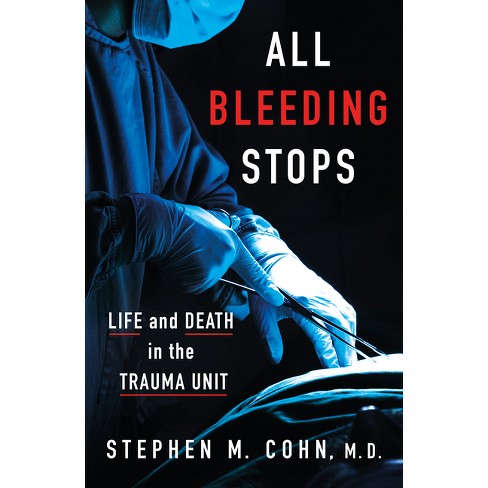
All Bleeding Stops is a mostly autobiographical book written by an experienced trauma surgeon, Stephen M. Cohn. During the course of the book, the reader learns how a trauma surgeon differs from other surgeons, how being a military doctor influenced the author, and quite a bit about the different ways that people end up in an emergency room. Chapter titles include “What Exactly is a Trauma Surgeon” and “Dealing with the Worst Injuries” which are the main focus of the book, but the author also has chapters on “Preventing Injuries” and “Managing the Public” which includes the author being involved in a high profile case.
I chose this title, in part, due to a mishap wherein I ended up in an ER and had orthopedic surgery. As Dr. Cohn says, patients choose elective surgeons and develop a bit of a relationship prior to their procedure, but in an emergency, whoever is on call becomes the doctor. I certainly didn’t choose the guy who rebuilt my shoulder, as I certainly didn’t plan to break it into four pieces! Anyway, I identified with some of the patients described in this book.
While I’d like to say this is a five star read, the not-so-linear organization takes it down a notch for me. That said, I really enjoyed this book, as it provides many anecdotal stories about trauma surgery, not only those performed by the author, but also those he heard about from colleagues. Many of the cases described survive, but there are those who don’t make it, and there is a certain dispassionate tone in this narrative. That’s not intended as criticism, but an acknowledgement that doctors who deal with trauma must maintain some distance in order to remain sane.
Again, I enjoyed reading this book, and for those who want to know more about how lives are saved and people put back together after terrible trauma, this book is quite enlightening.
Right after my last post, I was injured, quite badly, in a fall. While I had read the title above, hubby had convinced me that Medicare Advantage was the way to go, because “we are healthy.” And, I was, until I broke my shoulder and damaged the nerves which traverse the Brachial Plexus. Within a month of my fall, I tested Medicare Advantage and soon found that I wish I had opted for traditional Medicare.
In Why Medicare Advantage Plans are Bad the author begins by explaining Medicare and Medicare Advantage. Even the name sounds good, right? They call it Medicare Advantage because there are certain perks, which vary depending on which insurance company provides coverage. For instance, mine has vision benefits, which I have used, and gym benefits, which I have not. This book also has a chapter explaining why the government actually prefers that people choose Medicare Advantage.
For those about to reach the age to file, this book, especially the opening chapters, would be most helpful. Also very helpful now (although I wasn’t concerned prior to my accident) is the 6th Chapter, which explains the downside of Medicare Advantage plans for those with chronic illness. The answer is quite simple: co-pays. As a holder of Medicare Advantage, I have to pay $25 (or more) every time I visit a healthcare facility. Right now I am seeing multiple therapists every week. Some days I pay $25 to the hand therapist, then walk to another therapist in the same complex and pay $25 again. Then I do it again a couple of days later. Medicare requires that medically necessary therapy be covered for unlimited visits. Medicare would not require those co-pays, however.
Perhaps I will get “better” although I have pretty much given up on being “well.” But, with multiple providers for everything from therapy to tests, this journey will be expensive. I wish I had read Bynon’s book before I signed up for Medicare Advantage. And, although I read this book, I probably wouldn’t have reviewed it if I had not become a victim of what a nurse in the ER described as a “life changing” event. I started out quite healthy, but that can change, and quickly.
For those who are just going down this path, this book is certainly worth reading.
I was recently asked to make a talk about motherhood. While I am waiting for more info about what those folks want me to say, here’s a post I wrote on the subject about a decade ago.
Since I was quite young, I have loved this musical, as have many other people. I’ve owned the sound track in various forms, as well has having first a VHS then a DVD of the film. However, recently I read a short but glowing recommendation for this volume, so off to eBay I go, and low and behold, I got the book in a box with yet another DVD and sound track CD. Sweet!
This is what I’d call a “coffee table” book in size, but the content is a bit more than some such books. The forward is by Andrew Lloyd Webber, who was engaged in putting on a revival of The Sound of Music for the stage in London around the same time as this book (2006) but the book itself begins with the story of Maria von Trapp, the subject of a couple of books prior to her story being turned into the now famous musical.
For those of us who discovered the story via the 1966 movie, the musical actually begins a bit earlier, as a Broadway vehicle for Mary Martin. The music was done by Rogers and Hammerstein, of course, and the book takes the reader through much of the creative process, with photos of notes and typewritten song lists, as well as pictures from the Broadway and traveling productions. There is quite a bit of detail regarding the modifications done as the play was transformed into the movie. Fans of the film will know much of the content, no doubt, but there are nuggets of information which should prove interesting for even well-read aficionados, and there are quite a number of pictures taken during the lengthy location filming in and around Saltzburg.
There’s a bit of information regarding the careers of the “children” in the film, and a couple of pictures showing them all grown up. However, the book doesn’t end there. As this play is still being performed in various venues, there is some detail regarding its continued success. The last section is a fairly detailed recount of the revival done by Lloyd Webber’s production company.
When it comes to these photo centric books, sometimes one thumbs through, reading the captions, and that’s that. With this book, I read it, all in a couple of days. While it was not suspenseful, it was interesting and kept my attention from the forward to the credits. That’s rare for me. So, for fans of the film, it a top pick. For those interested in how a feature film is developed, it is also of more than passing interest. And, as it is no longer new, it is quite affordable, too. Win-win!
There’s a certain irony in the title of this post, as 2021 wasn’t a great year in some regards. Politics seemed crazy and crazier. People seemed to be getting over the virus, for the most part, but some were really sick or lost their lives. Healthcare providers seemed to get a handle on it, but not entirely. Oh, there were some bright spots in 2021, such as overall success for the stock market, and college football seemed almost normal.
And, entertainment, especially streaming video, always appreciated, became even more so. Everyone needs a break from reality. So, here’s some of the best books and shows I enjoyed in the past year:
On YouTube TV, hubby and I both very much enjoyed Yellowstone. This show is a modern western, with cowboys and rodeos, guns, big pickup trucks. The story reminds me of family shows of the past, such as “The Big Valley” which I saw in re-runs when I was much younger. However, the Dutton family is led by a patriarch instead of a matriarch, with Kevin Costner doing a fantastic job as the father of three grown children, and the head honcho of the ranch. His offspring are diverse and all interesting, if rather flawed. The Montana setting is certainly an important part of the series, and if you haven’t tried this show, unless you are extremely prudish or need a knight in shining armor to be the main character, I think you’ll like it.
Other streaming winners include the comedy series, Ted Lasso, which is now in its second season over on Apple TV, and Lost in Space in its third season on Netflix. Ted Lasso is a quirky story about an American football coach who is hired to coach a professional English soccer team.Lost in Space was originally a campy cult classic, but the modern iteration is more far more serious and has killer special effects along with good acting and quite a bit of suspense. The first season was amazing, the second season suffered from the sophomore blues, and season three is somewhere in the middle. Overall, it is one of the better space operas online, far surpassing any Trek or Star Wars recent entries that I have seen. (BTW, my son likes the Mandalorian, but I haven’t seen that, so the comment might not be entirely fair.)
The best book I read in 2021 was probably The Book of Lost Names, by Kristin Harmel. This novel is set in set in Europe, during World War II. In The Book of Lost Names, the point of view character remains the same, but there are some deliberate time skips as the story moves from 2005, wherein the main character, Eva, is quite elderly, and 1942-46, when a young Eva spent several months forging documents in order to save people from the Germans who were occupying France (and threatening all of civilization.) Eva’s story is a real page turner, as there are moments of suspense, of hardship, and (thankfully) success, both in saving children from the Nazi war on Jews, and in Eva’s growing affection for a fellow member of the resistance. While I don’t want to include any spoilers, the book in the title refers to a code added to an existing book in the library of the local Catholic church, and the code included the real names of children who were perhaps too young to remember their birth names, which had to be altered so they could travel using forged documents.
Inflation may be raging, but between streaming and eBooks, entertainment is fairly inexpensive these days. Gas and groceries are skyrocketing, but being entertained is fairly easy. Welcome, 2022!
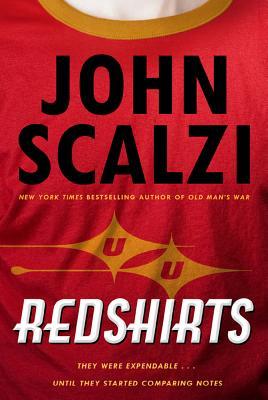
Fans of Star Trek, the original series, will immediately understand the premise of this very humorous novel. For the few folks who aren’t familiar with the show, there were a handful of officers who were the “stars” of Star Trek. In the show, the starship ventured from planet to planet. Often, one or more officers left the ship on “away” missions, and they were almost always dangerous. Those bridge officers were usually accompanied by security officers, and in the color scheme of the original series, security staff wore red shirts. As the show couldn’t lose any main cast members, the extras, playing security staff, would invariably be the ones to be maimed or killed.
In Redshirts, the author follows a young officer assigned to the Intrepid, the flagship of the Universal Union. Ensign Dahl is thrilled to be onboard, but soon becomes apprehensive, because he quickly realizes that when lowly crew members accompany the captain, its chief science officer, or its chief engineer, those lowly crew members would bear the brunt of any dangerous action. In other words, Ensign Dahl is a “red shirt” without actually wearing a red uniform. So, as a very intelligent young officer, Dahl must navigate the command structure of the Intrepid and learn how to stay alive. Quickly, he figures out that it is best to be anywhere other than on an “Away Mission.”
At times, Redshirts is laugh out loud funny. For instance, any attack on the ship will take out the lower decks, but the bridge always remains unscathed. And one young lieutenant has so many close calls, but he never dies, as he is a “main character.” Soon it becomes apparent that only a few characters will always survive. More experienced crew members seem to have figured out how to dodge being tapped for away missions, thus newbies like Ensign Dahl are more likely to end up dead. Rather than explain what they do and what the manage to figure out, I will simply say that the novel goes where the reader might not expect. And, while the novel really is funny, it is also a bit challenging.
Not since Galaxy Questhave I seen such a good parody of television space opera. Fans of the genre will certainly find something to like in Redshirts. And, for those few folks who have never seen Star Trekin any of its various iterations, this novel is still funny, but probably won’t resonate quite so well. However, the novel is rather, well, novel in that it doesn’t end at the end. Instead there are three sections after the end, called Codas. Some reviewers liked them, some did not. Hopefully, some of my readers will take up the challenge and try this book.
Science fiction fans tend to be smart, and it takes some smarts to appreciate this novel. That said, it is quite creative.