Last Stand series by William Weber—review and commentary

Last Stand: The Complete Box Set

From time to time, I’m offered a “box set” of eBooks, which strikes me as funny as there is obviously no box, just a longer than normal eBook. While these often seem to be great values, I seldom read an entire series. Last Stand is different, because I did indeed read all four books, and while I enjoyed them, I liked each one a little less, but that’s just me and what I Prefer to read, rather than any flaws in the books themselves.

Book one, Surviving America’s Collapse, was so suspenseful that I read it in less than 24 hours. Apparently survivalist/prepper books are a sub-genre, but this is my first such book. Viewed simply as fiction, readers might be annoyed, as the narrative often becomes pedantic, teaching survivalist techniques to the reader, but I rather enjoyed those segments. In short, the story begins with the hero, former Army officer John Mack, being the only guy in his neighborhood who understands that the vehicles, phones, and other conveniences aren’t working because some entity set off an “EMP” device. Mack rescues his wife, then his children, thinking they will soon retreat to his survivalist hideaway cabin, but his wife convinces him to remain in their neighborhood, to assist their friends. This proves to be increasingly difficult, as resources dwindle and nefarious elements attempt to takeover their community.

Book two, Patriots, begins in the second setting, the Mack family hideaway. The canvas of conflict widens a bit in this book, as Mack realizes the scope of the attack upon America, and feels the need to take up arms not just to defend his family, but his country. Book three, Warlords, is a bit darker in tone, as the forces behind the attack upon America begin divvying up the country. Book four, Turning the Tide, is on a grander scale, as Mack is one cog in the military effort to fight back against the foreign powers that seem to have figured out how to conquer the United States.

Each of these books has a fictional story, but invariably the author uses his story to also instruct the reader. Those who like lots of details about the military and/or weaponry might like these books more than I did, but I did enjoy them. Some of the characterizations are fairly stereotypical, and sometimes the main characters are able to overcome situations which would probably be hopeless without the assistance of the author. So, suspending one’s disbelief a bit is a necessary skill for staying with the series. Still, the suspense is sufficient to keep the reader turning the pages.

Survivalists, military buffs, and those who enjoy suspense will all find something to like in Last Stand. As of this post, the price for the eBook set is three bucks, which is a down payment on a hamburger! I can’t think of anything as entertaining as these books for that price, so take a look. These books are also available in paperback and as audio books, and all have hundreds of ratings on Goodreads, mostly 4-5 stars.
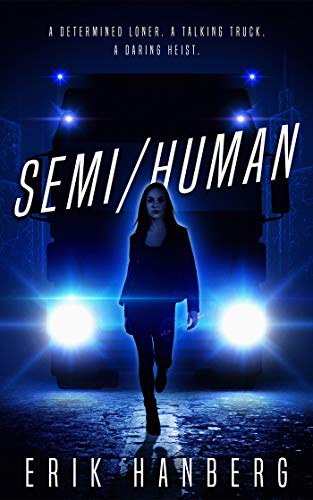
Semi/Human by Erik Hanberg—review and commentary

A Y/A science fiction yarn

As the pandemic has continued to plague businesses, many of them are accelerating their transition to robots and artificial intelligence, thus replacing or supplementing their all too frail human employees. Semi/Human is set in the near future, and in this novel Silicon Valley has finally written an adaptable code that makes most human employees obsolete. Vehicles drive themselves, dealers in Vegas are all robots, police have been replaced by armed drones, and so forth.

Main character Pen(ney) Davis is more than depressed, because like most other human jobs, her intern job at a Silicon Valley computer firm has been eliminated. However, Pen has come up with a less than practical scheme to steal a ridiculously expensive treasure from her former employer and get rich enough to care a lot less about being unemployed.

As Alexander Pope once observed, “A little bit of learning is a dangerous thing,” and recent intern Pen re-writes the code of a self-driving truck, intending to hijack it for a trip across the country, but ends up making the aforementioned truck autonomous instead. Fortunately for Pen, the truck, Lara B, is both friendly and grateful.

Lest I ruin this tale for readers, let me just say that this yarn is cogent, examining the societal damage which would ensue if gainful employment ceased, as well as the ethics of dealing with a self-aware, nearly omniscient super computer. There’s a dash of economic reality sprinkled in as well, because with no work, there’s no money coming in for the vast majority of the populace, so they end up fighting over whatever is left behind in the technological revolution.

There’s also more than a little suspense, as Pen and Lara B join forces to accomplish the original mission, wherein Pen hopes to acquire both riches and revenge in one fell swoop. Semi/Human is one of those rare books that blends a cautionary theme with an entertaining plot. Most of the characters are well drawn, and there is sufficient description of settings to keep the reader entertained but the plot never bogs down.

As a frequent reader of science fiction, it is rare for me to call a novel memorable, but for me Semi/Human is such a book. Perhaps I simply read it a the right time, or perhaps the book is really that good. If you like youthful, sassy heroines, self-aware computers (and trucks) along with a suspense filled story line, you really should try Semi/Human.

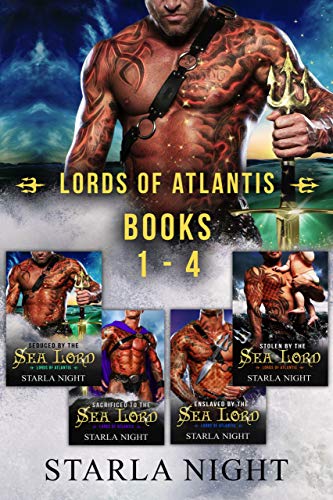
Seduced by the Sea Lord by Starla Night—brief review

A while back, I purchased (at a reduced price) the box set entitled Lords of Atlantis books 1-4, but the review is for Seduced by the Sea Lord, as that was the only novel I read. Quite frankly, it took me a while to read it, because it wasn’t very good.

Here’s the book blurb: “Determined warlord Torun cannot wait to claim Lucy, who mistook him for a shipwreck survivor and pulled his injured body from the ocean. All his instincts tell him she is his soul mate. Now she must join with him and give him a child. 

Lucy can’t believe the words coming out of this dominant male. He insists her destiny is to become a mermaid queen and mother to his future children. The one thing “destiny” forgot to mention was that Lucy’s a broke divorcee who can’t even have a child. 

It’s really too bad, because his gorgeous lips are all too kissable, and she’d love to see his iridescent gold tattoos moving as he flexed those broad, hard pectorals under the water…”

This cover image is for the set; I am reviewing book 1

There are a bunch of five star reviews for this set, by Starla Night, and one reviewer who rated the set at one star accused the others of being “paid reviewers.” Darn, I wish I could afford to pay some of those reviewers to put up five star reviews of my novels. Maybe I’d make some bank, but I’m too honest. Or poor.

Anyway, back to the review. The point of view character, Lucy, is chick-lit cute in her narrative. The alpha male hero is appropriately madly in love with Lucy. The bad guy is Lucy’s ex, and he is cardboard cut out bad. Many gals dislike their ex, but Lucy’s guy stole her money, her ideas, and her dignity. Yep, he’s bad, all right, but some how I didn’t hate him. Nor did Lucy’s grousing about him endear her to me.

The trappings of “mer” vs “human” seemed alternately implausible or just plain silly, which didn’t help the novel at all. In a word, this novel seems phony. I have three more books in the set, but unless I am stranded on a desert island with nothing else to read, I rather doubt I will re-visit the Lords of Atlantis.

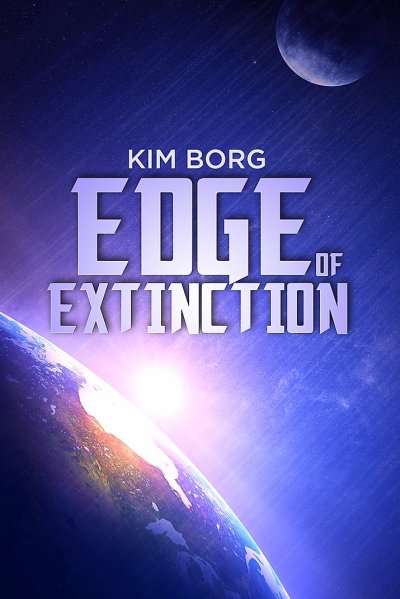
ARC review—Edge of Extinction by Kim Borg

EdgeOfExtinction_CVR_SMLI read Kim Borg’s debut novel as an ARC, and published public reviews on Big A and Goodreads, and I stand by that review. This one is going to be a bit different, however, and there are gonna be a few spoilers, so if that bothers you, go read the Goodreads version.
Science fiction is a modern art form, which probably begins with Mary Shelley’s Frankenstein, although there is some debate on that. Actually, there is also debate as to the exact definition of science fiction, along with what works should be classified as science fiction. For instance, many works of horror and some that are largely fantasy end up in the SF basket. As I don’t especially like either of those genres, that bothers me, but the lines are often blurred. Anyway, science fiction generally takes what is known (science fact) and extrapolates that is some manner (the fiction part.) I like to say it this way, science fiction asks “What if______?” In this case, we have a novel which poses several questions.

Borg’s novel is set in 2086, when Teslas drive themselves, which isn’t much of a stretch, and population control is a world-wide mandate, which extrapolates a bit more. Oh, and the Earth is a polluted mess, and rather than clean it up, at least one rich and famous guy  is looking to find a new spot to colonize. Apart from the one child per couple population control, which China tried a while back, none of this is much of a mental stretch.

However, after a few more scenes, the point of view characters, Dr. Amber Lytton and Dr. Joel Carter, become members of a space going team who board a ship called the Hermes, launch into space, and rely on a Phoenix drive to take them to the pristine Earth type planet, Arcadia. During their training, the couple learns that they are actually the second team to venture to the planet to assess it as a possible location for colonization. Once there, the travelers must dodge aliens of various sizes and levels of ferocity, while looking for clues as to the fate of their predecessors. Problems, both external and within the group, complicate the mission. Borg’s debut novel has quite a bit of suspense, a good character development, and lots of world building. The gadgets, although present, don’t over-power the story, either, which I like.

As in many worthy stories, the bad guys (or critters) aren’t all bad, and the good guys aren’t all good. There are a lot of questions to answer, such as will the villain who is only along to steal a valuable hunk of mineral get away? Will our point of view characters both live through the conflict between species which rule Arcadia? Is Arcadia a parallel planet to Earth, wherein the dinosaurs were never killed off? And, perhaps most important, are humans too wicked to trust to colonize any planet? This novel reminds me of some excellent science fiction writers, especially Jules Verne and Pierre Boulle (Planet of the Apes.) The ending isn’t quite a cliff hanger, but it opens the door for sequels, and I hope the author continues the story line in other novels.

Edge of Extinction is skillfully written and worth the reader’s time. Kim Borg states in her acknowledgements at the end of the novel that her goal is to both educate and entertain the reader, and while she certainly tries to educate, she does entertains. Borg is a new author for fans of classic science fiction to watch.


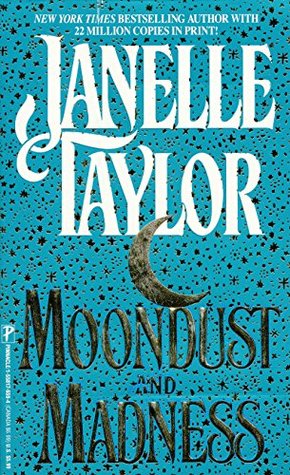
Retro Review: Moondust and Madness by Janelle Taylor

MoondustA friend (a generation older than I am) recommended books by Janelle Taylor, saying she is a prolific series romance writer from Georgia.  That’s true. Goodreads lists lots and lots of titles by Taylor, and apparently she sold quite a few books in her heyday. The series my friend recommended was “western” but as I am a science fiction fan, I chose to read book one in the Moondust series, Moondust and Madness.
Reviews for the ebook, which I read, are not plentiful, but are mostly positive. However, a deeper dive into those reveal that the positive reviews are mostly by readers who remembered this yarn from way back, whereas younger, first time readers are not impressed. I understand both points of view.

Moondust and Madness is a traditional 80s bodice ripper novel, which just happens to be set in space. Heroine Jana Greyson is a scientist who is abducted by an alien gathering up human mates for a large system of planets in another galaxy. These alien abductions are sanctioned by the alien powers that be due to the devastation of an engineered virus which caused a lack of fertility amongst the alien females. BTW, these aliens look just like humans, and can breed with them, so the only thing Jana (and her five hundred companions) need is an inner ear translation device and some brainwashing to help her get ready for her new life. Much of the science fiction trappings seem to have been lifted from Star Trek, from “Star Fleet” to transporters. That could be viewed as “ripping off” Trek, but I think it was more to give readers some familiar science fiction props. This is a romance novel, so there are very few explanations of how gadgets or space ships work.

Lots of political intrigue and the on-again off-again romance between Jana and her captor, Varian Saar, make up the more than five hundred pages of this novel, which begins a series featuring other characters set in the same universe. While I liked the book at times, it is just too retro for most readers. I won’t continue the series, but I did finish it.

For readers who like alien abduction and then fall in love plots, Myra Nour used this same basic plot for her much better novel, Love’s Captive. And, if you want a dose of reality wherein the heroine doesn’t fall in love with her captor, try my novel, Trinity on Tylos.


The Functional. Fragment. Celebrated. Or reviled.

ARC5Claimed (which may or may not also have the title of Rescued) came to me as an advanced review copy (ARC) which I read recently for a review site. Actually, I am glad to have the opportunity to review again, as it has been quite a while since I’ve done this. Most such sites really want a positive review, and I have written one. My comments for the site are true but censored a bit. What you’ll read here is more genuine.

First of all, sometimes minor mistakes are in an ARC, and I certainly understand that. The author used “fussed” for “fussy” for instance. That’s the kind of minor mistake that should be corrected before the final book is published. This book is a science fiction romance, with the emphasis on romance. For me, science fiction should have a bit science, but in Claimed/Rescued there aren’t many science fiction elements, apart from characters (lots of aliens) setting (a spaceship and a space station) and plot (alien abduction.) Apart from vivid descriptions of aliens, the other elements are not especially detailed.

Romance comes in several flavors these days, from very hot (nearly pornographic) to sweet (think Amish stories that talk about feelings rather than body parts.) Claimed/Rescued is skewed well on the sexy side of the continuum. For those who read romance for vicarious sex, this novel is a winner. From a science fiction standpoint, this yarn disappoints a bit. Okay, I don’t have to know how the ship goes or how the remote control on her wicked slave collar works, but a little more detail concerning the gadgets would be welcome. The most sci fi part of the book is the afore mentioned vast array of aliens, and those are described in varying levels of detail.

For me, the most annoying aspect of the book was the author’s reliance upon the “functional fragment.” Of course, lots of dialogue depends on the functional fragment. Think about one side of a phone conversation:

“Hey!”

“Oh yeah.”

“Really?”

“No kiddin’!”

I have no problem with the construction in that context. But. This author. Tends to write. Like. This. The words shared in this manner tend to be feelings or observations, such as “Handsome.” “Kindness.” “To Bond.” “To become as one.” “Tenderness.” “Aroused.” “Stay strong.” “Traumatized.” “Wary.” “Forever.” Y’all, I just listed a few of the functional fragments. Every once in a while, this could be an effective technique, but Claimed/Rescued is far too reliant upon these pseudo sentences.

No doubt Claimed/Rescued will be published, and there will be enough positive reviews that some science fiction romance fans will read it. And, those who want to experience sex vicariously may well enjoy it. But. All I seem to remember. Are. Those. Fragments.