Why do writers need editors?

editing-apps-800x600Before you say, “Duh!” please remember that some people have lots of self-confidence. Others can crawl off into a mental state and ignore the world around them, which can be considered a skill in the writing biz, but conformity is comforting to readers. Other writers seem to think that the rules don’t apply to them, like ee cummings. A few insist on ignoring the red and green squiggles that the word processor uses to offer help in eliminating common mistakes. Writers suffer from any of those problems, or have other idiosyncrasies that make editing necessary. Yes, I considered dealing with editors to be something of a pain, because I am self confident and not afraid to break a few rules.

However, I have learned quite a lot from writing teachers and editors. Friends and family will offer a few tips, but if those friends really like you, brutal honesty is off the table. Sometimes the distance combined with authority that goes along with having an editor is transformative. My first novel was a hot mess when it finally got a full length reading at the micro press that ultimately put it through line editing. My second novel was better, but still needed a lot of work in the editorial phase, beginning at conceptual, then line by line, and finally, proofreading. At that time, WCP did not pay proofreaders, instead relying upon volunteers, which was a bad business decision. My work suffered from that lack, as a few errors made it into the printed work, and sales were less than optimal.

Publishers seldom take on a fiction manuscript that isn’t complete, which leaves out the project development phase. Once the novel is finished, most writers will attempt to put it into the hands of either an agent or a publisher. Problems with style or continuity may crop up at this stage, but if the work is compelling, those can be addressed. What most people consider editing is copy or line editing, which is a line by line examination of grammar, spelling, mechanics, and style. Any “big changes” in the manuscript probably occur at this stage. The back and forth over details can be annoying or even funny, but most problems in the work are solved at this phase. Once, an editor challenged me on a detail where I described a man wearing a glen plaid suit. I thought it descriptive, but she thought it was a weird description that no reader would understand. Ultimately, the description remained, but that is the kind of thing that comes up in line edits.

Before printing comes proofreading, when any style or content changes have been addressed—so what’s left is a last look at spelling, capital letters, and adjustments to make the page layout work. I remember the copy editor at Whiskey Creek Press had to substantially change one sentence to avoid a page with a single word on it, and I was okay with her changes.

A good editor makes printed work better—by questioning, suggesting changes, and insisting on being absolutely correct. Real editing makes the author’s work shine, without the distractions of mistakes or inconsistencies. Nowadays, many people think that word processors have made editors obsolete. Unfortunately, that is simply wrong, and writing is suffering mightily. Errors abound, and the solution is a great editor who reads and corrects. Technology is advancing, but it cannot replace editorial expertise.


Want a book? Check eBay before you check out!

My daughter and I have been using eBay as our “go to” bookstore lately. As an eBay seller, I’ll assure you that the fees are far less when selling used items, including books, on eBay. When selling via the big A marketplace, the fees start at about $4, and go up incrementally. Obviously, selling anything other than textbooks or other high end items on the big A marketplace is not worthwhile. However, eBay’s current fee structure is 12% for books, which means sellers can offer better prices to customers. Also, big A has a flat fee of $3.99 to ship a book, unless the seller offers “free” shipping. As USPS offers “media mail” rates for smaller books, the shipping can be cheaper via eBay. Win-win, right?

Here’s an example of a book that I have placed on the marketplace for a client; basically big A gets $6 of the $17 price:

Amazon fee

The fee for that book on eBay would be $2.04. The difference between selling via eBay vs big A is 23%, which is about $4 on a book that costs $17.

Let’s say you’re a bottom feeder looking for a deal. Here’s what happens with a $5.50 book listed via the big A marketplace:

Amazon fee 2

The sale price is $5.50 and the fee for selling it via the marketplace is $4.21, which means the seller gets $1.29. Not many sellers will opt for such a small amount, which is bound to drive up the prices of used mass market paperbacks and/or popular hardcovers. By the way, as of this post, this same book is available for $3.34 on eBay, while the lowest possible price on big A is $4.75. Clearly, bottom feeders need to go to eBay for book purchases. And, while there, check out all the other goods available, from electronics, to clothing, to collectibles— often at better prices than you’ll find anywhere other than the neighborhood yard sale.

One reason buyers flock to big A is the user reviews. Unfortunately, those reviews are not particularly reliable. Big A is purported to fighting this issue, whether banning reviews by customers who have not purchased the item being reviewed, or attempting to  control “paid” reviewers. Lately, the issue with reviews on big A is a problem with “hijacked” reviews, where in a product’s reviews are actually for a different product. Certainly, if you must read those reviews, really read them, and don’t be fooled by the number of stars highlighted. All in all, while there may be more variety available on big A, the prices are probably better on eBay.

As a matter of full disclosure, I sell on both big A and eBay. My eBay store is here:

The Alternative Article

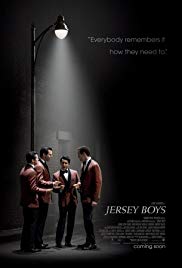
Jersey Boys on Netflix

Jersey BoysLike many of you, we use services such as Netflix rather than having a traditional cable subscription. At times, we miss the old TV Guide magazine, which would guide the viewing experience. Instead, with Netflix, there is some algorithm that knows my husband likes shoot ’em up flix, so I am not always happy with the suggestions. However, a couple of days ago, I noticed “Jersey Boys”as an option in our feed. I’m embarrassed to say that hubby actually, “What’s that?” I simply said, “Click on it and you’ll see.”
Anyway, fortunately for me, hubby likes music, especially vintage pop, so he was eager to take a look at the movie version of this musical, which had a great run on Broadway, and is still touring around the country. Jersey Boys tells the story the Four Seasons, featuring the fabulous Frankie Valli. Surprisingly, the film version is directed by Clint Eastwood. The cast is really great, with Christopher Walken in a small but pivotal role, and it also has the original Valli from Broadway, John Lloyd Young as well as Erich Bergen, who has a supporting role in another show we’ve watched on Netflix, Madame Secretary.

There is much to like about this film, which is actually a 2014 release, but I was most impressed with the sound track. And, as is possible when watching a film in the comfort of home, I paused it and did some research, finding that the cast sang, rather than having it dubbed by either the original band or by hired musicians. Many of the hits from the Four Seasons are present, including “Sherry”, “December 63 (Oh What a Night)”, “Walk Like a Man”, and “Big Girls Don’t Cry.” Valli’s solo, “My Eyes Adored You” is also in the film, as are other familiar tunes.

Although not entirely happy, for this film follows the rise and the ultimate fall of The Four Seasons, we enjoyed this film quite a lot. If you are a Netflix subscriber, the movie version of Jersey Boys is a great way to spend an evening. Toe tapping is optional, but recommended!

The book of the year?

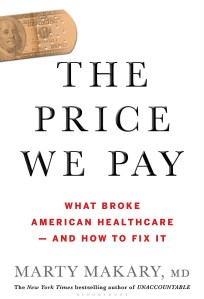
The price we pay book cover
Lots of books are published each year, and I can only read a few of them. But, when a really important general interest book comes along, I often put it on the top of my “to be read” pile. In September, Dr. Marty Makary, a surgeon associated with Johns Hopkins, released a book entitled The Price We Pay: What Book American Healthcare—And How to Fix ItSince most people in America eventually get sick or have an accident, and only a few of us are fifty rich, this is the ultimate general interest book.

In Part I, entitled “Gold Rush” Makary doesn’t have to travel far—he visits “health fairs” at local churches, where salespeople disguised as medical professionals do screening tests and scare participants, mostly those on Medicare, into unnecessary and rather expensive procedures, such as placing stents into leg veins. In the second chapter, he discusses the lack of transparency in hospital pricing, as well as the astronomical rise in common procedures. For instance, a medical center in New Jersey offers joint replacement surgery for $135,400.00, which rose a mere 76.8% in a single year. BTW, Medicare only pays 13K for that procedure. For his third chapter, Makary travels to Carlsbad, NM, where the medical center seems to have overcharged and then sued almost everyone in town. Back in Virginia, Makary visits the courthouse to learn more about similar shenanigans at Mary Washington Hospital in Fredericksburg. Sadly, this hospital is supposed to be a “not for profit” hospital, and thus receives favored tax status, too. Also in this section, Makary provides an analysis of the proliferation of for profit helicopter ambulance services, which charge somewhere between $40K and $60K for a ride that I could make in an hour in my Toyota.

In the second portion of the book, Makary delves into some medical practices that can be improved by focusing on individual physicians. One OB doctor in Florida had a reasonable rate of C-sections, until figuring in Fridays, when the rate rose 80%. Why? The good doctor didn’t want to be bothered on the weekend, so moms who were in labor on Friday got the surgery. This section of the book also discusses the opioid crisis, and Makary admits that he had to learn to write fewer prescriptions for pain pills, after learning about the misuse of all those pills.

Part III of the book is about “Redesigning Healthcare” and it does offer several solutions to problems, but one chapter in this section explains how drug prices are affected by middle men (pharmacy benefits managers) who don’t supply anything other than a big bill for their services. Here’s an example: A pharmacy is paid $34.94 for 90 40mg doses of Zocor, but the employer is charged $442.85–and the PBM gets over $400 on that one transaction. Another chapter discusses problems in health insurance, which less and less helpful except in catastrophic circumstances, and there is even a chapter on “wellness” and how those well meaning programs are far too costly, especially as they often mean an invasion of privacy, or worse, over-treatment for minor issues.

Makary doesn’t make the mistake of only discussing problems without discussing solutions. Several positive programs are mentioned throughout the text, including websites such as ImprovingWisely.com, and the last chapter is a bit of a call to arms. In short, legislators and employers need to be educated on these matters, and healthcare consumers should do everything possible to demand transparent pricing for upcoming procedures.

The Price We Pay is a very important book. This should be the topic of your next book club, a gift for your friends and/or family, or even a holiday gift for your doctor or your legislator. Please buy this book, read it, and pass it on. Knowledge is power, and as this text has lots of information for Americans, this may well be the most important book you will read this year.

My video is reaching students!

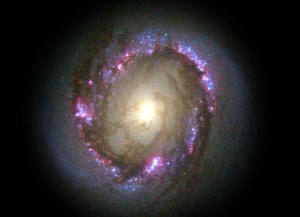
NASA nebula

A still shot from NASA

Way back I took classes in “podcasting” and “movie-maker.” Afterward, I came home and practiced what we’d learned in class. I made three videos, which are a lot closer to Powerpoint presentations, if the truth be told. Anyway, one of them has had a bit of success—”A Brief History of Science Fiction.” This video was designed with a few still images, mostly screen shots from NASA such as the one I featured on this post, and two audio tracks. We’d been warned in class about using commercial music, so I downloaded a freebie track that I thought sounded dramatic. The second audio track is my voice, reading story boards, in my rather strong Southern U.S. accent. I did write the story boards, based upon my study of the science fiction genre, my training in English literature, and what of that matched up with the still images that I managed to acquire at the time.

Science fiction is an ever changing literary and film genre (with more than a dash of animation) so my video is already a bit dated. Still, I was most gratified when reading a very valid complaint about the loud musical soundtrack. The complainant stated that my little YouTube video was required for class. Gosh darn! My Brief History of Science Fiction is required by a teacher (somewhere?) for a class (in something?) I’m flattered. Really.

If you don’t mind hearing that awful musical track, head over to YouTube and see A Brief History of Science Fiction. While you are there, the link to my “book trailer” for The Gift Horse is still live also.

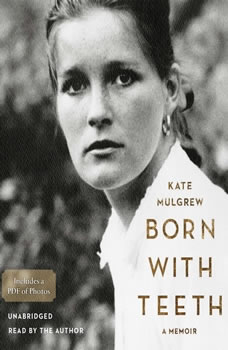
Born with Teeth—A Memoir; review and commentary

Born Mulgrew

Kate Mulgrew’s Memoir

My guess is the first I heard of Kate Mulgrew was when she starred in Mrs. Columbo, but that’s not a certainty. Like many fans of all things Star Trek, I was both thrilled and a bit concerned when Mulgrew was very publicly named the newest captain in the fourth iteration of that television franchise, Star Trek Voyager. And, I was rather amazed to by her character in Orange is the New Black, in a role that is far from her roots as a distinctive and attractive leading lady.

Regardless of when one first noticed Kate Mulgrew, she is a force on the screen. Recently, I read her memoir, which has the curious title Born with Teeth. Apparently, she was indeed born with teeth, which were extracted so she could feed properly. For Mulgrew’s fans , there may not be all that much new information, but the style of her prose does illuminate readers on her perspective in regards to matters that matter most. The narrative is mostly linear, although she skips a lot of years and events. First, the reader learns just how dedicated she is to her craft and how much work it has been. Second, readers will become better acquainted with Kate’s large family, and see how they have influenced her. One of my favorite passages is when, as a schoolgirl, Kate invited her artist mother to hear her recitation of poems she had written. Upon learning about the program, Kate’s mom, Joan, gives her a copy of a poem (The White Cliffs of Dover) to read, and during the school program young Kate not only read her poems, but she read the classic poem so well that her audience was almost in tears. Afterward, Kate’s mom told her that she could either be a bad poet or a great actress. Apparently, Kate took those words to heart, because from that early age, she put all of her effort into becoming an actress.

Fans of Ryan’s Hope (a soap opera that was Kate’s first big break in television) or Star Trek Voyager (perhaps her most influential role) will find a few gems, but she doesn’t concentrate on those stints. Instead, what Mulgrew writes about is relationships. While filming Ryan’s Hope, Kate became pregnant, and as she was not married and quite young, she assumed she’s have to leave her job. Instead, the pregnancy was written into the show, and her character gave birth a few days after Kate did it in real life. The Mary Ryan character kept her baby, but Kate gave up her daughter for adoption. Later, she expends both time and money in an attempt to find her biological daughter, and that search is a focal point of the memoir.

Certainly, Mulgrew has experienced quite a lot of grief, as one of her sister’s died of a brain tumor and another succumbed to pneumonia. Romance has not always been easy, either. Mulgrew also writes of her loves—her first husband, Robert Egan, and the sons that he fathered, and how divorce affected her and the boys. Later, she reveals how her love for her second husband, Tim Hagan, endured a rather on again then off again period. The memoir ends as she meets her daughter and her relationship with Hagan finally settles into marriage.

I’m a science fiction fan (and writer) so I was just a tad disappointed in this memoir. I’d love it if Kate would do as Shatner has done and publish a book about her time portraying Captain Janeway. Perhaps she will, when she has more time, for she does seem to be one busy lady.