Infinity Lost— a quick review

I’m in the midst of a semester of teaching writing, and I generally read and write less when faced with lots of student papers. However, I did spend a couple of evenings with Infinity Lost by S Harrison. The main character is Finn, the only child of a reclusive industrial tycoon. Finn is an innocent, but as the story unfolds, she is not just a teenage girl. Certainly, science fiction is a favorite genre, and this entry by a new-to-me author is quite interesting.

There are some neat concepts in this story. At times, it was a bit confusing, but mostly, the author does a very good job of describing interesting technology. there is quite a bit of suspense, too. Actually, I began thinking that this novel reads well, but it might be a better screen play than a novel. It is the first entry in a trilogy, and I suppose there might be a film in the making.

Is last year’s best science fiction novel is this year’s best science fiction film?

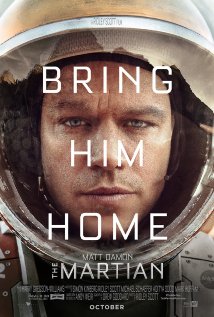
movie poster image of The MartianI think so, but I certainly haven’t seen all of the science fiction films of 2015. However, last night, I saw Ridley Scott’s version of The Martian, and it is really, really good. The guys with me (hubby and our unmarried 22 year-old son) absolutely loved it, and they had not read the book. (I wrote about Weir’s originally self-published novel last year.)

No doubt there are any number of professional and amateur reviews of the film, so I will do a bit of compare and contrast with the book. First, the beginning and the ending are different. Not vastly so, but the visual medium requires a different approach. However, the spirit of the novel, as well as much of the plot, is intact. The film begins with the astronauts on the surface of Mars, taking care of exploring and introducing characters. The action begins quickly, as the storm sets in and the crew aborts the mission. In the book, the back story unfolds as stranded astronaut Mark Watney recovers from his wound, assesses options, and determines each course of action. Either way, the story soon slows a bit, as this modern take on “Robinson Crusoe” unfolds. In order to get the audience out in a timely manner, the events in the film are compressed a bit. However, some things, such as the mission commander’s affection for “disco” music actually work much better in the film, as 80’s hits make up much of the sound track.

The casting is excellent, and the amount of screen time for players other than the central character, Watney, reflect a slightly different approach to the story. In the novel, chapters go by before there is any mention of the characters back on earth, but that, too, is accelerated for the film version. Actually, I like the film’s approach better than the novel, as it ramps up the suspense a bit.

Some folks in my generation have been very, very disappointed in the choices our government has made regarding space exploration. (Or should I say, the lack of space exploration.) The Martian can certainly thrill audiences of many ages, as my son really loved it. But it will especially appeal to those of us who watched NASA missions in our youth, and dreamed of continued exploration. This isn’t space opera— it is fiction based on real science.

At the most basic level, The Martian is good entertainment. It’s not particularly violent, or sexy, but it has plenty of action. The conflicts here are mostly man vs. the environment, and the environment is very believable. Perhaps, however, the younger audience will also ask why our government is so concerned about minutia, such as providing everything from cell phones to farmer’s markets, rather than taking the lead on larger initiatives, such as exploring the solar system.

Forged by Jennifer Rush (a quick review of an even quicker read!)


Yeah, we just got underway with a new semester, so I haven’t had much time to read… and even less to write. However, I did squeeze in an evening of reading, which I devoted to “Forged” by Jennifer Rush. This is closer to a long short story than to a novella, but it is billed as a prequel, so that’s fair, I suppose. Since I haven’t read any of the series, I was a bit baffled by this piece. Dani seems to be quite the victim, but she is being manipulated somehow. The writing is good, but there seemed to be more going on than I was able to understand. The why and the who were a bit ambiguous, and the twist at the end was indeed unexpected.

Ultimately, I felt more confused than intrigued, but those were my mixed emotions when I got to the end. Others seem to enjoy the series, so at some point, I may revisit it, but “Forged” was simply not compelling. So… let’s say it is for fans, but not a good intro to the series.

Up to Date— a quick review of a quick read.


Very light romance is not normally my thing, but a friend suggested that if I would “like” Gemma Halliday on Facebook that I could get a freebie on Friday. So, one of the recent choices was a romance novella called Up to Date, which is also billed as Better Date than Never series, Book #8.

When I began Up to Date by Susan Hatler, I was immediately hooked. The main character’s name is Ginger. Her sister is named Mary Ann. And, yes, their dad was a big fan of Gilligan’s Island. The tone of this book kinda goes along with that… a bit romantic and quite a bit of comedy. This version of Ginger is miserable in her job, because being an office manager is a real snoozefest. Her home life lacks stability, because flighty sister Mary Ann never seems to have money to pay rent, but has lots to spend on frivolous social matters. Ginger is artistic and highly interested in home decor, so her true calling is to be an interior decorator. Knowing this, and knowing her talent for it, a friend suggests that Ginger donate her design services as a prize in a charity auction. The winner of the auction is a guy who wanted to date Ginger, but in typical romance fiction style, Ginger doesn’t care for him. Or maybe she does.

Anyway, I really enjoyed this light romance and urge those who enjoy the genre to download Up to Date. I read the Kindle version, and it is a most pleasant way to spend an evening.

Mockingbird— a novel for children, but a good read for adults as well

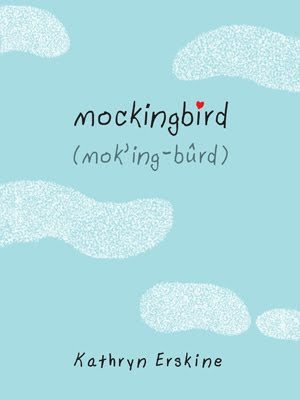
Mockingbird by Kathryn ErskineMy local library doesn’t have an available copy of Harper Lee’s new/old Go Set a Watchman available just yet, so I chose a novel that I first learned about when taking a graduate level course in improving reading in secondary schools, Mockingbird by Kathryn Erskine. The premise in this YA novel is that our narrator, Caitlyn, is a fifth-grader with Asperger’s Syndrome. I have a family member with a similar diagnosis, so this novel interests me on more than one level. Caitlyn had been quite dependent on an older brother, Devon, but he is not with her any longer. For anyone who does not know, the vast majority of symptoms of Asperger’s are associated with communications skills. Caitlyn exhibits many of the classic symptoms, but there is both humor and pathos in her approach to life. Her father seems to want to help her and connect with her, but he is suffering from a different malady. As the exposition unfolds, the reader learns that Devon was killed in a school shooting and their mother died of cancer a couple of years prior to the events of the novel. So the father is reeling emotionally, and Caitlyn is struggling with adjusting to these losses and with trying to develop empathy for other people. Other players in this novel include young Caitlyn’s teacher, counselor, and her fellow students. Try as she might, Caitlyn has trouble “getting” what others seem to understand with little trouble. This, too, is typical for Aspies.

Mockingbird derives its title from the many references to the movie/book To Kill a Mockingbird, and I do not believe that the novel would resonate nearly as well if the reader had not either seen TKAM or read it. But, with most readers knowing a bit about the famous story by Harper Lee, it is fairly safe to say that most readers will “get” the references.  Indeed, I really, really enjoyed the novel, but I did need some tissue toward the end— it is that kind of story.

Reading YA lit is more and more common these days, because big publishing is far more open to publishing those stories. Getting a contract is rather difficult for new writers of adult fiction, but YA sells well, so it is becoming a crowded field. I don’t want to spoil it for potential readers, but I do want to encourage fans of TKAM to read Mockingbird. Although it could be read by upper elementary on up, it is a touching story for readers of any age.