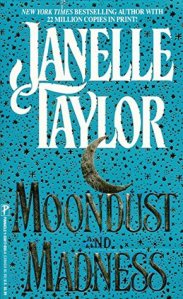
 A friend (a generation older than I am) recommended books by Janelle Taylor, saying she is a prolific series romance writer from Georgia. That’s true. Goodreads lists lots and lots of titles by Taylor, and apparently she sold quite a few books in her heyday. The series my friend recommended was “western” but as I am a science fiction fan, I chose to read book one in the Moondust series, Moondust and Madness.
Reviews for the ebook, which I read, are not plentiful, but are mostly positive. However, a deeper dive into those reveal that the positive reviews are mostly by readers who remembered this yarn from way back, whereas younger, first time readers are not impressed. I understand both points of view.
Moondust and Madness is a traditional 80s bodice ripper novel, which just happens to be set in space. Heroine Jana Greyson is a scientist who is abducted by an alien gathering up human mates for a large system of planets in another galaxy. These alien abductions are sanctioned by the alien powers that be due to the devastation of an engineered virus which caused a lack of fertility amongst the alien females. BTW, these aliens look just like humans, and can breed with them, so the only thing Jana (and her five hundred companions) need is an inner ear translation device and some brainwashing to help her get ready for her new life. Much of the science fiction trappings seem to have been lifted from Star Trek, from “Star Fleet” to transporters. That could be viewed as “ripping off” Trek, but I think it was more to give readers some familiar science fiction props. This is a romance novel, so there are very few explanations of how gadgets or space ships work.
Lots of political intrigue and the on-again off-again romance between Jana and her captor, Varian Saar, make up the more than five hundred pages of this novel, which begins a series featuring other characters set in the same universe. While I liked the book at times, it is just too retro for most readers. I won’t continue the series, but I did finish it.
For readers who like alien abduction and then fall in love plots, Myra Nour used this same basic plot for her much better novel, Love’s Captive. And, if you want a dose of reality wherein the heroine doesn’t fall in love with her captor, try my novel, Trinity on Tylos.
 I like for the price to be the price. But, I must be one of the few people who think that way. Fair and square pricing works for me: I can budget for what I need to purchase, and know when it is okay to splurge a bit. However, I have a dear friend who won’t buy anything unless she negotiates a better price. This practice is downright embarrassing at times. Recently, we were in a charity thrift store and she saw a large ceramic vase filled with fake flowers. (I know, taste varies.) Anyway, it was priced fairly, but she stood in line to ask a harried clerk to lower the price by $5. The clerk said, “The price is the price.” My friend walked away. “It’s a charity,” I reminded her. As we got into the car, my friend made up some excuse about the quality of the item. But, I know her. No discount, no sale is her motto.
 What to read? When I was young (a very long time ago) my mother took my sisters and me to visit the public library every week. This was “free” entertainment, and as we were fairly poor, it was a great deal. However, there was that day when I’d read everything of interest to me in the children’s and young readers category. Again, this was a long time ago, when “young adult” publications were not a big category. I remember her guiding me over to the adult fiction section (meaning not for kids, but nothing racy—it was a public library) and she suggested some titles. My first reads from that section were what mom would term “mysteries” although romantic suspense would be closer to the genre of that time. The authors were Phyllis A. Whitney and Mary Stewart, although I can’t remember the titles. So began my transition into reading for pleasure, an activity that is still a big part of my life.
 Over my almost two decades of writing and (occasionally) publishing, I’ve learned some stuff. Lots of stuff, actually. Some of what I learned (such as a great place to buy a box for a manuscript) is out of date. However, there are some resources that budding writers should utilize that are still quite relevant, so here goes—

 We’ve all heard the old saying that states it is not good when “one hand doesn’t know what the other hand is doing.” Basically, when an organization gets too big or too disconnected from itself, then there is at a minimum a loss of cooperation, and at worst, the organization works against itself.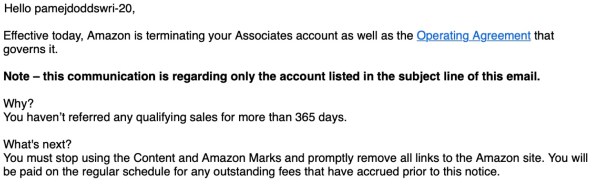
 Honestly, this is just on example of the problems at big A. Lots of articles have been published about problems there. The most troubling ones (for consumers) are the

