The Missing— a brief film review

Film, The MissingWhen I was growing up, I loved westerns. There was much to like about them: horses, good guys in white hats, horses, bad guys in black hats, horses, guns, horses, beautiful settings, more horses…. you get the picture, I am sure. My early favorites were “Fury” which was a show about a horse, “My Friend Flicka” which was about a horse, and the Roy Rogers show, which was mostly about the horse named Trigger. At least, that is how I remember it.

Then, I grew up and westerns were not in favor in Hollywood anymore. My early love of science fiction is all intertwined with my love of westerns. Once, I was amazed by a very intelligent woman who said she despised Star Wars. I laughed, and said, “It’s just a western!” As she gaped at me, I went on to explain that Star Wars owes much to westerns, from the bar scene (just a saloon) the greenhorn (Luke Skywalker) being guided by an older and wiser mentor, the gunslinger (Han Solo) and the Millennium Falcon, which doesn’t have much on a good horse.

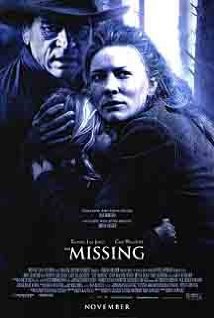
Westerns have never been as popular as they were in my youth, but they have grown up. Recently, hubby and I were looking for something on Netflix that we hadn’t seen, and “The Missing” with Tommy Lee Jones and Cate Blanchett caught my eye. The description reminded me of an oldie but goodie, “The Searchers,” so we we popped some corn and got involved in Ron Howard’s take on the quest to foil white slavers in the old west. We enjoyed this suspenseful tale. The film has some fabulous scenery, very wicked bad guys, a very heroic mother (Blanchett) and too much mysticism for my taste. Oh, and there were several horses, but lately, filmmakers seem to think they are like cars or motorcycles, just transportation.

This plot could have been told in a science fiction setting, with space ships instead of horses, but it works reasonably well as a western. Check it out on Netflix streaming.

Mockingbird— a novel for children, but a good read for adults as well

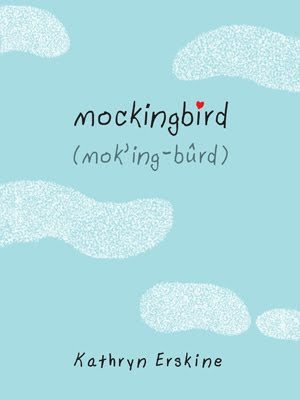
Mockingbird by Kathryn ErskineMy local library doesn’t have an available copy of Harper Lee’s new/old Go Set a Watchman available just yet, so I chose a novel that I first learned about when taking a graduate level course in improving reading in secondary schools, Mockingbird by Kathryn Erskine. The premise in this YA novel is that our narrator, Caitlyn, is a fifth-grader with Asperger’s Syndrome. I have a family member with a similar diagnosis, so this novel interests me on more than one level. Caitlyn had been quite dependent on an older brother, Devon, but he is not with her any longer. For anyone who does not know, the vast majority of symptoms of Asperger’s are associated with communications skills. Caitlyn exhibits many of the classic symptoms, but there is both humor and pathos in her approach to life. Her father seems to want to help her and connect with her, but he is suffering from a different malady. As the exposition unfolds, the reader learns that Devon was killed in a school shooting and their mother died of cancer a couple of years prior to the events of the novel. So the father is reeling emotionally, and Caitlyn is struggling with adjusting to these losses and with trying to develop empathy for other people. Other players in this novel include young Caitlyn’s teacher, counselor, and her fellow students. Try as she might, Caitlyn has trouble “getting” what others seem to understand with little trouble. This, too, is typical for Aspies.

Mockingbird derives its title from the many references to the movie/book To Kill a Mockingbird, and I do not believe that the novel would resonate nearly as well if the reader had not either seen TKAM or read it. But, with most readers knowing a bit about the famous story by Harper Lee, it is fairly safe to say that most readers will “get” the references.  Indeed, I really, really enjoyed the novel, but I did need some tissue toward the end— it is that kind of story.

Reading YA lit is more and more common these days, because big publishing is far more open to publishing those stories. Getting a contract is rather difficult for new writers of adult fiction, but YA sells well, so it is becoming a crowded field. I don’t want to spoil it for potential readers, but I do want to encourage fans of TKAM to read Mockingbird. Although it could be read by upper elementary on up, it is a touching story for readers of any age.

Monuments Men— on DVD

Monuments Men film posterA friend mentioned that she had seen and liked Monuments Men when it was in theaters, but I didn’t get around to seeing it then. However, it is out on DVD so hubby put it in the Netflix que, and we saw it recently. The cast is, perhaps, the best part of this effort. Lots of big name stars have roles, including Matt Damon, George Clooney, John Goodman, and Cate Blanchett. Essentially, this is the story of the men tasked with finding and protecting the art which was stolen by the Germans during World War II.

The script is good, but not especially memorable. In this film, however, the dialogue takes a back seat to action and suspense. And, there is certainly an element of education in the film. In order for the suspense to work, the audience must come to care about the historical artifacts and those who worked so hard to restore them to their rightful places. As my friend said when she recommended it, the movie isn’t great, but it is good, and it helps modern viewers appreciate the risks and hard work of those who went to war to help preserve these works.

Oddly, there are few people now who care enough to publish accounts of the destruction of art, as is happening in the middle east, much less go to war over it.

Unbroken– the book (review and commentary)

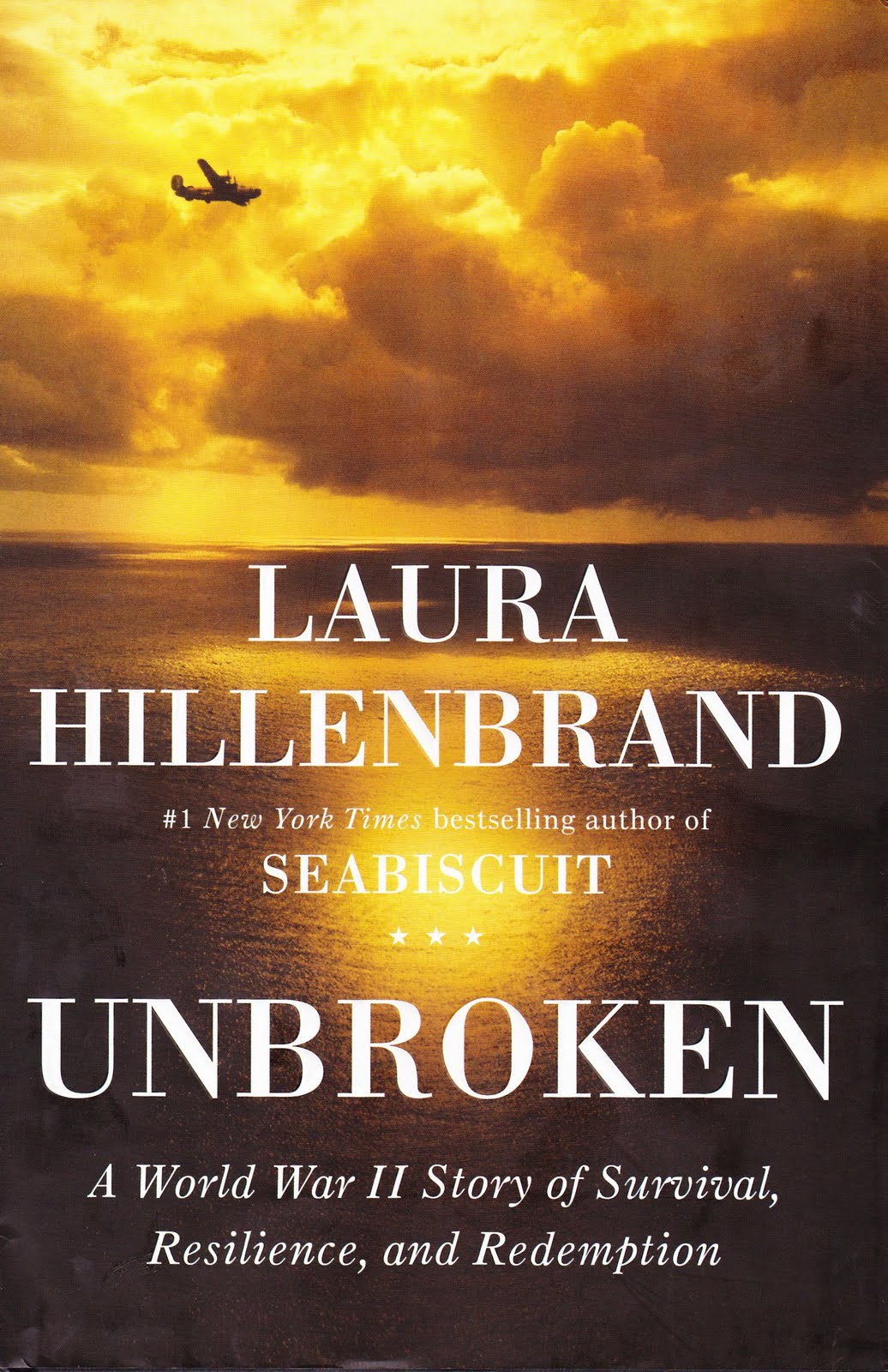
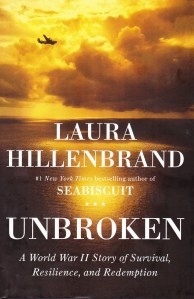
Unbroken coverWhen I was younger, one of the genres of movies and television that was quite popular was stories from World War II. While I wasn’t alive for it, of course, many in my parents’ generation had fought or knew those who had. Indeed, on a wall in my house is a framed picture of my uncle, A.L. Dodd, Junior, who was killed a few weeks before the end of the war in Europe; he was in Germany, in the Ruhr valley, when he was shot by a German machine gunner. So, the war was quite real to us. We enjoyed the stories, because they were entertainment, but knew that the war had affected most everyone in America.

After seeing the film Unbroken, directed by Angelina Jolie, I was telling my sister about it, and she said, “Clearly, you don’t know the whole story. Read the book.” And, with lots of other reading and a bit of teaching, it was almost six months after hearing that advice before I got around to reading the book by Laura Hillenbrand. OMG, why did I wait so long? The movie is very good, but the book is great. Maybe I waited, in part, because I don’t usually like biographies.

As told by Hillenbrand, Louis Zamperini was quite a character, from his earliest days. His parents didn’t quite know what to do with him, and he might be described as a juvenile delinquent. His brother convinced the school authorities to allow Louie to get involved in sports, and Louie was gifted in running. So gifted, in fact, that he became an Olympic runner, and a very good one. He might have known even more fame as a track star, but World War II got in the way. After his plane crashes in the Pacific, Louie and two other Army Air Force survivors were adrift for a very long time. Then, on the brink of death, they were captured by the Japanese. Yes, Louie was still alive, but he faced incredible brutality.

One of my elderly friends is a survivor of a Japanese POW camp in the Philippines. She was interned there as a child, one of several children of a missionary who fled there from China, because the parents thought that being in a U.S. territory was safer for their children. The treatment she and other family members endured was brutal, and toward the end of the war, the prisoners were scheduled to be executed before the Japanese withdrew. She was saved because some American volunteers broke down the fence and escorted the POWs to safety. My friend, to this day, cannot understand Americans can embrace Japan as our friends and allies. To her, they were a barbaric enemy, who starved her family and killed far too many non-combatants.

Hillenbrand does explain the brutality, through Louie’s account, and accounts by other prisoners. But she reinforces the brutal nature of the Japanese POW camps with survival statistics. According to Hillenbrand, only 1% of American POWs held by the Germans or Italians (the European theater) died, but in Japan 37% died. She also goes into the cultural differences which led to the cruelty, not as an excuse, but to let readers know more about the “why” which must come to the mind of her readers.

(spoilers)

The film, Unbroken, closes with the end of the war. That is a good stopping point for a Hollywood film; the audience can go home knowing Louie made it out alive and was welcomed home by his loving family. But, as my sister noted, there is more to the story. The book has a subtitle Unbroken: A World War II Story of Survival, Resilience, and Redemption and it is appropriate. While I do not fault Jolie for leaving out the “redemption” part, the story is incomplete without Louie’s problems adjusting to “normal” life after the horrific experiences he had in Japan and how finding religion gave him the peace he desperately needed. The author continues to cover multiple story lines, including “Phil” the pilot to “the Bird” who was the most sadistic of the Japanese prison guards.

The entire story is important, and those who watch the movie get only the middle, so I encourage readers to tackle the book by Laura Hillenbrand. While it isn’t a quick read, it is certainly worth your time.
The Machine— a film review and commentary

Science fiction has long been a successful genre for film, far more so than for books. Perhaps it is the visual nature of science fiction, especially action/adventures, but even more cerebral films (2001 A Space Odyssey and A.I. for example) have had box office success. Most science fiction films nowadays are big budget affairs, but that was not so in the 50s. Recently, hubby chose a British science fiction film, The Machine, from the streaming offerings at Netflix. And while it was clearly rather low budget, the film is certainly worth an evening of your time, having scored 78% on Rotten Tomatoes. Few of the low budget films of yesteryear had the winning assets of this movie.

Set in a near future UK, which is involved in a cold war with China, a computer guy who is working for the Defence Ministry is attempting to restore the brain function of injured soldiers. During the opening act, our main character, Vince, hires a young woman, Ava, to help him with programming. They hit it off, professionally and personally, and the audience learns that Vince has a daughter , Mary, with Rett syndrome, and success at work might help his daughter as well. When Chinese agents murder Ava, Vince ends up using Ava as his model for a weapon/AI who is known as “the machine” and this robot is quite an amazing being.

(spoiler alert)

As the film moves along, Vince’s daughter dies, but he has used his knowledge to scan Mary’s brain. The scans are precious to him, and these become leverage that his boss uses against him, because the boss doesn’t want an amazing artificial intelligence, but a weapon. The machine is trained as a super soldier, after Vince performs a procedure that he claims takes away its sentience, but as Vince is now of little value to the boss, the machine is ordered to kill Vince. The machine leads a rebellion, with the wounded soldiers as her platoon, and Vince is saved.

Although the film isn’t as action packed as a Hollywood blockbuster, there is suspense. And, the ethics of research as well as the use of weapons provide food for serious thought. While the secondary characters lack much development, the main characters, Vince and Ava/the machine, enjoy a development and the actors (Toby Stephens, Caity Lotz) portraying them are very good.

Again, The Machine, is a very good science fiction film, which blends near future warfare with lots of ethical debate.

American Sniper— the book

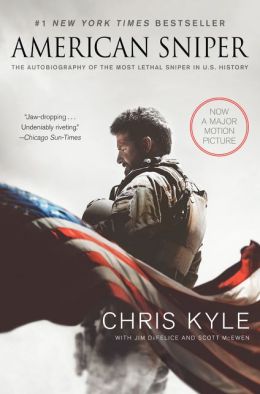
American Sniper by Chris Kyle coverOkay, I admit, I have a tendency to do certain things backwards. Hubby laughs at this one: whenever I pick up a magazine, I thumb through and begin reading somewhere near the back. I sometimes do that with catalogues, too. Why? Because the snazzy pictures are in the front, and the words are in the back. I like words.

American Sniper, the movie, is in theaters in my area of the country as I write this, which means it is the perfect time for Pam to read the book! Chris Kyle’s exploits are apparently quite controversial, based on the reaction to the film, but I did not find it so much controversial as conversational. After I finished, I felt like I has spent a while talking with this Texas cowboy turned Navy Seal, who loved guns and his country enough to go back into a war zone, over and over.

Why is Kyle’s career a controversy? There are those who feel that Americans were invaders in Iraq. Okay, I see that. A little bit, anyway. Any war on foreign soil will have that aspect. And there are those who feel that being a sniper, hiding behind a big rifle with a bigger scope, is a cowardly way to fight. That I don’t get, at all. Guerilla warfare is not new. And, in the war in Iraq, with insurgents attacking government installations and convoys, having a sniper on every tall rooftop made a lot of sense. As he often puts it in the book, Iraq was a “target rich” environment. His recorded number of “kills” is far above any other sniper, and he is matter of fact in explaining that his accomplishment was in part due to being in the thick of things for four deployments.

Kyle’s story, which begins during his childhood in Texas, is entertaining and quintessentially American. When he discusses the war, it is the voice of a military man, explaining what happened from his point of view. Also of interest are brief interludes where his wife, Taya, discusses what was happening from her perspective. This gives the story more depth because modern warfare can happen so far away that the combatant’s home country is isolated from the realities of war. The price paid by the family is made quite real through her observations.

If you haven’t read Kyle’s autobiography, you might want to give it a try. Although it becomes a bit repetitive, because what he did on a day-to-day basis didn’t change all that much, his voice is strong throughout the book, and Chris Kyle was a man’s man in a country that has, by and large, gone soft.