The Crown— review and commentary

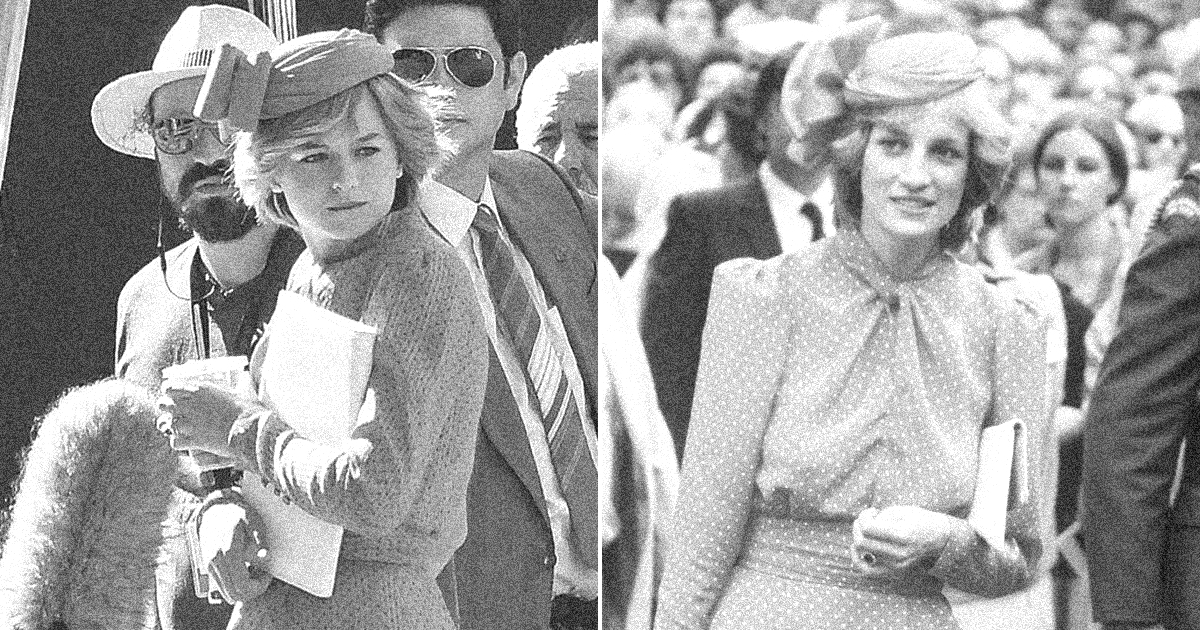
Which is which?

Netflix has some amazing original content, and one of its best efforts thus far has been The Crown, a somewhat fictional series based on the reign of Elizabeth II. Written and produced by Peter Morgan, this series begins while Elizabeth is still a youngster, but when her father takes over for his brother (who abdicated the throne so he could be with his “commoner/divorcé” lover) Elizabeth becomes the heir to the throne. From that time period, her father grooms her to serve the people and the royal family, a/k/a The Crown. Seasons 1 and 2 feature Claire Foy as Elizabeth, and former “Dr. Who” Matt Smith is Prince Philip. Perhaps the best performance in this award winning season goes to John Lithgow as an aging Winston Churchill, who guides and yet admires the young monarch as she works to live up to the responsibility thrust upon her when her father dies at a fairly young age.

The Crown does a fantastic job of intertwining history and some suppostion, thus educating a new generation about some of the most important (or at least entertaining) events in United Kingdom in the past few decades. Each season spans several years, so the cast changes in order to better show the aging of the characters. For instance, while Claire Foy is Elizabeth in the first two seasons, the queen is portrayed by Olivia Coleman in seasons three and four. The latter dropped onto Netflix November 15, and Coleman does a really good job as the middle aged sovereign, as does Gillian Anderson as Margaret Thatcher. Another season four cast addition is Emma Corrin, who bears more than a passing resemblance to young Princess Diana. The series has been mostly been praised, but season four is a bit more controversial. Since this season portrays the “fairy tale romance” between Prince Charles and Diana, then quickly lays out the conflicted marital mess that ensued, because apparently Charles didn’t love Diana at all, but maintained his relationship with his former lover, Camilla Parker-Bowles, during most of the marriage, some viewers (and those close to the real people) have been a bit riled.

Of course, Prince Charles and Princess Diana separated then divorced, but younger fans apparently didn’t realize the “why” in the divorce until The Crown brought this back in a big way on the small screen. Recently, the social media accounts of Prince Charles and (now wife) Camilla have been inundated with snarky posts. Furthermore, officials in the U.K. have asked producers of The Crown to assure the public that the show is fictional.

History only works after the fact. Peter Morgan (series creator and chief writer) benefits from the many publications about the British royals, and is able to pick and choose what he presents to the audience in The Crown. Mostly the characterizations and storylines seem spot on, but those close to the royal family point to discrepancies, and no doubt some “fiction” does come in. Regardless of these points, The Crown has extraordinarily high production values. The cast is first rate, the scripts mostly entertaining; and the sets, costumes, and locations all contribute to the feeling of being an eyewitness to history. If you haven’t seen it yet, this series is one of the very best shows on Netflix.

Last Stand series by William Weber—review and commentary

Last Stand: The Complete Box Set

From time to time, I’m offered a “box set” of eBooks, which strikes me as funny as there is obviously no box, just a longer than normal eBook. While these often seem to be great values, I seldom read an entire series. Last Stand is different, because I did indeed read all four books, and while I enjoyed them, I liked each one a little less, but that’s just me and what I Prefer to read, rather than any flaws in the books themselves.

Book one, Surviving America’s Collapse, was so suspenseful that I read it in less than 24 hours. Apparently survivalist/prepper books are a sub-genre, but this is my first such book. Viewed simply as fiction, readers might be annoyed, as the narrative often becomes pedantic, teaching survivalist techniques to the reader, but I rather enjoyed those segments. In short, the story begins with the hero, former Army officer John Mack, being the only guy in his neighborhood who understands that the vehicles, phones, and other conveniences aren’t working because some entity set off an “EMP” device. Mack rescues his wife, then his children, thinking they will soon retreat to his survivalist hideaway cabin, but his wife convinces him to remain in their neighborhood, to assist their friends. This proves to be increasingly difficult, as resources dwindle and nefarious elements attempt to takeover their community.

Book two, Patriots, begins in the second setting, the Mack family hideaway. The canvas of conflict widens a bit in this book, as Mack realizes the scope of the attack upon America, and feels the need to take up arms not just to defend his family, but his country. Book three, Warlords, is a bit darker in tone, as the forces behind the attack upon America begin divvying up the country. Book four, Turning the Tide, is on a grander scale, as Mack is one cog in the military effort to fight back against the foreign powers that seem to have figured out how to conquer the United States.

Each of these books has a fictional story, but invariably the author uses his story to also instruct the reader. Those who like lots of details about the military and/or weaponry might like these books more than I did, but I did enjoy them. Some of the characterizations are fairly stereotypical, and sometimes the main characters are able to overcome situations which would probably be hopeless without the assistance of the author. So, suspending one’s disbelief a bit is a necessary skill for staying with the series. Still, the suspense is sufficient to keep the reader turning the pages.

Survivalists, military buffs, and those who enjoy suspense will all find something to like in Last Stand. As of this post, the price for the eBook set is three bucks, which is a down payment on a hamburger! I can’t think of anything as entertaining as these books for that price, so take a look. These books are also available in paperback and as audio books, and all have hundreds of ratings on Goodreads, mostly 4-5 stars.

Semi/Human by Erik Hanberg—review and commentary

A Y/A science fiction yarn

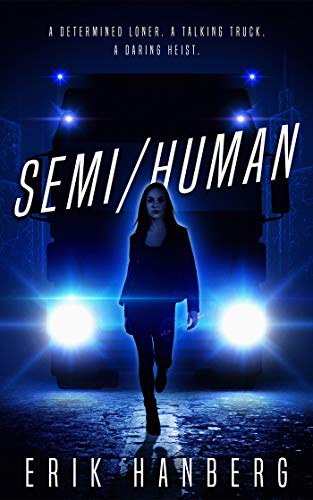
As the pandemic has continued to plague businesses, many of them are accelerating their transition to robots and artificial intelligence, thus replacing or supplementing their all too frail human employees. Semi/Human is set in the near future, and in this novel Silicon Valley has finally written an adaptable code that makes most human employees obsolete. Vehicles drive themselves, dealers in Vegas are all robots, police have been replaced by armed drones, and so forth.

Main character Pen(ney) Davis is more than depressed, because like most other human jobs, her intern job at a Silicon Valley computer firm has been eliminated. However, Pen has come up with a less than practical scheme to steal a ridiculously expensive treasure from her former employer and get rich enough to care a lot less about being unemployed.

As Alexander Pope once observed, “A little bit of learning is a dangerous thing,” and recent intern Pen re-writes the code of a self-driving truck, intending to hijack it for a trip across the country, but ends up making the aforementioned truck autonomous instead. Fortunately for Pen, the truck, Lara B, is both friendly and grateful.

Lest I ruin this tale for readers, let me just say that this yarn is cogent, examining the societal damage which would ensue if gainful employment ceased, as well as the ethics of dealing with a self-aware, nearly omniscient super computer. There’s a dash of economic reality sprinkled in as well, because with no work, there’s no money coming in for the vast majority of the populace, so they end up fighting over whatever is left behind in the technological revolution.

There’s also more than a little suspense, as Pen and Lara B join forces to accomplish the original mission, wherein Pen hopes to acquire both riches and revenge in one fell swoop. Semi/Human is one of those rare books that blends a cautionary theme with an entertaining plot. Most of the characters are well drawn, and there is sufficient description of settings to keep the reader entertained but the plot never bogs down.

As a frequent reader of science fiction, it is rare for me to call a novel memorable, but for me Semi/Human is such a book. Perhaps I simply read it a the right time, or perhaps the book is really that good. If you like youthful, sassy heroines, self-aware computers (and trucks) along with a suspense filled story line, you really should try Semi/Human.

Seduced by the Sea Lord by Starla Night—brief review

A while back, I purchased (at a reduced price) the box set entitled Lords of Atlantis books 1-4, but the review is for Seduced by the Sea Lord, as that was the only novel I read. Quite frankly, it took me a while to read it, because it wasn’t very good.

Here’s the book blurb: “Determined warlord Torun cannot wait to claim Lucy, who mistook him for a shipwreck survivor and pulled his injured body from the ocean. All his instincts tell him she is his soul mate. Now she must join with him and give him a child. 

Lucy can’t believe the words coming out of this dominant male. He insists her destiny is to become a mermaid queen and mother to his future children. The one thing “destiny” forgot to mention was that Lucy’s a broke divorcee who can’t even have a child. 

It’s really too bad, because his gorgeous lips are all too kissable, and she’d love to see his iridescent gold tattoos moving as he flexed those broad, hard pectorals under the water…”

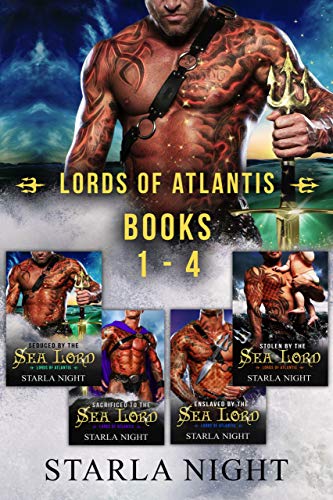
This cover image is for the set; I am reviewing book 1

There are a bunch of five star reviews for this set, by Starla Night, and one reviewer who rated the set at one star accused the others of being “paid reviewers.” Darn, I wish I could afford to pay some of those reviewers to put up five star reviews of my novels. Maybe I’d make some bank, but I’m too honest. Or poor.

Anyway, back to the review. The point of view character, Lucy, is chick-lit cute in her narrative. The alpha male hero is appropriately madly in love with Lucy. The bad guy is Lucy’s ex, and he is cardboard cut out bad. Many gals dislike their ex, but Lucy’s guy stole her money, her ideas, and her dignity. Yep, he’s bad, all right, but some how I didn’t hate him. Nor did Lucy’s grousing about him endear her to me.

The trappings of “mer” vs “human” seemed alternately implausible or just plain silly, which didn’t help the novel at all. In a word, this novel seems phony. I have three more books in the set, but unless I am stranded on a desert island with nothing else to read, I rather doubt I will re-visit the Lords of Atlantis.

Toxic Charity: How Churches and Charities Hurt Those They Help— review and commentary

ToxicA friend who works on the staff of a large church recommended this book to me, and while it lacks sufficient support for some of the concepts, the principles are sound. Basically, the title says it pretty well—whether just throwing money or a week of unpaid labor at poverty—this act of charity might do more harm than good.

Author Robert D. Lupton has plenty of experience in urban ministry, and he cites many examples from his experience in Atlanta, Georgia, which is where he lives and works. But, as I have seen lots of churches gather a group of volunteers for week long “mission trips” I was fascinated by the story of a church in Mexico that was painted six times during one summer, by six different sets of volunteers. Indeed, what the author terms “religious tourism” is big business. He states that in 2005, $2.4 billion was spent by 1.6 million Americans, who traveled abroad for short term mission trips. My favorite statistic: “The Bahamas, it is estimated, annually receives one short-term missionary for every fifteen residents.” Okay, I have never traveled abroad on a mission trip, but the Bahamas sounds like a great place to visit. (My daughter mentioned knowing of a local church that did a mission trip to Ireland. Sounds heavenly!)

Lest readers get the idea that all Lupton does is make the good hearted look either mis-guided or just plain stupid, he does mention that many people set out on these trips with good intentions. Then he explains that in the third world, a little bit of money spent properly can do quite a lot. He explains the use of “micro loans” which can give a struggling person a needed hand up. For example, a $50 loan to a woman in Nicaragua allowed her to buy a sewing machine so she could ramp up her production of baby clothes. Once she paid off the loan, she still had the increased earning capacity.

In the U.S. many churches and other charities give away certain items. One example was giving holiday presents to needy families, but the fathers in such situations are often embarrassed that they can’t match the generosity of the well meaning givers, and are thus emasculated in front of their wives and children. Another example was a food bank, wherein the recipients had come to view the handouts as entitlements, which the author then contrasted with a food co-op, where members paid a small ($3) membership fee, and the members then gathered food from free or discounted sources, set their own rules for distribution, and so forth. The co-op helped the members but did not demean them or destroy their work ethic.

Toxic Charity is a bit controversial, but the U.S.A. is one of the most generous nations which has ever graced this planet. Unfortunately, just throwing money at problems can actually make things worse. This book is a must read for anyone who is involved in charity work, faith based or not, because it explains the problem but gives some good guidelines for better ways to help without hurting the recipient or wasting effort and money.

The Night Manager (television series)—a brief review and commentary

managerOften, the best stories begin as, well, stories. Before The Wizard of Oz was a groundbreaking film, it was a book by L. Frank Baum. Before 2001 A Space Odyssey was an influential science fiction film, it was a book by Arthur C. Clarke. Television series have also been book based, including such diverse stories as Little House on the Prairie, based on a series of books by Laura Ingles Wilder, and Game of Thrones, which was based on a series of books by George R. R. Martin. There are literally dozens of others, but I’m going to discuss one that you might have missed: The Night Manager, based on a book by John Le Carré. A friend recommended this six part series, and we usually enjoy the same sorts of stories.

The Night Manager is currently on a streaming service offered by a large online reseller, the one that starts with an A. Originally, however, the series was made for British television and shown in the states on AMC. As I don’t subscribe to cable, I missed it there, but my hubby and I saw this winner of three Golden Globe awards recently. The plot, although updated a bit from the 1993 novel, is intricate enough to puzzle, but not nearly as confusing as modern teleplays tend to be. The direction is subtle but sure. The acting is simply outstanding, with a star cast including Hugh Laurie (who starred eight seasons in House M. D.) and Olivia Coleman (who dons The Crown in seasons 3 and 4 over on Netflix.) The main character is brought to life by Tom Hiddleston, who has several Marvel movies as well as a video game in his resumé. This series was rather expensive to make, by BBC standards anyway, and was filmed in Egypt, Morocco, Spain, Switzerland, Turkey, and the United Kingdom.

Here’s a bit of plot summary: A former soldier for the British army, Jonathan Pine, is portrayed as the night manager of a Cairo hotel as the story begins. He gets involved with a mysterious guest who is the girlfriend of a local gangster. Through her relationship with the gangster she has acquired information linking illegal international arms sales with Richard Roper (Hugh Laurie), an English billionaire. Just after leaking information regarding the illegal arms, she is found murdered.

(Minor spoilers ahead)

Fearing for his own life, Pine flees, and is next seen, a few years later, doing the same job at a remote hotel in Switzerland. When super villain Roper visits the Swiss hotel, Pine longs to have some revenge, and soon he is enlisted by British Intelligence to spy on Roper. Before long, he has a new identity and an opportunity to infiltrate the small network of arms dealing. Getting information out, while staying alive and undercover is quite a challenge.

One reviewer called it a “classy thriller.” That nails it, but do check out this amazing bingeable series.