Rich Man’s War— a review

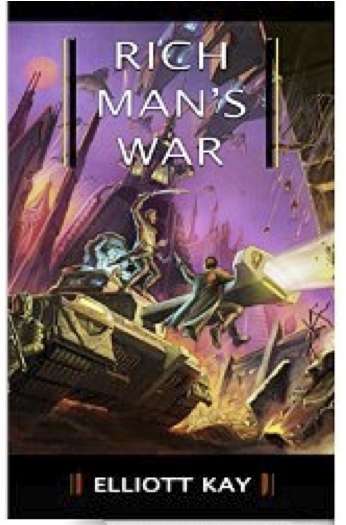
Rich Man's War cvrA couple of entries back I reviewed Poor Man’s Fight by Elliot Kay, and I really did like that book. Okay, in part, I liked it because it is in one of my favorite sub-sub-genres— a coming of age military science fiction story. But, that book was well-written and highly entertaining, and such books are sometimes too formulaic. Rich Man’s War is the sequel, and it does take up shortly after the events of the first novel in this series. The action, once it really gets going, is almost non-stop in PMF, but RMW is a more complex story, so it doesn’t move with the vim and vigor of the first one. Worse, it is quite easy to get bogged down in the “who is this part about, friend or foe” because the battles are large scale, so the cast of characters has grown exponentially.

Still, I am glad for the sequel to PMF. Somehow, readers just knew that Tanner Malone had a career ahead of him, and there is a natural desire to see the character evolve. Both Tanner and some subordinate characters from the first novel are important characters here, but in this entry, the corporations which have pretty much made Archangel inhabitants into economic slaves are the enemy. The plot development is organic, that is, what happens in this novel often has roots in the first one. I do not believe that RMW stands alone particularly well, so do read the first book first.

That said, I did enjoy the further adventures of highly decorated war hero Tanner Malone, and it is a good read if not a great one.

Going, going, almost gone

TrinitycoversmThe Whiskey Creek Press version of Trinity on Tylos is about to become a bit of a collector’s item. When it was first published, I was mostly pleased, although the final edits were rushed and far too many mistakes made it into the print copy. The paperback was not of the best quality, either. The ebook, at least the one I got from the now defunct Fictionwise, was far worse. What few royalty reports I received indicated low sales, and even lower royalties. At one point, I was getting seventeen cents per ebook sale, and a typical quarterly check was about five bucks.

When the book came out, in 2006, I sought out speaking engagements, author-guest slots at science fiction conventions, and I did quite a bit of internet promotional activity, hoping to help Trinity find an audience, and to do my part to help sell the book for WCP. By 2007, I realized that the sales were not going be as good as my self-published debut novel, so I spent far less time promoting it. But, WCP continued to be a disappointment, too. Just to get Amazon to list it, WCP required that I purchase two copies at full price; then, initially, the title was misspelled on Amazon’s website. Eventually, the print book was listed correctly, and I did have a couple of very good reviews on Amazon, as well as several from other sources. When Amazon’s Kindle format began to take on increasing importance, WCP indicated that eventually all of their titles would be available for the Kindle. While Trinity on Tylos was available for the Nook, it was never converted to Kindle format. My original contract was for two years, but I did not ask for my rights back, in part because I hoped WCP would eventually pay me more royalties, and that they would support the book. And, to be honest, I was very busy with my adjunct instructor job, as well as being mom to teenagers, so I didn’t push either promotion or accountability from WCP.

After years and years of zero communications regarding sales, I can only conclude that either there were no sales or WCP kept all of the royalties. I will never know which. I’ve maintained a website, with promotional materials, links to vendors, and so forth, at my expense, and I finally came to the conclusion that WCP was never going to pay me anything ever again. Anyway, I did ask to have my rights back at the end of last year, via email, and there was no response. I asked again recently, via snail mail, and while I still have not heard a word from WCP, I noticed today that Trinity on Tylos is no longer listed for sale by Whiskey Creek Press nor by Barnes and Noble. Amazon still has it for sale, but they list the one lonely copy, and I do remember that I paid for it in 2006. I’ll bet it is quite shopworn by now!

Fellow WCP authors are in a bit of an uproar, because WCP has been sold to a New York firm, Start Media. Some of those other authors have suggested that I self-publish it, as they are doing with their own books, and I have talked with Booklocker about doing the formatting and cover. Since I don’t have a clean copy of the manuscript, I’ll be doing some editing before doing anything else.

In the meantime, Whiskey Creek Press is going, going, soon to be gone. Various interent sites have chronicled the demise of this small press, and much of the dirt is recorded here. For whatever reasons, I’m sad, which is illogical, because the publisher hasn’t been paying me or even bothering to respond to email. And there is little solace in knowing that I am not the only author that they deemed not worth a simple email.

Honor Harrington—revisited

Image

Quite a while back, when I decided to abandon the best seller list and read what I like and only that, I first read David Weber’s Honor Harrington series. Back then, I had a membership in a “Science Fiction” book club, because the internet, as a commercial arena, was in its infancy, so I learned of new titles and authors via the club “magazine” which was, of course, a monthly sales brochure. I began with In Enemy Hands and, quite frankly, I didn’t like the book all that much. The author seemed to spend many more pages focusing on characters and events which were not about the intriguing protagonist, Honor Harrington, and there were so many concepts that I didn’t understand, such as why she had a “treecat” perched on her shoulder, and why everyone was so horrified when the bad guys tried to kill it. Clearly, there was more back story than I was understanding, so I used my dial-up connection and learned that I’d entered a series that was already several books long. I slogged through the book, thinking that I’d have to figure this out, and later I did order On Basilisk Station from Amazon, and met a younger Captain Harrington, as she takes her first starship command, into a backwater area with a bit of backstory, political intrigue, and lots to admire in the main character. But, that book didn’t make me stay up half the night, either. BTW, when I book robs me of sleep, I know its really good.

Still, this Harrington lady was undoubtedly worthy of more of my time, so I moved on to The Honor of the Queen. That one was a homerun, out of the park. When Honor loses her mentor and risks everything to save the beautiful yet backward plant of Grayson, I could hardly turn the pages fast enough. Often, sophomore entries in series are weak, but not in this series. Weber’s heroine moves through space, time, and political intrigue in the next entries, The Short, Victorious War and Field of Dishonor, a weak book if read outside of the series, but important in the complete story line, then The Flag in Exile, which is my second favorite of the series, perhaps because Honor saves Grayson again. Or maybe its the scene where she cuts an enemy “from the nave to the chaps” with a later day version of a samarai sword, in front of the ruling body of the entire planet. Then, Honor revisits both friends and enemies from the debut novel in Honor Among Enemies, which also has a strong story line. Only after these six rather lengthy novels is the stage set for the rather dark entry, In Enemy Hands, which was my introduction to Honor Harrington. When I read it again, after reading the first six books, I liked it better, but it is still a dark chapter in Harrington’s long life.

Recently, I picked up the second book, The Honor of the Queen, as a Kindle Freebie from Amazon, and I was hooked all over again. In the past couple of weeks, I re-read it, plus books 3, 4, 5, and 6 in the series. Since I know how it all comes out, well, up until book 11 or so, when I quit reading the series, my zeal for Honor’s exploits is fading a bit. However, anyone who likes military science fiction, or merely a strong heroine, would probably enjoy Books 2-6 of Weber’s Honor Harrington series. As the series has grown longer, it has attracted more and more fans, so there are a number of reviews and sites where readers can learn more, such as the Honorverse Wiki. Honestly, there are few authors who have Weber’s talent, and almost none who have it plus his level of productivity, for in addition to the Honor Harrington series, he has other series, along with some great stand alone novels such as Apocalypse Troll and In Fury Born.

How can I summarize David Weber’s contribution to science fiction? To my pleasure reading? How about, “Wow!”
Voyage Through the Stars—and Back in Time!

Image

My husband stumbled upon an episode of “Star Trek Continues” and after just a few minutes, we were hooked. This upscale “fan film” site is really something to see. There are only a couple of full episodes, but a fully funded Kickstarter campaign from last year should fund at least a couple more episodes. We really liked the loving homage of this effort. Seeing new episodes with the same music, similar storylines, familiar costumes and props, and amazingly original looking sets make this nothing like the “reboot” movies.

These free online videos, which do include some shorter “vignettes” are made by a not-for-profit-entity, filming in Kingsland, Georgia, in a warehouse with 10,000 square feet of sets built to look just like the sets from 40+ years back. The actors do not just dress and look somewhat like the original series characters, but add their own interpretations as well. And, get this: the actor portraying Chief Engineer Scott is James Doohan’s son, Chris. That casting choice is far more authentic than the reboot’s Simon Pegg. Kirk is portrayed by Vic Mignogna, a voice actor and director, and Todd Haberkorn is Spock.

At first, seeing these different actors portraying well known (and loved) characters seemed odd, but after a few minutes, we were more interested in the story line than the actor’s faces and voices. There are some new characters, too, as the premise is that STC is telling the tales from years four and five of the “five year mission” that was only three years long in the original series. Had the series continued, no doubt new characters would have come along, so this concept works well.

Fans of TOS should check out Star Trek Continues, because it is quite entertaining. My husband and I are hoping for many new episodes. And, as residents of Georgia, we are wondering if they are going to have another open house, as they did a couple of years back. I’d love to see those sets!

Rogue Program by Darrell Bain

One of my favorite eBook authors is Darrell Bain, and his Savage Survival is one of his best yarns. So, when I noticed that Rogue Program was a sort of a sequel to SS I purchased it. (I linked my old review on Amazon to the previous title above, so I am not going to rehash the plot here.)

What Bain did with this one is similar to how David Weber decided to flesh out another of my favorites, wherein he took the fabulous Path of the Fury and added enough material to make a megabook, In Fury Born. Quite frankly, I never finished Weber’s rewrite, which contains a prequel. In Rogue Program, Bain does it the other way, the reader begins with a brushed up version of Savage Survival, and ends with additional material to form the sequel part.

I am not going to say that Bain ruined it, but I did have trouble finishing. Ironically, I enjoyed the opening section quite a lot, even though I had already read it. When he gets to the new material, the story keeps moving, but becomes rather boring. Scratch that; at times it is exceedingly boring, for when the survivors from SS return to earth, they more or less conquer it, and then they have to govern it. Here is my analysis of the book:

Surviving= excitement.

Conquering= some excitement.

Governing=boredom.

The price for each book is the same, so buy Rogue Program and read until you get tired of it. I’m betting most readers will give up two-thirds of the way through. I did finish, but it was a Herculean task.

Cinder— a review

Young adult fiction is the best place to look for new ideas, or old ones wearing new garb. Marissa Meyer’s Cinder is the latter, as it is a science fiction version of Cinderella. The reviews were fabulous, so I purchased the eBook version, and promptly pushed it aside. Part of me wants to dislike YA, since I skipped into the adult section at the local library while I was in the seventh grade. Instead of beginning Cinder, I read a nifty self-help book called the $10 Root Cellar: And Other Low-Cost Methods of Growing, Storing, and Using Root Vegetables (Modern Simplicity). Yeah, I know, I can’t quite believe I read that one either. But, hubby and son have been watching a bunch of YouTube vids on how to survive a time WOROL (without rule of law) and/or zombie attacks. And, I don’t know about everyone else, but if I am staying cooped up, I want something to eat!

Okay, okay, I digress. So, having learned all about burying an old fridge to store root veggies in (for that zombie apocalypse), I pulled up Cinder on my iPad. And, almost immediately, I was hooked. The character is amazing; Meyer has so skillfully drawn her, that I can just see her stuffing her grimy gloves in a back pocket. And, yes, there should be little suspense. How many times did my kids watch the Disney version of Cinderella? Not to mention my reading the Golden Books version to my daughter. She used to call the stepsisters, “the uglies.” How cute, right? So, I know the plot.

But, while Meyer’s tale is sorta/kinda true to the traditional tale, there is sufficient deviation to give the reader some suspense. And, the narrative is pretty good, but the characters just about jump off the pages. Especially Cinder, who is a cyborg with a mean stepmom, two flighty “uglies” A/K/A stepsisters, and an android or two for good measure. The queen of Luna is perhaps the best villainess I have read about this year. Maybe this decade.

Others have noted that the Oriental overtones seem to be grafted onto the story, and that is a valid criticism. But, I am not sure that the storyline would have worked at all if the characters had been more realistically Oriental. This yarn is the first in a series, and I am looking forward to revisiting Marissa Meyer’s retelling of traditional stories.

So, even if you don’t get into re-tellings of fairy tales, if you like gritty science fiction, you might just like this story. And, if you do like re-tellings, this one is very good.