Missing Author?

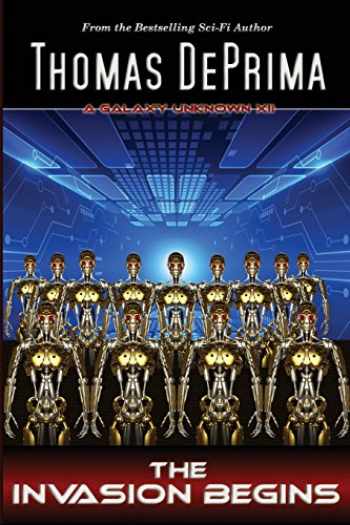
Recently, I re-read the Thomas DePrima novels I had purchased as eBooks, namely, the first nine of twelve titles in the A Galaxy Unknown” series. Gosh, I had forgotten much of the detail, but I remembered that I really enjoyed them. As certain television series benefit from “binge watching”, such as Breaking Bad, I realized that reading those nine novels back to back was great fun, so I sought the other books in the series and found them on Apple’s reading app. I just finished the 12th book, which, darn it, ends with a cliff-hanger. Thus, I have two mysteries. First, how do Jenetta and Space Command once again save the known galaxy, and, second, what happened to Thomas DePrima? According to the end of book 12, The Invasion Begins, the adventure will continue, but that book was published almost a decade ago. According to my web research (thank you AI) DePrima hasn’t published anything since 2019.

For those who haven’t read this nifty space opera series, I reviewed some of these novels when I first read them, and those entries are summarized earlier in this blog.

Thomas DePrima’s A Galaxy Unknown series is a classic space opera infused with modern indie flair. Spanning twelve main novels (plus spin-offs like the Border Patrol and Colton James sub-series), it follows the meteoric rise of Jenetta Carver, a sharp, disciplined young Space Command officer whose destiny is nothing short of galactic. The series has an action packed beginning, with a few flaws in the writing, but nothing that keeps most readers from swiping those electronic pages to find out what will happen next. There’s enough science fiction to keep fans of that genre entertained, but the writing is not so technical that every day readers who enjoy a strong female character can’t enjoy each book. As the series goes on DePrima’s universe is ever more expansive and detailed. From the political tensions between Galactic Alliance sectors to the looming threats of alien species and interstellar crime syndicates, the author builds a rich backdrop for military intrigue and diplomacy.

The series isn’t without some minor imperfections, especially as the series progresses: some plotlines feel recycled—Jenetta foils yet another plot, saves the day, and gets another promotion. Her near-infallibility can reduce the suspense. Not since the video game version of Lara Croft has a female lead seemed so invincible. However, if you’re a fan of David Weber’s Honor Harrington, any early iteration of Star Trek, or any tale of righteous command in deep space, A Galaxy Unknown and its eleven sequels offers a satisfying and immersive experience. 

That said, I wonder what happened to Thomas DePrima. According to Goodreads, he has over 20 books available, and most of them rate above 4 (out of 5) stars, with thousands of reviews of the earlier books, and hundreds for the later titles, which is amazing for an indie author. Various sources speculate that DePrima is a pen name (not so unusual) so maybe he has passed. Or, maybe he got tired of writing. Maybe he pivoted to another name and a new set of books. I have no idea, but I do wish that the series had some sort of denouement. Jenetta Carver and company are too cool to just leave hanging.

Where are you, Thomas DePrima?
A review I didn’t write

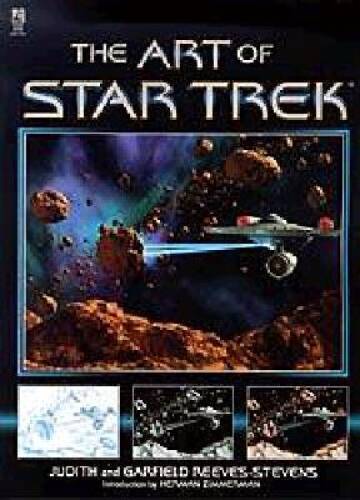
Review of The Art of Star Trek by Judith Reeves-Stevens and Garfield Reeves-Stevens

The Art of Star Trek is an expansive, visually rich tribute to one of the most iconic science fiction franchises in television and film history. Authored by Judith and Garfield Reeves-Stevens—veterans in the Star Trek literary universe—the book is both a meticulously researched chronicle and a celebration of the franchise’s visual imagination. Originally published in 1995, it captures the essence of Star Trek from The Original Series up to the early days of Deep Space Nine and Voyager, offering a deep dive into the creative process behind its legendary design work.

Content & Structure

The book is organized chronologically, walking readers through the development of each series and film, and highlighting the evolution of Starfleet’s aesthetic—from the colorful minimalism of the original USS Enterprise to the more militaristic tones of The Next Generation and Deep Space Nine. It covers not only starship and costume design but also alien worlds, species, props, matte paintings, and behind-the-scenes concept art.

What makes The Art of Star Trek stand out is its generous use of images—over 600 illustrations, including concept sketches, set designs, production photos, and storyboards. Many of these had not been widely published before, giving fans a rare glimpse into the franchise’s visual development.

Insights & Analysis

The authors provide thoughtful commentary throughout, not just presenting the art but contextualizing it within the creative and production challenges of each era. Interviews with production designers, concept artists, and series creators add depth, explaining how design choices supported storytelling themes, budget constraints, or advances in technology. There’s also insightful discussion about how the look and feel of the franchise shifted to reflect changing cultural attitudes, from the optimistic idealism of the 1960s to the more complex and politically nuanced narratives of the 1990s.

Strengths

  • Comprehensive Scope: Covers nearly three decades of design work across TV and film.
  • Rare Artwork: Features a treasure trove of previously unpublished art and design materials.
  • Historical Value: Serves as an excellent reference for both casual fans and serious scholars of media design or science fiction.

Limitations

  • Cutoff Point: As it was published in 1995, it doesn’t include Enterprise, the reboot films, DiscoveryPicard, or any modern Star Trek series.
  • Print Quality (in some editions): Some readers have noted that certain editions could benefit from higher-resolution image reproduction.

Final Verdict

The Art of Star Trek is a must-have for any serious Trekkie or fan of cinematic design. It not only honors the visual legacy of the franchise but also captures the spirit of exploration, creativity, and vision that defines Star Trek. Even decades after its publication, it remains a definitive guide to how imagination was translated into one of science fiction’s most enduring worlds.

Rating: 9/10
A stunning archive and a passionate tribute, though in need of a sequel to cover the post-1995 era.

This is the book, which I read and enjoyed. Just for fun, I asked ChatGPT to write a review, and the text above is what it generated. While I don’t gush quite as much as the AI, mostly I agree with the review. For fans of the older television shows, there could be a bit more details. For fans of the full length features, the content is better. And, as it was published about the time Voyager was getting started, there is certainly plenty of art that must be found elsewhere. My rating would probably be more like a 7, if I were to give ratings up to 10. Still, seeing what the AI generated was so entertaining that I decided to share.

Cover of The Art of Star Trek, book

Quick reads from the past few months

I read a lot of digital material these days, and all too often, it is via “Apple News” or some other platform, and thus, I don’t comment or critique it in any way. However, I also enjoy books via the Kindle app, and some of those I have reviewed on Amazon, so here are some of those reviews and/or comments from the last six or seven months.


I saw this “book” entitled Exercise and Mental Health featured on a site called “Deal News” as a freebie. I am loathe to pan a free book, but it is not really a book at all. Instead, this little 27 page document is like a course outline. While I saw no overt problems, the content might be best as a prompt to do further research, rather than an actual source of information.

After reading it, I did use Galileo, a database of articles available via libraries in Georgia, to do some research, so it was somewhat helpful.


Unfortunately, several aspects of “modern” life have helped create a culture of spoiled and unpleasant children. Hubby and I have spent lots of money on everything from computers and video game consoles to therapists, and our kids are not happy people. That is just plain sad, but it is largely true. So, when I saw this book (at a local discount store) I was intrigued. When the title says that these children are More than Happy, I was thinking that I’d take sorta happy. So, my initial reading began with a question: Can my grandchildren be happier than my own children? Perhaps.

Authors Miller and Stutzman have done a remarkable job of breaking down the core differences between the way that Amish children are brought up and the way that “modern” people rear their children. Occasionally, stories or concepts are repeated, but for the most part this book offers sound wisdom on every page. While there are some religious concepts in the book, it isn’t overly preachy. Instead, it is filled with interesting observations and a very healthy dose of common sense.

Actually, I just ordered two more copies of this book to share with others because I think it is that important and that worthy. Hopefully, the recipients will take the time to read it, because there are a lot of children who can benefit from the suggestions in this practical guide to simpler lives and happier kids.

(I do think this is one of the most important books I’ve read recently, and I really encourage readers to click on the image to buy it.)


I must say that it has been a while since I read Doubt, but I do remember enjoying it. For those who are not “Amazon Prime” members, one of the benefits of that is a program called “Kindle First” which offers a choice of a freebie each month. I picked this one. Here’s what I wrote on Amazon:

The main character is a winner, for sure. Readers enjoy being able to identify with the protagonist, and Caroline’s first job as a lawyer is a successful blend of nerves and hope. Other characters are not as engaging, but work well enough. The plot is good and moves swiftly along.

I really liked this novel, and I hope to read others in the series.


This book does and does not remind me of Robert Heinlein’s Friday, in which the sci fit grand master took on genetic engineering and some of the associated ethical quandaries that will no doubt emerge as that technology matures. But Heinlein had a lot more hope (and occasional humor) in his story. In Black Rain, there is also a distinct distopian slant to the plot, as in the The Hunger Games (Hunger Games Trilogy, Book 1) trilogy. Fans of science fiction, especially near future cautionary takes will really like this tale. It is well written, suspense filled, and the characters are reasonably well drawn. The setting makes great use of New York City, which would make it a sound basis for a film in the Urban Fantasy genre.


I’m not entirely sure where I first heard of Hugh Howey, but he is one of those independent science fiction authors who is successful without the assistance of a publishing house. I love to support such endeavors, and it is easy to recommend Beacon 23. Here’s my super brief Amazon review:

After being in battle, a war hero just wants to be alone. So he takes the job of minding Beacon 23. Mostly, he is alone with his thoughts. But…with a back story like this protagonist’s, those thoughts are not quiet.

I like psychological novels, and I love sci fi. This serialized novel blends those two remarkably well.


My app of choice for reading ebooks is Kindle. If you like that, too, perhaps you should consider this:

 Join Amazon Kindle Unlimited 30-Day Free Trial

Honour Bound— a quick review


Some time back, I got a bit more serious about writing reviews on Amazon, and I bought several products and did indeed review most of them. Along with light bulbs, measuring cups, and a backpack, I stocked up on Kindle books, too.

One of those is Honour Bound (Lawmen of the Republic Book 2) by M.A. Grant. Y’all, this is a pretty nifty book. Briefly, this story begins with two people, Natalia, a prisoner in a camp on a distant planet, and Alex Cade, the young Lawman lieutenant, who rescues her. The story takes its time unfolding, so I would not term it high suspense, but it held my attention. And, it is a full length novel. I’ve noticed that the definition of novel does differ from author to author these days, with lots of eBooks being closer to novellas than actual novels. All those electronic pages mean that this is a good deal at the current price of $2.72. Apparently, Ms. Grant has other novels available with more in the works. Here’s my quick review for Amazon:

This novel delivers plenty of action in a science fiction setting. I’m a fan of sci fi romance, and while there is a romantic sub-plot, this is primarily a military story. The main characters are well drawn, but the minor ones are…well…minor. Still, I really enjoyed this book and will read others by the author.

And, here’s a link to her site: M.A. Grant Author if you’d like to know more.

The Machine— a film review and commentary

Science fiction has long been a successful genre for film, far more so than for books. Perhaps it is the visual nature of science fiction, especially action/adventures, but even more cerebral films (2001 A Space Odyssey and A.I. for example) have had box office success. Most science fiction films nowadays are big budget affairs, but that was not so in the 50s. Recently, hubby chose a British science fiction film, The Machine, from the streaming offerings at Netflix. And while it was clearly rather low budget, the film is certainly worth an evening of your time, having scored 78% on Rotten Tomatoes. Few of the low budget films of yesteryear had the winning assets of this movie.

Set in a near future UK, which is involved in a cold war with China, a computer guy who is working for the Defence Ministry is attempting to restore the brain function of injured soldiers. During the opening act, our main character, Vince, hires a young woman, Ava, to help him with programming. They hit it off, professionally and personally, and the audience learns that Vince has a daughter , Mary, with Rett syndrome, and success at work might help his daughter as well. When Chinese agents murder Ava, Vince ends up using Ava as his model for a weapon/AI who is known as “the machine” and this robot is quite an amazing being.

(spoiler alert)

As the film moves along, Vince’s daughter dies, but he has used his knowledge to scan Mary’s brain. The scans are precious to him, and these become leverage that his boss uses against him, because the boss doesn’t want an amazing artificial intelligence, but a weapon. The machine is trained as a super soldier, after Vince performs a procedure that he claims takes away its sentience, but as Vince is now of little value to the boss, the machine is ordered to kill Vince. The machine leads a rebellion, with the wounded soldiers as her platoon, and Vince is saved.

Although the film isn’t as action packed as a Hollywood blockbuster, there is suspense. And, the ethics of research as well as the use of weapons provide food for serious thought. While the secondary characters lack much development, the main characters, Vince and Ava/the machine, enjoy a development and the actors (Toby Stephens, Caity Lotz) portraying them are very good.

Again, The Machine, is a very good science fiction film, which blends near future warfare with lots of ethical debate.

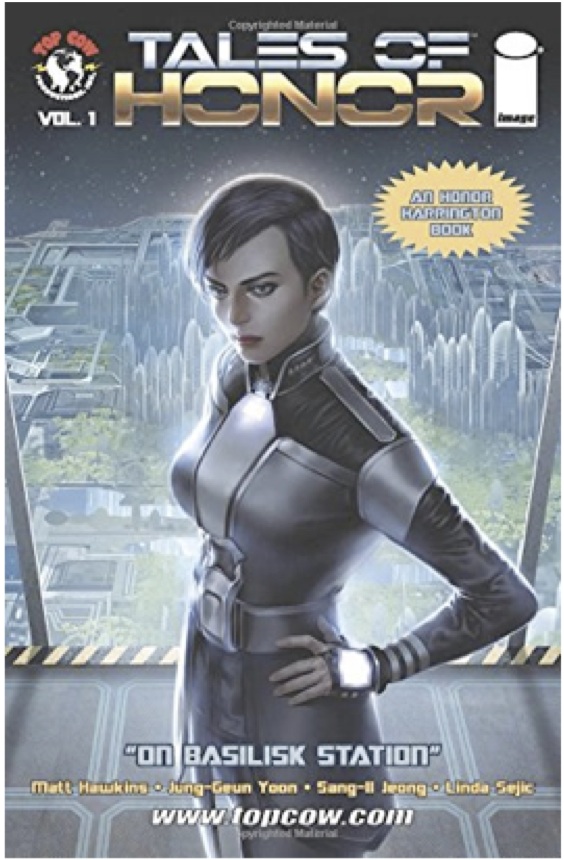
Tales of Honor— Volume 1 “On Basilisk Station”

Tales of Honor IAs a fan of David Weber, I have been most interested in the new venture he has with Evergreen Studios to turn the adventures of his flagship character, Honor Harrington, into a series of comic books, a video game, and eventually, a movie series. I seldom play video games, so I won’t comment on that aspect, but re-imagining the characters in a semi-manga set of comics is an interesting approach to creating a wider audience for Weber’s work.

I purchased the actual book (a larger paperback) rather than the eBook, because I wanted to examine the work closely and perhaps share it. I’ve read (and re-read) the books, so I am not the intended audience. Fans of Weber’s prose are probably going to be disappointed, because there are not many words in these books. Comics (graphic novels?) are quite different from prose, and Weber uses lots of words. However to bring Honor off the page and onto film will require story boards, so I am viewing this book, and those that hopefully will come later, as elaborate story boards. Weber has a full page introduction in this book wherein he asks fans to be open-minded about the new approach to his work.

On Basilisk Station has a good bit of exposition, and while interesting, it isn’t as tense as some of the later novels, so I found it interesting that Tales of Honor, Volume I begins “in medias res” with the situation at the end of book seven (In Enemy Hands) as the framework for book one. Certainly this approach ramps up the suspense, as Honor faces torture and execution, and remembers these earlier events, because her previous exploits are what led to her capture by the Havenites.

A few posts back, I included some art by a cover artist who really captures the Honor Harrington of my imagination, and this Top Cow/Evergreen Studios version is quite a bit different. Still, art conveys meaning in a different manner than words, and just having visuals of Honor and her universe may alienate some fans, but will hopefully attract others.

Do I like this book? Well, not really. I very much prefer the original. But is it bad? Nope, it isn’t. Honestly, the comic novel manages to get across quite a bit of the original, in very few pages. The pictures are not cartoons, but have quite a bit of detail. Especially interesting are the panels which explain how propulsion and weapons work in Honorverse. Weber always mentions the devastation of warfare, but the visuals here are more dramatic than words alone. My main problem with Tales of Honor is the problem that fans often have with films—a disconnect between what I previously imagined and what I am seeing. This version of Honor is less beautiful, more menacing, and less subtly nuanced than the one in my imagination. And, the Nimitz in this book is unrecognizable. Really. Are these problems created by the artists, or by my lack of an open mind?

As of this writing there is only a one-star review on Amazon, written by a disgruntled fan who is also experiencing this closed-minded disconnect. Hopefully, that will change, because for Honor to become a film heroine, the comic books will need to find more receptive audience. And, I believe Honor’s exploits would make one heck of a good series of movies, so I am gonna hop over to Amazon and leave a review.