Little Girl Blue— the Life of Karen Carpenter

Karen CarpenterI’ll admit it, I am getting old. And, apparently, revisiting topics from one’s youth is an interest that older folks have. In the years right before his death, my dad would come home after a lively session at the senior’s center, watch a rerun of Gunsmoke on television, and take his afternoon snooze. While I remember Gunsmoke (along with Sky King, Fury, Roy Rogers, and even Bonanza) I have no desire to revisit them. However, I have a number of Carpenters CDs, because their music is still musical to me. I don’t like to watch the videos (and there are a boat load on YouTube) because their hairstyles and clothing remind me of just how long it has been since those tracks were recorded.

Because she knows how much I love the Carpenters music, some years ago my sister gave me the official biography of the Carpenters by Ray Coleman, which I enjoyed. I’ve seen the tv movie version of their story, which is also on YouTube, along with a PBS special celebrating their music.

Due to inclement weather here in the south, I’ve had more time to read lately, and I stumbled upon a “new” biography, Little Girl Blue— the Life of Karen Carpenter, which was actually published four years ago. This one is “unauthorized,” thus promising to shed some light upon the parts of their story that the Richard Carpenter would rather not have publicized. In some respects, Little Girl Blue delivers.

Most people will want to read this book to know more about Karen (and Richard’s) lives and their music, but some will want to know more about Karen’s battle with anorexia nervosa, a disease that was almost unheard of when she died. Non-fans will probably find it odd that anyone even cares, some thirty years after Karen’s untimely death, but I didn’t care if they weren’t cool in the 70s, and I don’t care now, so I’m interested in their lives, their music, and only a little in the disease that killed Karen.

I’m torn, because in some ways Randy L. Schmidt’s bio, a rather odd combination of the duo’s lives and their musical successes and failures, does succeed, but sometimes it reads like gossip. That is due to his reliance upon “those who knew her.” There are pages and pages of documentation, so there was quite a lot of research that went into this book. But the sources of “new” information are friends and co-workers, some of whom seem glad to finally be heard.

I’m not famous, so no one is going to write my biography, but if someone did, and used Schmidt’s approach, it might read like this: “Pamela J. Dodd did not even use her husband’s name on her books, which infuriated his sister-in-law, who had this to say—” or “in an email a close family member quoted Dodd’s son as saying ‘Rob once said, “Moms the boss…what she says goes.” ‘ In other words, well documented opinions are still, well, opinions.

On the other hand, there are some really interesting revelations about Karen’s financial situation, such as their mother had a trusted friend handle the money and basically put the duo on an allowance, as if they were still in high school. When they finally hired a money manager, there were bank accounts all over the place, because the mother would deposit the maximum covered by FDIC and then open a new account in yet another bank. Even more interesting was the portrait of Karen’s husband as exactly what Karen feared: someone who married her for her money, not for love. The scene where Karen is on the phone, almost hysterical, because the dealer was repossessing the Rolls Royce that her husband had “given” her, lets readers understand her naivete, as well as painting Burris for the gold-digger that he surely was.

Reviewers of this book often focus on the in-depth examination of Karen’s anorexia, especially her relationship with her mother and brother, and some have said that Karen’s mother was unable to say, “I love you” to Karen. That scene takes place in the office of Karen’s therapist, apparently the only therapist that she consulted during an eight year plus struggle with eating disorders, wherein Karen’s mother, Agnes, wouldn’t cooperate with the therapist’s directive to tell Karen that she was loved. In that situation, I might have been both angry and embarrassed, so I have some sympathy for the mom.

Over and over, Schmidt’s book explains the tragedy that Karen’s life became, even before the seemingly inevitable tragedy of her death. If fame and fortune come too early, there can be a terrible price to pay. The entire Carpenter clan was simply not prepared for the success that Richard’s brilliant arrangements and Karen’s amazing vocals brought the family. While Karen paid the biggest price, the whole family suffered, and that is ironic, as well as tragic.
Rogue Program by Darrell Bain

One of my favorite eBook authors is Darrell Bain, and his Savage Survival is one of his best yarns. So, when I noticed that Rogue Program was a sort of a sequel to SS I purchased it. (I linked my old review on Amazon to the previous title above, so I am not going to rehash the plot here.)

What Bain did with this one is similar to how David Weber decided to flesh out another of my favorites, wherein he took the fabulous Path of the Fury and added enough material to make a megabook, In Fury Born. Quite frankly, I never finished Weber’s rewrite, which contains a prequel. In Rogue Program, Bain does it the other way, the reader begins with a brushed up version of Savage Survival, and ends with additional material to form the sequel part.

I am not going to say that Bain ruined it, but I did have trouble finishing. Ironically, I enjoyed the opening section quite a lot, even though I had already read it. When he gets to the new material, the story keeps moving, but becomes rather boring. Scratch that; at times it is exceedingly boring, for when the survivors from SS return to earth, they more or less conquer it, and then they have to govern it. Here is my analysis of the book:

Surviving= excitement.

Conquering= some excitement.

Governing=boredom.

The price for each book is the same, so buy Rogue Program and read until you get tired of it. I’m betting most readers will give up two-thirds of the way through. I did finish, but it was a Herculean task.

Short Reviews of my Summer Reading (thus far)

I’ve read a few new (or new to me) titles, which could all be loosely grouped into the sub genre of science fiction romance. These titles were chosen because the authors are favorites of mine.

First, I read the novella “The Day Her Heart Stood Still” by Susan Grant. This yarn, originally published in a collection, is now available as a stand alone from Amazon’s Kindle Store. Grant’s early works, especially the suspense filled Contact and the light-hearted time travel novel Once a Pirate are my all time favorites by Grant. TDHHSS is just as light-hearted as the latter, but is more like Contact in subject matter. Anyway, it is the story of an astronaut’s encounter with an extra terrestrial, and since the format is short, the love story happens at a whirlwind pace. As I read it, I kept thinking it would have made a great stand alone novel. And, Grant is especially good at connecting with her readers, so she has a neat back story on the story on her website/blog.

Pauline Baird Jones is a fabulous writer, and there are a some wonderful examples of her creativity in her sequel to a sequel, Kicking Ashe. The book which began this series, The Key, is one of my favorite science fiction/romance stories. While I liked the sequel, Girl Gone Nova, I didn’t love it. Maybe it has been too long since I read those yarns, but somehow the Kicking Ashe story didn’t really work for me. However, Jones’ character development and prose is as entertaining as ever, and this story has earned great reviews and a Galaxy award over at SFR. Maybe it was just me….

Another series in this genre that I have enjoyed is by Janet Miller, and it all began with Promises to Keep, followed by the first book I read in the series, Beloved Enemy.  I seemed to have missed Beloved Traveler, but I enjoyed Beloved Stranger quite a bit. All of these books are far more romance than science fiction, but in a day and age when marriage between men and women is more and more ephemeral, the idea of mating for life is something to admire or even fantasize about. Indeed, the whole Gaian concept of “attachment” of males to females is a bit more fantasy than science fiction, but I have enjoyed the stories in this series and I do recommend them to true romantics.

I’ve read a few other items too, but nothing worthy of a review. Still, the hottest part of the summer is yet to come, so I will probably be reading rather than out sweating….

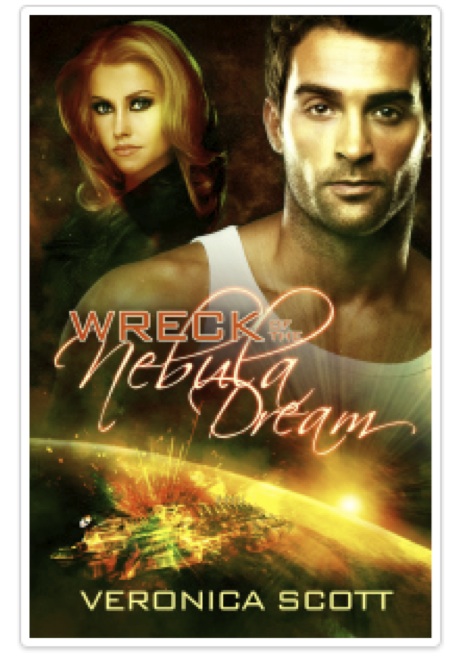
Wreck of the Nebula Dream— a review

Wreck of Nebula Dream coverDo you remember all the obstacles faced by the survivors of the Poseidon Adventure? Did you cringe at the fate of the passengers left to die on the Titanic? Did your skin crawl when reading about the “medical experiments” performed on holocaust victims? I remember those emotions, and they all come into play when reading Veronica Scott’s space opera, the Wreck of the Nebula Dream. This book is one heck of a bargain, and it lacks the usual problems associated with Amazon Digital Services as publisher. The only down side is that something like 60% of the apostrophes are turned the wrong way.

Although not a perfect story, this one is darned close. The hero is, well, heroic, but not arrogant. The heroine is a great side kick. There are kids, a bit of fantasy and magic, and some stock characters, too. The story does take a little while to get going (in media res would have helped this author) but once the disasters start happening, one thing leads to another, and the action is constant. I really liked this novel.

While it is available in print, I read the Kindle version, and I didn’t get much sleep the night I purchased it. That is not a complaint, but I think I need a nap now….

Alarm of War—Best Space Opera I’ve Read Recently!

Okay, the story line is hardly new: green recruit impresses everyone, gets promoted, and saves the day. But, Alarm of War by Kennedy Hudner does have some freshness, and most of the spelling and all of the grammar is correct. That’s saying quite a great deal in this day of self-published ebooks available for the Kindle.

Our main character is Emily Tuttle. Yep, that does not sound like a heroine’s name, now does it? Especially not a military fiction heroine, who should have a big name, like, oh, say, “Honor Harrington.” But, our heroine is Emily Tuttle, and she doesn’t look particularly heroic, being rather small. Oh, and she has a master’s degree—in history. Her best bud in training is a tall Hispanic chick named Maria, who goes by “Cookie.” And the smartest dude in the training group is a geeky guy named Hiram. And what is really odd is that the leadership of the training facility actually recognizes who is smart and acts accordingly. Maybe the government will do stuff like that in the future.

Anyway, the novel begins with background and political intrigue; actually, too much of that. Oh, it helps to know all that as the story moves along, but it might be better dished out in the middle of the story. To be honest, I did not get interested in this novel until a royal despot kills a lawyer and uses him for decor. Then, I got interested, and I stayed interested. Just when the reader believes that he or she knows exactly what is going to happen, something comes along to shake things up a bit and keep the reader turning the pages.

This one ends with a bit of a cliff-hanger, so I went back to Amazon, intent on purchasing the sequel. Unfortunately, Alarm of War was published in August, and there is (as yet) no sequel. Darn.

I hope that Mr. Hudner is busy working on part ii of this yarn. Maybe it will be out by Christmas. Gosh, I hope so.

All Books— $4

News stories about publisher prices come and go; the latest has the U.S. attorney general going after Apple’s iBooks prices. Let me key that in again… Apple’s iBooks prices. Not the New York big six; not Amazon. While I do believe that book prices are as artificial as aspartame, I don’t really believe that Apple is the culprit in price fixing. The attorney general is just doing some election year grandstanding.

As I have stated in previous blog posts, the 800 pound gorilla in book sales in the U.S. is Amazon. Even when Amazon begins charging sales taxes, and that will happen because our government’s spending is out of control; Amazon will still have the lion’s share of new book sales, due to its ubiquitous internet presence and its killer Kindle app. But, increasingly, Amazon is the best way to sell used books, and that is the reason all books will eventually be around four bucks.

I’ve been selling off my home library for a few months now, but I still have the bulk of it, because I have not found a way to compete with the “power sellers” who offer thousands of used books for a penny, plus Amazon’s $3.99 shipping. Thus, virtually any used book is available for a mere $4.

Having moved recently, I packed many, many boxes of books, and I usually check the price for anything that I don’t want to own forever. Most of them are only a penny on Amazon. I can’t make any money on that sale. Here is how the math works for me:

Book price .01

Shipping fees to me 3.99

Commission(s) to Amazon -$1.00 (transaction fee) and -.80 (minimum commission)

Postage to customer -$3.15 (for a book weighing between 1 and 2 pounds).

Thus, I lose $.95 per book, or more if I use packaging that I purchased, if the book sells at the going rate of $4.00. Heavier books will result in a greater loss, because Amazon’s shipping fees do not adjust for heavier items.

So, most of my books either end up parked on a shelf or in the “yard sale” pile. And, I do know that most of those won’t sell at a yard sale, either, so they’ll end up being donated to charity. Therefore, the owner of a used book must either want to keep it, or be ready to toss it.

Tis sad, but all physical books will become used books. So, if you don’t like the publisher’s price, just wait. Eventually, most any book will be available for four bucks.