Twenty-five Years Later

Where were you when __________?

There are some events so powerful that we remember exactly where we were when we heard the news. As youngster, I was in my seat in Mrs. Spratlin’s second grade class when our principal, Mr. Ash, told us that the president, Mr. Kennedy, had been killed in Dallas. My parents were feverishly working on renovations to our new (very old) home, and I rode the bus there, telling them the news. Neither of them knew, having spent the day installing a floor in what would soon be my bedroom.

When Ronald Reagan was shot, I was working as a sales clerk in a lumber store in Winder. We stood around a radio, listening to coverage of that event, remembering the Kennedy assassination.

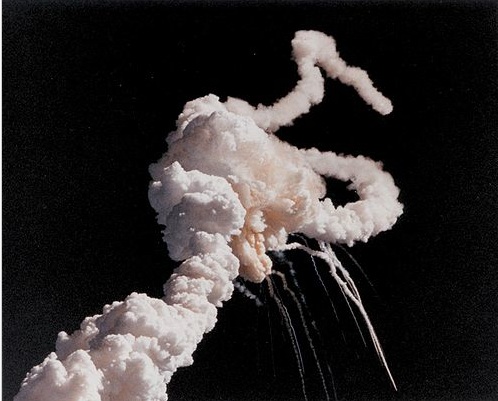
And, when the Challenger blew up, I was at Jefferson High School. It was so cold (below zero) in northeast Georgia that the school had cancelled classes for students, but we had a “work day” for teachers. I was in the business department lab, averaging grades on a calculator, since this was before the proliferation of computers and electronic gradebooks. A fellow teacher stopped by to tell me, and at first I thought she was joking. Space travel had become so routine that it was not particularly newsworthy. That day, however, when I got home, I saw image after image on television, like the one above, and heard the stunned anguish of the friends and colleagues of the astronauts.

That day proved that space travel is still a very risky business. And one person in particular, teacher Christa McAuliffe, represented all Americans that day. There were seven people killed in that explosion, but the others were NASA people, trained for the space program, and presumably ready to risk their lives. But McAuliffe was one of us, granted the opportunity to do her job, teaching, from a platform high above the earth. At first, news outlets showed the unfolding reaction on the faces of McAuliffe’s parents, who were in Florida for the launch, but later, the news outlets became more sensitive to the loss.

Yes, twenty-five years have passed since the Challenger made its seventy-three second journey, and NASA has not fully recovered from the blow. The space program still has no better vehicle than the space shuttle, and in part, that is due to America and Americans deciding that manned space travel is too expensive and too risky. Politicians have gone along with the desires of their constituents to spend the nation’s money on programs to defeat poverty instead. So, if there is to be travel to the rest of the solar system, or beyond, America won’t be the force behind it. I’ve accepted that.

Still, someone, somewhere, will take up the task, because this planet will run out of resources, and there will only be “out there” for man to explore. When Spain, France, and even England ran out of money and gusto, they became lesser nations. The decline of European nations led to America being a “super power” in the second half of the twentieth century. There are many signs of decay here in America, but the lack of any desire to expand beyond these shores, a kind of political egocentrism, is a sure sign that our bright sun is setting. China, which holds much of our nation’s debt, seems to be the up-and-coming power now, so the first man on Mars probably won’t be speaking English.
By Pamela/Pilar Posted in writing

Let them watch Star Trek

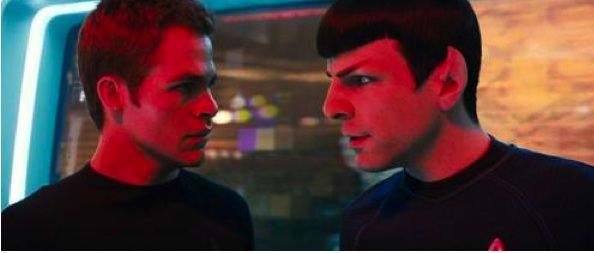
We have had a bout of bad (or good) weather, depending on one’s point of view. This week, we have had a snow followed by freezing rain, followed by enough cold to keep refreezing the roadways. I really can’t recall missing an entire week of classes over a weather event, but that is what we have had. So, in addition to some organizing at home, I have been watching the telly a bit more. I’ve seen both The Wrath of Khan (1982) and  the DVD version of JJ Abrams Star Trek (2009) with Chris Pine as James T. Kirk and Zachary Quinto as Spock in the course of one week. Until now, my favorite film version of Trek was Khan, with the riveting Ricardo Montleban in the title role, and the original series stars reprising their television roles.

As I am old enough to remember the original series in first run episodes, and am still a fan of it, I was skeptical of this new version. Still, JJ Abrams’ Alias was one of the few modern television series that I watched eagerly, so I did indeed go to the theatre to take in this “reboot” of Star Trek. By using the science fiction theme of time travel, and the subsequent altered reality, the script writers were able to retell the story, with fresh new versions of the characters. Yet, for the most part, the film pays homage to the original, and the use of both Leonard Nimoy and Zachary Quinto as Spock (the elderly ambassador and the fresh young Star Fleet officer) helps make the whole thing work.

Any summer block buster needs plenty of top-notch special effects, and this Star Trek does not disappoint in that department. The casting is simply superb, and the script isn’t half bad either. But, I am most happy that this new version did attract an audience of younger folks. The last time I went to see a Trek movie in the theatre (prior to this one) the audience looked like a convention for middle aged science fiction fans, and there weren’t too many of them. My own children, who don’t care for the original series or the next generation versions of Trek, really liked this film. For the concept of Star Trek to go on, it must reach young people, and this one did a great service for the fan base by re-introducing beloved characters and the magnificent vehicle known as the star ship Enterprise.

By Pamela/Pilar Posted in writing

A Perfect Conflict

When I was finishing my master’s degree, the head of the English Department at North Georgia College related to me that some of my professors were concerned that I was just as apt to quote Star Trek as Shakespeare. To this day, and it is has been more than a score of years since I finished that degree, that complaint brings a half-smile to my face. While it was a matter of concern for the scholarly, I have always viewed my ability to blend modern literature with traditional literature as an asset.

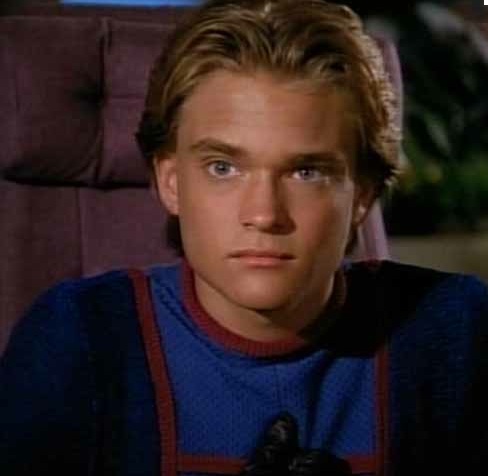
Recently, I was watching a vintage episode of Star Trek, The Next Generation, on BBC America. In Suddenly Human the Enterprise rescues some Talarian trainees from a dying ship. The medical staff of the Enterprise is shocked to find that one of the cadets is a human. Dr. Crusher performs DNA tests and finds that the young man is Jeremiah Rossa, the grandson of a star fleet admiral, who was missing and presumed dead after the colony was attacked by Talarian forces. Since the admiral’s only son was killed in the attack, Jeremiah is her only surviving offspring. Even more troubling, Crusher believes the boy might have been abused, since his body has endured several injuries during the time he has been with the Talarians. The young human calls himself Jono, professes to be the son of Captain Endar, and strictly adheres to Talarian traditions, including a total disregard for women in uniform, which causes quite a few problems for the fully integrated crew of the Enterprise, especially female officers Dr. Crusher and Counselor Troi. Wisely, Counselor Troi suggests the Picard mentor the boy, since he clearly displays affection for “his captain” and Picard reluctantly agrees. Meanwhile, Captain Endar shows up, acknowledges that he rescued the boy and adopted him by Talarian custom, and demands his return.

Picard faces a perfect conflict. On the one hand, Jono/Jeremiah is human, is the grandson of a star fleet admiral, and everyone expects him to be welcomed home. After talking with Captain Endar, Picard comes to realize that the young man was not abused, but suffered injuries in an effort to fit into to Talarian society and to make his adoptive father proud. Endar clearly cares deeply for the boy, although he dismisses the rest of humanity as weak alien creatures. Returning Jono would be violating the wishes of a superior officer, the grandmother. Both Troi and Crusher urge Picard to give Jono time to remember his humanity, while Endar threatens war and brings in backup warships to make good his ultimatum. Releasing Jono would defuse the war threat, and Jono clearly prefers his Talarian father to any of the humans, even Picard.

As the audience waits for Picard to come up with a solution to this well-developed conflict, Jono makes a surprise move. During the night, he takes a dagger and plunges it into Picard’s chest. After the requisite commercial break, Crusher performs surgery, and Picard, though weak, asks to have Jono brought to his bedside. Instead of berating him, Picard asks, “Why? Why did you do it?” and Jono replies that he assaulted a superior officer and is prepared to die.

Picard insists on getting dressed and taking Jono to the bridge, where acting captain Commander Riker is ready to go to war for the admiral’s son. Instead, Picard tells Endar that he made a mistake, and that Jono will be returned to him immediately. After Jono’s attempt to have Picard execute him, Picard realizes that nurture does outweigh nature. Jono was reared by a Talarian, so he has fully embraced that culture. And life, unlike a video player, has no rewind button.

The viewer may be left saddened by this episode. The awakening humanity in Jono/Jeremiah is something the viewer wants to see develop. And, as humans, most viewers will sympathize with the grandmother and want to see her have what remains of her family restored, rather than see the gruff Captain Endar win the conflict.

This episode, first shown in 1990, is not especially satisfying, and that is what makes it great. Characters are just pawns, reacting to situations created by authors. Without facing conflict, characters can’t be either cowards or heros. While most “professors” won’t acknowledge it, science fiction can portray human emotions just as well as classic tales from centuries ago, and Suddenly Human is an example of soft science fiction at its very best.

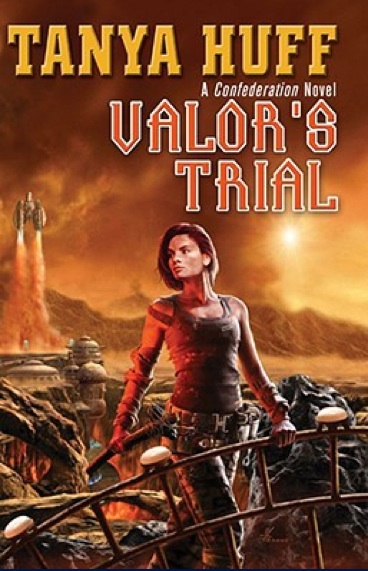
Valor’s Trial

Tanya Huff’s Gunnery Sergeant Torin Kerr is a real kick-butt heroine, and in Valor’s Trial, she begins with some serious action. For the next three hundred pages, the story seldom lags. The plot is basic: Kerr is involved in a hopeless battle with a faceless enemy known for taking no prisoners. In the blink of an eye, her position, and all of the personnel are simply gone. Obliterated. The Corps declares her dead, but neither her lover nor her father can believe it. Actually, neither can Torin Kerr, when she awakens in an underground POW camp, but she does feel quite put upon. Still, one of the duties long held by military forces is to escape, and Kerr is quite determined to do so, regardless of the obstacles or the odds, and no one, not even her fellow Marines, will deter her for long.

Huff’s writing comes across as authentic. The world building is always effective, but her characterizations, via actions and dialogue, are where her skills really shine. I’ve read a fair amount of military fiction, especially science fiction, and while others may hatch more creative plot lines or more expansive empires, no one can touch her realistic prose.

If Tanya Huff had written Star Wars, we’d all believe that Luke, Leia, and Han Solo are real enough to step off of the screen and go to the local watering hole for a drink. Listen up, Syfy channel, when y’all get serious about movie making, take a long look at the Confederation series.

By Pamela/Pilar Posted in writing

The Gift of Light

The second stanza of Poe’s magnificent poem, The Raven, describes the weather of this month: “Ah, distinctly I remember it was in the bleak December.” But our modern celebration of Christmas often defies the bleakness with a show of light. As a youngster, my family would go on a “light tour” during the month, and for the past few Christmas Eves, I have gone to church and then taken a long light tour with some friends and family members. For any of you who live in my patch of northeastern Georgia, my folks voted the town square in Dahlonega as their favorite light show, but there are plenty of cheerful lights in Helen, Cornelia, and in downtown Athens, also. Gainesville and Clarkesville are trying, but are not quite as successful. What makes Dahlonega the winner is the small size of the town square and the abundance of lights. While we circled the old courthouse over and over, we saw people parking and walking around. Some posed in an empty sleigh, set up near the visitor’s bureau, ready for everyone’s Kodak moment.

Recently, I read a seasonal feature story about communities using lights to brighten up the lives of their neighbors. The most affecting of these stories was one of a youngster who was losing his battle with leukemia. Having been sent home to hopefully enjoy one last Christmas, at the age of two years, little Dax’s neighbors lit up the entire neighborhood, even though it was only October, so he would have plenty of Christmas to see. Yes, they decorated early, just in case he did not live until Christmas Day. The gesture was a welcome one for the sickly young man and his parents. Dax got to see his final Christmas, including the light gifts of his neighbors, because he lived until December 30 of 2009. As the article pointed out, decorations on the interior of a home are for the occupants, but decorating outside is a gift to others who pass by.

When you are out looking at lights, and I hope you will look for them in your neck of the woods, don’t be impatient, as some of the folks are on my road. Across from my home, there is a brilliant light show that is either treasured or mocked by locals, depending on their “Scrooge Factor.” A few nights ago, a car had slowed to a crawl to look at the illuminated decorations, and another vehicle ran up behind and began sounding its horn. Maybe the driver of that second auto was in a hurry, or maybe he just did not understand the gift of light in the bleak December.

By Pamela/Pilar Posted in writing

Something new at Christmas

Mary, Did You Know?

There are two rough drafts for this month, and they will more than likely remain in the drafts section of this blog. As I try to come up with something new for Christmas, I realize how hard it is to add to the message of Christmas. For some, this time of year is all about material things, and that is truly sad. No human gift can compare, and certainly not replace, the gift of God to man.

However, words and music can make a powerful statement, and this “new” Christmas carol (first recorded in 1992) is now a favorite of mine. If you have not heard this song, then you might enjoy a carol written in our time, about a message for all time.

By Pamela/Pilar Posted in writing