Leviathan review

Image

A couple of years ago, I purchased a copy of Scott Westerfield’s novel, intended for a young adult audience, for my son. Alas, he never read it, but that is not a judgment against the book, as my son tends to read books with video game tie-ins.

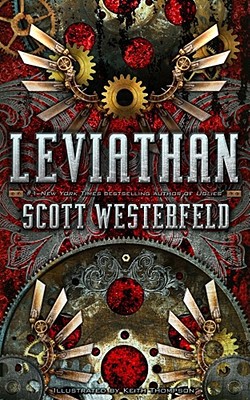
Since I was assigned a book presentation, (that’s a new term for report, y’all) I pulled Leviathan off the shelf. The book itself is inviting. The cover is amazing in its detail, and the form of the book is slightly non-standard, being just a bit taller and narrower than the norm. The paper is high quality, and the print is just a little wider than normal, which required adjusting the “leading” as the book was formatted for print.

Leviathan is an alternate history set in the era of World War I, written for a young adult audience in a genre known as “steampunk,” and is the beginning of a trilogy. The novel has two point-of-view characters, Aleksander Ferdinand, the (fictional) prince of the Austro-Hungarian Empire, who is forced to flee after the assassination of his parents, Archduke Franz Ferdinand and his wife, Sophie. The other point-of-view character is Deryn Sharpe, a commoner, a young woman who disguises herself as a boy so she may join the British Air Service. As the war unfolds, these characters provide insight into two forces in the war. The dualities do not stop there, however, for the British forces of this alternate history have bred various beasts to be both servants and machines of war, such as the Leviathan of the title. The Austro-Hungarian forces rely upon large mechanical warfare machines, such as the walker that Alek has been learning to pilot.

From the moment that young Alek is awakened by trusted old retainers, his story is suspenseful, but not unfamiliar. Count Volger guides Alek literally and spiritually toward a safe haven, as he pilots a huge walker, one of his army’s machines of war, as enemies of his father and of the empire seek to kill him. Alek is not on a hero’s quest so much as he is making the transition from innocence to experience. Nevertheless, there are times when he is heroic, such as his efforts to assist the stranded crew of the Leviathan, when it is wounded and lands near his hideaway in Switzerland.

Young Deryn, too, is on a journey, and while her adventures are also important to the plot, there is far more humor in her part of the story, as her character is propelled though the air via the large creature/ship of the title. The British forces use any number of genetically altered beasts as machines of war. Also, through Deryn, Westerfield makes some pertinent comments on the nature of humanity, such as her weary observation that the young airmen “endlessly competed to see who could spit farther, drink rum faster, or belch the loudest.”

By and large, I found this novel to be well crafted, but there are a couple of annoyances. First, the author substitutes words, such as “barking” for another four-letter word that is universally used as a vulgarity these days. Secondly, the initial swapping back and forth between point-of-view (POV) characters was a bit distracting, but after the first chapter, each POV character is on stage until the next chapter.

Westerfield alternates his POV characters in each chapter until the two meet upon a barren snow covered mountain, roughly half way though the 400 plus page novel. Alek saves Deryn from being trapped in the snow; then she promptly turns him in to her superiors. He is briefly held prisoner, but the British forces have far more to worry about than a mysterious young man from a mountain village. Ultimately, Alek is released so he can assist the crew of the leviathan, so the prince of Austro-Hungary and the crew of the great ship must cooperate to escape from the approaching German forces.

Westerfield’s Leviathan begins with a gripping first chapter and enough action to keep most readers entertained. Although I have not read much young adult literature, this author’s skill is such that I just might read more of his work.

Studying English in the Post Test and Term Paper Era

This is a follow-up to my last post, obviously. My online course is in full swing, and the syllabus was not a shock, because I have been involved in post secondary education in recent years, but it was a bit disconcerting. My course will be graded on forum entries, book presentations (reports), think pieces (term papers by another name) and the now ubiquitous annotated bibliography. No tests at all.

My husband asked, “Are you just doing 100% busy work?”

I said, “Yes” but he is male and I like to keep things simple for him.

Mostly, this course is busy work. Going to grad school nowadays seems to be a training ground for production of organic fertilizer. There is, however, some reading which is rather interesting, especially since the book reports are to be over young adult novels. Mostly, I skipped that sort of reading when I was the appropriate age, so apart from an occasional “coming of age” story, I have read little YA stuff.

To say that I am looking forward to these works is over-stating my position, but the assignments will force me out of my comfort zone a bit, and that is useful.

Still, I was always a good test taker, and I will miss having the opportunity to show what I know.

Back to School— for me!

For several years, I taught basic English classes at a local technical college, but in the past year, technical colleges in Georgia are the new junior college, so my transcript didn’t quite pass muster. So, it is either go back to college (for one course) or do as Candide suggested and cultivate my garden. If this doesn’t work out, I do have a plan for upgrading the plants around here….

Just registering was an adventure. I think I am the oldest person they have had lately. They kept asking if I was okay to climb the stairs, and I am thinking, “my knee surgeon did a good job— let’s live large and climb the stairs!” Anyway, I have a big credit card bill for tuition and five books (yep, five books for one course) because the course, which is really an education course, has an English prefix. Ironically, the problem with my transcript is a course which was taken in the English department which has an education prefix, so I guess that is fair.

Whether or not I will ever teach again is weighing in the balance, so I will no doubt put some effort into this new endeavor. However, if this fails, then I guess I will put the plant plan in the que!

Best Advice I Did Not Follow

From time to time, someone asks me about my writing.

“Are you still writing?”

Well, kinda.

“Any more books since Trinity on Tylos?”

Well, not published.

“Are you going to write a sequel to The Gift Horse?”

Well, I should, but I made so many people mad with the first one, that I dunno.

When I think about writing for publication, I think about the best advice I was given, and it is advice I should follow, even today. That gem of wisdom is simply this: Write something short to give yourself some traction. To explore ideas vs. marketability. To build a resumé.

That is good advice. Really. If I had written a story or two about exploited women, and had them rejected, as they undoubtedly would have been, I might have canned the whole idea of finishing The Gift Horse and putting it out as a debut novel. If I had written some science fiction short stories, and if they ended up in anthologies, I might have had more reasons to be selected as a guest at science fiction conventions. And, as a bonus, shorter works take less time to write, and often less time to publication.

Note that I did not say it is easier, because it isn’t. Or it shouldn’t be easier. The shorter the piece, the more polished it should be. Poetry, for instance, is generally far more polished than prose. And fiction is usually more polished than non-fiction. Do you doubt me? Then read the instructions that came with your last purchase; those are often an indictment of the state of non-fiction writing in our times.

For those who have not published, or have not published recently, the best answer might be an article, a short story, or a paid blog entry. Keeping it short is a good idea, but giving it away is probably not. People love freebies, and they don’t like it when they have to pay, especially after they had been reading for free.

Middle School Mentality

Since the video of bus monitor Karen Klein was posted on YouTube, there has been much written about the incident, but not much written about the mentality of the students who tormented her. If you haven’t seen the video or read any of the news stories associated with it, a brief summary of the incident is in order. In a video shot by a fellow student, a group of boys are heard calling an older female bus monitor fat, discussing what it would be like to stab her, and saying that her family would want to commit suicide because of their association with her. Klein does dissolve into tears, but never strikes back at her juvenile tormenters.

As a former teacher, and one who spent years working with students in the middle grades, I sadly state that this video is not so shocking to me. First, I will state that although I was sometimes the target of some taunts, my position as a teacher gave me more authority, and so I never dealt with anything so horrible. But, that said, parents and the public must understand the “middle school mentality” does include more than a bit of viciousness. More than once, I have described middle school students as being similar to a pack of rabid dogs. Individually, they are usually okay, but when grouped together, it is not uncommon to get some really bad chemistry. If there is an age where homeschooling is more appropriate, I believe it is the middle grades. When kids lose their need to impress adults, but before they become accountable, there is a danger zone, and grades 5-9 tend to be the rough ones, for the students as well as for the teacher and staff members.

My own children suffered bullying at that age; in fact, I was blessed to have a husband with a high enough position in the community that he could literally call up the superintendent of schools and ask him to personally intervene in a bad situation that was causing our daughter to go through emotional turmoil.

I have little doubt that the parents of those students in the video do not have to endure constant profanity and threats at home. Actually, I would imagine that the parents were probably shocked at the video of Klein being tormented. While the parents are partially responsible, the students are of an age to take responsibility for their actions. However, putting such students with so little control together, and giving those in authority no real power to keep the students in line, is the real problem.

If these students were in a homeschool, being responsible to one or two adults, and entrusted with assisting younger students, they simply would not get into a situation where they would have nothing better to do than torment others. Anyone who had read Lord of the Flies knows that it is not a new problem.

I’m sorry for Karen Klein, but not shocked. She has stated that if she had retaliated, she would have been fired. If any aspect of this incident is shocking, it is that society doesn’t realize what goes on when middle school mentality is allowed to run amok.

Because it is the right thing to do.

Once upon a time, I owned an iBook, so well-used that I was on my third keyboard when the hinge broke, damaging the case as it blew out. Having purchased AppleCare, I was not too upset, until some Apple Genius told me that I had dropped it and caused the damage, and Apple wouldn’t pay for accidental damage. After a few days of phone calls, trips to Apple service centers, emails to various officials at Apple, and many hours of trying to get my computer fixed (at no charge) some guy named Steve called me from Apple. He listened to my tale of woe, and said that Apple was not contractually obligated to pay for my computer, but that they were going to do so anyway, “because it is the right thing to do.” And so they did.

Since the dude on the phone didn’t use his last name, I don’t know for sure if I spoke with the head honcho of Apple or not, but after having read Job’s biography, I wonder. At several points in the book, Steve Jobs did what he believed to be right, even if everyone else thought it was wrong. Despite being a jerk, he was a person who wanted to produce great products and put them in the hands of people. Each iteration of Macintosh computers have been simple to use and as elegantly designed as possible, because Steve Jobs had a vision of what the personal computer should be. The iPod and the iTunes store work together seamlessly, because Jobs loved music. The iPhone is unparalleled because Jobs wanted a phone that was better than what he could buy. The iPad is mobile computing at its best, because  Jobs made the deals that made it possible. Indeed, Jobs had several talents, and even some of his personality flaws contributed to his success. Like a coach who is both loved and feared, Jobs was able to get people to do more than they ever dreamed possible. Apple, despite being the most valuable company in the world, continued to have the flexibility to capitalize on opportunities, because there was one strong mind at the helm.

Was he a genius? I think so. Was he a jerk? At times. Was he a criminal? Some tabloids say he was, but I view him as merely eccentric. Did he have a real life? I hope so, but Walter Issacson’s biography of Jobs is roughly 75% about Apple (and Next), and what Jobs did there, including too much information about office politics. Perhaps another 10% is about his time as  head of Pixar.  Since Jobs’ widow and offspring were no doubt in the midst of mourning when this book was released, I suppose that it is too much to ask for more details about his family life. Was he in the delivery room when his kids were born? I don’t know. Did he ever attend a PTA meeting? I don’t know.

Having read quite a number of articles and even a few books about Apple and its products, I found some of Issacson’s book to be tedious. But, for anyone who didn’t know much about Jobs, the biography is quite enlightening. Jobs’s adoptive father was a strong influence on him, but so was his interest in eastern religion. He’s one of the more famous college dropouts of his era, and that, too, is relayed in terms of how it helped him at Apple. Jobs was more artist than engineer, more salesman than CEO, but his insistence on doing things his way was more often “right” than “wrong” and the world is a far different place than it would have been had he not lived. No, really. Imagine our world with clunky IBM based computers, no iPod, iPhone, iTunes, iPad, and no products which copy those technologies. Steve Jobs said he wanted to change the world, and he did.

That’s quite a legacy, and one worth reading about. If you haven’t yet read Walter Isaacson’s biography of Steve Jobs, it is well worth the time it takes.