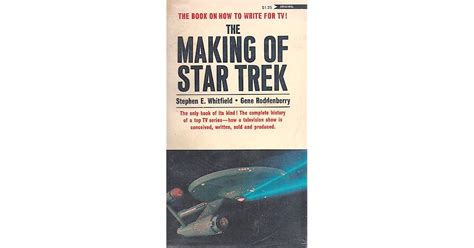
The Making of Star Trek by Stephen E. Whitfield—a retro review

Way long time ago, I borrowed a copy of The Making of Star Trek from a friend. After watching some episodes of The Original Series (TOS) on Pluto TV, I remembered the book, so I ordered a vintage paperback via eBay. Once I had it in hand, I could revisit a wonderful read, as well as wallow in some insider info once again. First printed in 1968, this book is both a history of Star Trek, with quite a few photos, and a “how to” guide to creating, producing, and writing a television series. However, as the book was written as the series was coming to a close, the legacy and cultural significance of Star Trek were not yet known to Whitfield (or Gene Roddenberry, who is listed as a co-author.) For more casual fans, there are other sources, from videos to more focused books.

When a ground breaking television series is created, there are thousand decisions to be made. From character names to methods of propulsion, this volume covers in detail how many of the concepts that make Star Trek work were developed, some visionary, such as the multi-cultural crew (unheard of in the mid-sixties) while others were merely practical, such as the “transporter” which was necessary as it would slow down the action if every port of call required a shuttle craft excursion (or worse, landing a huge space ship.) Within these pages are excerpts from memos to and from ST creator Roddenberry, quotes from NASA consultants, and preliminary sketches of possible ship configurations.

As this book was written alongside the filming of the series, there are glimpses of who wrote (and re-wrote) scripts, which actors were cast, and how the characters evolved. Letters from some of the actors, with insights into how their characters were to be portrayed, are included. Loosely organized chronologically, but with sections on such topics as “weaponry” and “the bad guys,” the reader sees how items familiar to TOS fans were developed over time.

Previously, I wrote a bit about a tour of The Neutral Zone Studios, where Star Trek Continues was filmed, and where fan films are still made. Our tour included some of the information in this book, but quite a bit of it was different, as the guides took a more hands on approach. Anyone planning a trip there might well read The Making of Star Trek prior to taking the tour. While the book does compliment Gene Roddenberry’s creative genius, many people helped create this vision of the future. Some of it has come to fruition (think folding cell phones) and some might never (Warp drive), but the influence that this one television series, which most deemed a failure when it ceased production, is difficult to minimize.

The Making of Star Trek is no longer in print, so it does require a bit of searching, but for fans, it is worth the effort.


Body Suit by Suzanne Hagelin

Titles are important, as is the case with this trilogy opening novel’s title, but I almost didn’t read this one. Body Suit? Sounds like a fashion mistake from my youth. Once I began, the narrative style didn’t grab me from the outset, as the point-of-view characters switched back and forth between a soon to be indentured servant/colonist and a rather prissy seller of space suits. Hold on, y’all, because it gets better! Or maybe the author’s style grew on me. Anyway, the switching back and forth continues as the two-fold adventure develops, but each character fleshes out so well that I genuinely enjoyed each character’s time as POV.

The purchaser of the body suit, Silvariah Frandelle, initially travels to a space station called Guam, where she learns both how to navigate being a servant (called a Contractor in the book) and how to use the fancy body suit of the title, and then to Mars, as a miner at the new Resnik colonial facility. Back on Earth Walter Cuevas, who sold the suit for far less than its MSRP in exchange for some tips on how the suit performs, learns to act on the suggestions that the business savvy Sil Frandelle communicates to him. His fortunes grow by leaps and bounds as Sil helps him get lucrative advertising deals, then offers tips on which stocks to purchase based on her observations while in space.

Both Sil and Walter must deal with Artificial Intelligence entities, too. Sil is introduced to the Companion while on Guam, and the AI is also present with her on Mars. The Companion is really her Taskmaster, but the programmers chose a more benevolent title for the AI, as its job is multifunctional, assessing (or perhaps spying on) her, while also directing her industrial activities on behalf of those who own her contract. Walter, as he grows more wealthy entrusts Daisy, a personal assistant AI who is styled as a young female human, to assist him in his business matters as well as being a loyal and undemanding companion, unlike his ex-wife. But, like any program, even a personal assistant can be hacked….

There are almost too many minor characters to keep straight, quite a bit of action, and sufficient suspense to keep the reader swiping the pages. Sil’s stay on Mars only starts out boring. The plot moves along quite well, actually. I really liked this story, once I got into it, and I am tempted to buy the rest of the trilogy, although the book stands alone well-enough.

Body Suit is science fiction, obviously, but in the manner of great sci-fi, because it delves into some really controversial aspects of the role of artificial intelligence in society. As programs such as Chat-GPT are growing in popularity, the moral questions broached in this novel are timely. Without spoiling the suspense with specifics, the novel also touches on how eugenics might change society, too. But, more than that, there are some interesting word choices in this novel, which let the reader know that some thought went into this one! I highly recommend it.

Retro Review: Michael’s Wife by Marlys Millhiser

I’ve occasionally written about re-reading old favorites, and I recently turned my eyes to The Mirror by Marilys Millhiser, and beside it, Willing Hostage, residing on my “keeper” shelf. However, my favorite novel by Millhiser is Michael’s Wife. When I was in high school, I borrowed this novel from a friend who had checked it out of the local library and read the opening chapters during Spanish class. After class I begged to keep it but was rebuffed. No, I had to get on the waiting list at the library. Seems like I had to wait months before I got to read the book in its entirety. I loved it!

Michael’s Wife was published in 1972 so modern readers should consider it a period piece and be prepared to suspend a bit of disbelief as well as setting aside certain notions of proper behavior. The story opens with the main character awakening in a dry stream bed in the desert. She has no memory of who she is, nor why she is there. She is afraid, however, and her fear motivates her to walk swiftly toward a roadway. Shortly after she finds the road, she is offered a ride from a rough looking man named Harley McBride, who is willing to help her as long as she isn’t a hippie. She assures him she is not, but says nothing when asked her name. Somewhat amused, Harley calls her “Doe Eyes” because he says her brown eyes remind him of a doe he saw while hunting. When asked, Harley tells her that he shot the doe right between the eyes. (Remember, modern readers, this is a period piece.)

While visiting a restroom, our amnesiac main character finds something hidden in the waistband of her slacks: A slip of paper—“Captain Michael Devereaux, Luke A.F.B.” handwritten across it. With this clue, she asks Harley to take her to Luke Air Force Base. Harley supplies lunch and some information as they drive from Florence to Phoenix. Harley stops as a motel owned by his brother in Phoenix, and our POV sees a sign wanting a waitress. She offers to take the job in exchange for a room and Harley’s brother agrees. Once she has the privacy of the motel room, she calls Luke Air Force Base and finally reaches Captain Devereaux. After she utters a few halting phrases, he calls her Laurel and tells her to stay put, he will be there in half an hour.

Okay, I hate book reviews with spoilers. The summary here is only the first chapter. This novel has quite a few twist and turns, and although it was classified as romantic suspense when released, it is more suspense and any romance is secondary. There’s some violence, including sexual violence, so this story isn’t for the faint of heart. (Honestly, I can’t understand modern readers who quit reading when a character loses his temper, but can embrace 50 shades of bondage.) Some of the reviewers on Goodreads were unhappy that this novel is very different than The Mirror, which is a time travel yarn. I get that, but in my case I much prefer the plot of Michael’s Wife. Millhiser is a creative writer who crosses between genres, and she did write other supernatural yarns, such as Nella Waits.

Millhiser died in 2017, so I only felt minor guilt at re-reading Michael’s Wife on a freebie site. She leaves a legacy of 15 novels, and her later works were a series of mystery novels featuring a sleuth named Charlie Green. I might try one of those, or I might re-read Willing Hostage, as I have fond memories of that one as well.

Why Medicare Advantage Plans are Bad by David W. Bynon

Right after my last post, I was injured, quite badly, in a fall. While I had read the title above, hubby had convinced me that Medicare Advantage was the way to go, because “we are healthy.” And, I was, until I broke my shoulder and damaged the nerves which traverse the Brachial Plexus. Within a month of my fall, I tested Medicare Advantage and soon found that I wish I had opted for traditional Medicare.

In Why Medicare Advantage Plans are Bad the author begins by explaining Medicare and Medicare Advantage. Even the name sounds good, right? They call it Medicare Advantage because there are certain perks, which vary depending on which insurance company provides coverage. For instance, mine has vision benefits, which I have used, and gym benefits, which I have not. This book also has a chapter explaining why the government actually prefers that people choose Medicare Advantage.

For those about to reach the age to file, this book, especially the opening chapters, would be most helpful. Also very helpful now (although I wasn’t concerned prior to my accident) is the 6th Chapter, which explains the downside of Medicare Advantage plans for those with chronic illness. The answer is quite simple: co-pays. As a holder of Medicare Advantage, I have to pay $25 (or more) every time I visit a healthcare facility. Right now I am seeing multiple therapists every week. Some days I pay $25 to the hand therapist, then walk to another therapist in the same complex and pay $25 again. Then I do it again a couple of days later. Medicare requires that medically necessary therapy be covered for unlimited visits. Medicare would not require those co-pays, however.

Perhaps I will get “better” although I have pretty much given up on being “well.” But, with multiple providers for everything from therapy to tests, this journey will be expensive. I wish I had read Bynon’s book before I signed up for Medicare Advantage. And, although I read this book, I probably wouldn’t have reviewed it if I had not become a victim of what a nurse in the ER described as a “life changing” event. I started out quite healthy, but that can change, and quickly.

For those who are just going down this path, this book is certainly worth reading.

Mother’s Day 2022

In his letter to the Romans, the apostle Paul says this:

We have different gifts, according to the grace given to each of us. If your gift is prophesying, then prophesy in accordance with your[a] faith; if it is serving, then serve; if it is teaching, then teach; if it is to encourage, then give encouragement; if it is giving, then give generously; if it is to lead,[b] do it diligently; if it is to show mercy, do it cheerfully. (Romans 12:6-8, NIV)

Many churches sometimes ask members to do a spiritual gifts assessment. That’s teacher-talk for a test, y’all. Anyway, these assessments generally indicate the area or areas wherein the Christian has gifts. However, mothers and grandmothers know that they’d better be pretty good at all of them.

Prophesying is, to an extent, discernment. Moms have much to discern these days, from social media to some really odd fashion trends. God does care about matters in today’s world, and it takes the Holy Spirit’s influence to help us deal with the craziness. 

Moms must also serve, whether it is hosting the rec department baseball team, chaperoning the youth group, or making sure that everyone has clean clothes for school. 

Moms are also teachers, with a huge curriculum to cover. Moms teach social skills, such as how to shake hands and make up after a playground dispute, practical skills such as tying shoes and making killer peanut butter and jelly sandwiches. Moms teach organizational skills, by making schedules to accommodate all the busy-ness of modern life. 

Moms are tasked with encouragement, too. Mom has to help kids get over the loss of a soccer match, a best friend, or a beloved pet, and help children have hope for a better tomorrow. 

Moms give, of their time, their talents, as well as their income. 

Moms often take on leadership roles, whether it is planning a homeschool outing, a bake sale to pay for summer camp tuition, or figuring out how to pay for a week’s worth of groceries with half a week’s worth of income. 

Moms must demonstrate mercy, because sometimes there’s some slight which must be forgiven. Yes, mothers need to have a lot of spiritual gifts.

Every person here either is a mother or had a mother. Some of us are fortunate to have the opportunity to honor our mother, and perhaps even a grandmother today. I lost my mother many years ago, but she was a good Christian as well as a great mom, and she modeled many of the spiritual gifts. I hope to honor her by following her example.

Thanks to all the folks here who are mothers, have honored mothers, or merely remember what your own mother did for you, whether it was today or long ago.

By Pamela/Pilar Posted in writing