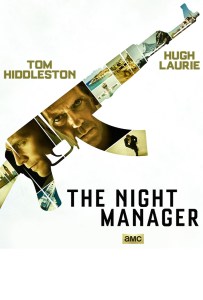
The Night Manager (television series)—a brief review and commentary

managerOften, the best stories begin as, well, stories. Before The Wizard of Oz was a groundbreaking film, it was a book by L. Frank Baum. Before 2001 A Space Odyssey was an influential science fiction film, it was a book by Arthur C. Clarke. Television series have also been book based, including such diverse stories as Little House on the Prairie, based on a series of books by Laura Ingles Wilder, and Game of Thrones, which was based on a series of books by George R. R. Martin. There are literally dozens of others, but I’m going to discuss one that you might have missed: The Night Manager, based on a book by John Le Carré. A friend recommended this six part series, and we usually enjoy the same sorts of stories.

The Night Manager is currently on a streaming service offered by a large online reseller, the one that starts with an A. Originally, however, the series was made for British television and shown in the states on AMC. As I don’t subscribe to cable, I missed it there, but my hubby and I saw this winner of three Golden Globe awards recently. The plot, although updated a bit from the 1993 novel, is intricate enough to puzzle, but not nearly as confusing as modern teleplays tend to be. The direction is subtle but sure. The acting is simply outstanding, with a star cast including Hugh Laurie (who starred eight seasons in House M. D.) and Olivia Coleman (who dons The Crown in seasons 3 and 4 over on Netflix.) The main character is brought to life by Tom Hiddleston, who has several Marvel movies as well as a video game in his resumé. This series was rather expensive to make, by BBC standards anyway, and was filmed in Egypt, Morocco, Spain, Switzerland, Turkey, and the United Kingdom.

Here’s a bit of plot summary: A former soldier for the British army, Jonathan Pine, is portrayed as the night manager of a Cairo hotel as the story begins. He gets involved with a mysterious guest who is the girlfriend of a local gangster. Through her relationship with the gangster she has acquired information linking illegal international arms sales with Richard Roper (Hugh Laurie), an English billionaire. Just after leaking information regarding the illegal arms, she is found murdered.

(Minor spoilers ahead)

Fearing for his own life, Pine flees, and is next seen, a few years later, doing the same job at a remote hotel in Switzerland. When super villain Roper visits the Swiss hotel, Pine longs to have some revenge, and soon he is enlisted by British Intelligence to spy on Roper. Before long, he has a new identity and an opportunity to infiltrate the small network of arms dealing. Getting information out, while staying alive and undercover is quite a challenge.

One reviewer called it a “classy thriller.” That nails it, but do check out this amazing bingeable series.
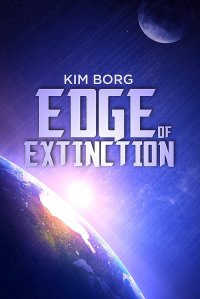
ARC review—Edge of Extinction by Kim Borg

EdgeOfExtinction_CVR_SMLI read Kim Borg’s debut novel as an ARC, and published public reviews on Big A and Goodreads, and I stand by that review. This one is going to be a bit different, however, and there are gonna be a few spoilers, so if that bothers you, go read the Goodreads version.
Science fiction is a modern art form, which probably begins with Mary Shelley’s Frankenstein, although there is some debate on that. Actually, there is also debate as to the exact definition of science fiction, along with what works should be classified as science fiction. For instance, many works of horror and some that are largely fantasy end up in the SF basket. As I don’t especially like either of those genres, that bothers me, but the lines are often blurred. Anyway, science fiction generally takes what is known (science fact) and extrapolates that is some manner (the fiction part.) I like to say it this way, science fiction asks “What if______?” In this case, we have a novel which poses several questions.

Borg’s novel is set in 2086, when Teslas drive themselves, which isn’t much of a stretch, and population control is a world-wide mandate, which extrapolates a bit more. Oh, and the Earth is a polluted mess, and rather than clean it up, at least one rich and famous guy  is looking to find a new spot to colonize. Apart from the one child per couple population control, which China tried a while back, none of this is much of a mental stretch.

However, after a few more scenes, the point of view characters, Dr. Amber Lytton and Dr. Joel Carter, become members of a space going team who board a ship called the Hermes, launch into space, and rely on a Phoenix drive to take them to the pristine Earth type planet, Arcadia. During their training, the couple learns that they are actually the second team to venture to the planet to assess it as a possible location for colonization. Once there, the travelers must dodge aliens of various sizes and levels of ferocity, while looking for clues as to the fate of their predecessors. Problems, both external and within the group, complicate the mission. Borg’s debut novel has quite a bit of suspense, a good character development, and lots of world building. The gadgets, although present, don’t over-power the story, either, which I like.

As in many worthy stories, the bad guys (or critters) aren’t all bad, and the good guys aren’t all good. There are a lot of questions to answer, such as will the villain who is only along to steal a valuable hunk of mineral get away? Will our point of view characters both live through the conflict between species which rule Arcadia? Is Arcadia a parallel planet to Earth, wherein the dinosaurs were never killed off? And, perhaps most important, are humans too wicked to trust to colonize any planet? This novel reminds me of some excellent science fiction writers, especially Jules Verne and Pierre Boulle (Planet of the Apes.) The ending isn’t quite a cliff hanger, but it opens the door for sequels, and I hope the author continues the story line in other novels.

Edge of Extinction is skillfully written and worth the reader’s time. Kim Borg states in her acknowledgements at the end of the novel that her goal is to both educate and entertain the reader, and while she certainly tries to educate, she does entertains. Borg is a new author for fans of classic science fiction to watch.


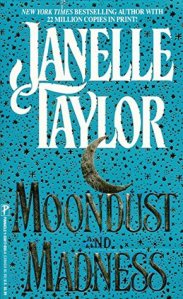
Retro Review: Moondust and Madness by Janelle Taylor

MoondustA friend (a generation older than I am) recommended books by Janelle Taylor, saying she is a prolific series romance writer from Georgia.  That’s true. Goodreads lists lots and lots of titles by Taylor, and apparently she sold quite a few books in her heyday. The series my friend recommended was “western” but as I am a science fiction fan, I chose to read book one in the Moondust series, Moondust and Madness.
Reviews for the ebook, which I read, are not plentiful, but are mostly positive. However, a deeper dive into those reveal that the positive reviews are mostly by readers who remembered this yarn from way back, whereas younger, first time readers are not impressed. I understand both points of view.

Moondust and Madness is a traditional 80s bodice ripper novel, which just happens to be set in space. Heroine Jana Greyson is a scientist who is abducted by an alien gathering up human mates for a large system of planets in another galaxy. These alien abductions are sanctioned by the alien powers that be due to the devastation of an engineered virus which caused a lack of fertility amongst the alien females. BTW, these aliens look just like humans, and can breed with them, so the only thing Jana (and her five hundred companions) need is an inner ear translation device and some brainwashing to help her get ready for her new life. Much of the science fiction trappings seem to have been lifted from Star Trek, from “Star Fleet” to transporters. That could be viewed as “ripping off” Trek, but I think it was more to give readers some familiar science fiction props. This is a romance novel, so there are very few explanations of how gadgets or space ships work.

Lots of political intrigue and the on-again off-again romance between Jana and her captor, Varian Saar, make up the more than five hundred pages of this novel, which begins a series featuring other characters set in the same universe. While I liked the book at times, it is just too retro for most readers. I won’t continue the series, but I did finish it.

For readers who like alien abduction and then fall in love plots, Myra Nour used this same basic plot for her much better novel, Love’s Captive. And, if you want a dose of reality wherein the heroine doesn’t fall in love with her captor, try my novel, Trinity on Tylos.


The Functional. Fragment. Celebrated. Or reviled.

ARC5Claimed (which may or may not also have the title of Rescued) came to me as an advanced review copy (ARC) which I read recently for a review site. Actually, I am glad to have the opportunity to review again, as it has been quite a while since I’ve done this. Most such sites really want a positive review, and I have written one. My comments for the site are true but censored a bit. What you’ll read here is more genuine.

First of all, sometimes minor mistakes are in an ARC, and I certainly understand that. The author used “fussed” for “fussy” for instance. That’s the kind of minor mistake that should be corrected before the final book is published. This book is a science fiction romance, with the emphasis on romance. For me, science fiction should have a bit science, but in Claimed/Rescued there aren’t many science fiction elements, apart from characters (lots of aliens) setting (a spaceship and a space station) and plot (alien abduction.) Apart from vivid descriptions of aliens, the other elements are not especially detailed.

Romance comes in several flavors these days, from very hot (nearly pornographic) to sweet (think Amish stories that talk about feelings rather than body parts.) Claimed/Rescued is skewed well on the sexy side of the continuum. For those who read romance for vicarious sex, this novel is a winner. From a science fiction standpoint, this yarn disappoints a bit. Okay, I don’t have to know how the ship goes or how the remote control on her wicked slave collar works, but a little more detail concerning the gadgets would be welcome. The most sci fi part of the book is the afore mentioned vast array of aliens, and those are described in varying levels of detail.

For me, the most annoying aspect of the book was the author’s reliance upon the “functional fragment.” Of course, lots of dialogue depends on the functional fragment. Think about one side of a phone conversation:

“Hey!”

“Oh yeah.”

“Really?”

“No kiddin’!”

I have no problem with the construction in that context. But. This author. Tends to write. Like. This. The words shared in this manner tend to be feelings or observations, such as “Handsome.” “Kindness.” “To Bond.” “To become as one.” “Tenderness.” “Aroused.” “Stay strong.” “Traumatized.” “Wary.” “Forever.” Y’all, I just listed a few of the functional fragments. Every once in a while, this could be an effective technique, but Claimed/Rescued is far too reliant upon these pseudo sentences.

No doubt Claimed/Rescued will be published, and there will be enough positive reviews that some science fiction romance fans will read it. And, those who want to experience sex vicariously may well enjoy it. But. All I seem to remember. Are. Those. Fragments.

The editors are children

Screen Shot 2020-06-16 at 3.01.40 PM

The other day, I wondered aloud why writing is so bad these days. My young adult son scoffed and informed me that he went to school with some of the staff at the news outlet that posted the story above. He didn’t view these fellow students as the best or brightest, obviously.

My sister, a media professional, informed me that these days, editors (and program directors) are more interested in how many hits an item gets on YouTube or Twitter than how well written or researched an item might be.

Considering the power our nation gives the media, it is scary how low the bar is set for those who write, edit, and direct what the rest of us consume.

Oh, and look out for the back Nissan.


Here’s another one:

Screen Shot 2020-06-16 at 6.31.04 PM

That’s from a site with a big budget, but again, there’s not much editing going on.

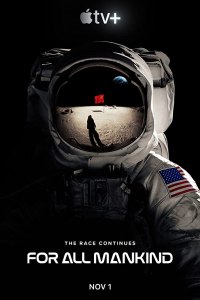
For All Mankind—on Apple TV

MankindWith the purchase of a new device from Apple comes a free subscription to their relatively new paid streaming platform. As hubby and I are often seeking a new television series to binge watch, we just finished For All Mankind on the Apple platform, and overall, we liked it quite a lot. However, I read several reviews, with criticisms being at least as numerous as the accolades, and often both are well deserved. The series was developed in part by Ronald D. Moore, who has a stellar (pun intended) reputation for writing and producing excellent science fiction, from Star Trek the Next Generation to Outlander, and with the simply superb reboot of Battlestar Galactica in between.

The scenario is quite promising: In an alternate history, the Soviet Union beats the United States to be the first nation to put a man on the moon, and the growing rivalry between nations causes the space program of the United States to flourish, rather than founder. Neither our citizens nor our politicians like being second best, so the need to catch up and surpass drives the plot. As an alternate history, many of the characters are based upon real people, but quite a few characters are inventions. Even those who are based upon real people have different adventures (or mis-adventures) due to the fictional nature of the series. The acting is good, as is the writing. The effects are very good, also. The sets, props, and costumes are really amazing—it’s truly a back to the 60s look. So far, so good.

But, as many negative reviewers have noted, the series is typical of our “social justice” modern agenda. Immigration, same sex relationships, race relations, and feminism are more than just sub-plots in this re-imagining of the space race. Each of these social justice themes has a story arc devoted to it, and these themes are every bit as strong as the “what if America had continued to send people to the moon?” theme that is the advertised plot line.

Alas, any subtle use of themes is no more. This alternate history is very good, but the social justice warriors are using a sledge hammer to right perceived wrongs. For All Mankind is just like many modern day productions in that regard. What could have been A+ for Apple’s streaming service is instead closer to a B-.

If you have Apple TV, check it out. If you don’t, I wouldn’t buy it for this series alone.