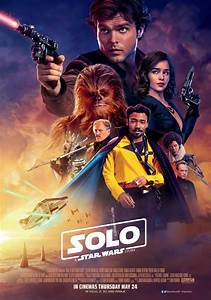
Solo— a Star Wars Story

Solo posterOur son is a big time Star Wars fan, and he initially said he planned to skip this movie. Based on the box office stats, apparently a lot of folks felt the same way. However, a friend apparently convinced him to go see it, and he came back raving about how much better it is than Star Wars Episode VIII. Last evening, hubby and I went with him to our very small local theatre to see Solo- A Star Wars Story before it closes up and leaves for cable and the Red Box.

I did like it rather a lot. The cast is really great, from a decent likeness of the main character by Alden Ehrenreich to a fabulous supporting cast with veteran actors including Woody Harrelson and Paul Bettany, as well as modern favorites such as West World star Thandie Newton and Game of Thrones star Emilia Clarke. The look and feel of the film, although a bit dark, is up to Disney and Star Wars standards, too. While I thought there was too much action (if such a thing is possible in a summertime blockbuster film) all of it was top notch.

For real fans of the series, there are some pluses and minuses of course. The film does a good job of filling in the small and big pieces of the original trilogy, especially those that occurred in the original film, Star Wars: A New Hope. Example: Han Solo proudly tells Obi Wan Kenobi that the Millennium Falcon made the Kessell run in 12 parsecs. How? When? And why was that important? Solo fills in all those blanks. How did Han and Chewy meet? Again, this film supplies some answers. Overall, the script writers (father and son Kasdan and Kasdan) performed a minor miracle in getting so much into two action packed hours.

Although I’ve read that it was a marketing problem, or a saturation problem—no one knows for sure why Star Wars fans have not embraced Solo. That’s too bad, because it is in many ways very similar to the much better received Rogue One: A Star Wars Story— it fills in blanks in the original film, gives us new characters to love and hate, and is a visual spectacle with a very good musical score.

Beat the summer heat and go see Solo—A Star Wars Story soon. Very soon, because it will be moving to video in a few short weeks.

Some Science Behind My Science Fiction

Having just read an article in Popular Science online about what a”Generation Ship” might look like, I was gratified to see that some of the core concepts in my science fiction novel, Trinity on Tylos, are firmly rooted in science.
The article speculates about what challenges the multi-generation inhabitants of a colonizing venture (based on an extrapolation of current space technology) might face. Topics addressed include propulsion, medical issues, livestock, and robot workers.

In Trinity on Tylos, the alien captain of the Archeonite III has a big problem: his colony of survivors died out, but he has the ability to grow little Archeons from stored genetic material. He just needs some baby mamas, and my characters Venice Dylenski and Alathea Duke end up with the task. In the Popular Science article, We Could Move to Another Planet with a Spaceship Like This, the author mentions that “speculators say it’ll take 20,000 souls to start a healthy population on a new world. One space-­saving tip: Bring frozen embryos and people to diversify the gene pool upon arrival.” That’s right out of my novel, where Azareel and his android medical team design the embryos that Venice and Alathea gestate.

As in the Popular Science article, robots are probably going to be the grunt workers of the future. In my novel, the Archeons use robots (as they take the form of their makers, I call them androids) as workers. A limited but technologically proficient population would no doubt employ robotic workers, freeing the populace to supervise or take on  tasks that require a more creative mind.

Trinity on Tylos is a complex story, because it goes beyond being just a space opera and delves into human relationships, made more complicated by the limited number of people with whom the characters interact. Also, it is a story of surviving on a somewhat hostile planet, solving such issues as having enough water to irrigate crops. The Popular Science article mentions farming as one of the most necessary activities once the generation ship reaches a new planetary home. Indeed, when I wrote Trinity on Tylos, I remembered the words of William Bradford, a leader of the pilgrims who settled Massachusetts, who wrote “what could they see but a hideous and desolate wilderness, fall [sic] of wild beasts and wild men—and what multitudes there might be of them they knew not.” Survival is not easy, and the Popular Science article, although very positive in outlook, does not ignore the difficulties that might face the future generations of humans whose journey began with some adventuresome ancestors.

Technological progress and science fiction often go hand in hand, because what writers dream up, engineers can (sometimes) make happen. However, the reverse is also true— when creating a science fiction story, there must be some science blended in with the fiction. Trinity on Tylos is science based fiction, and it is available for your Kindle reader or Kindle enabled device; just click on the cover art.


Trading for a Dream— review of book 2 in the Yrden Chronicles

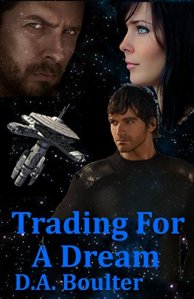
TradingDreamcoverSince I first began reading eBooks on my iPad, I’ve used Amazon’s Kindle more than any other app, because it works well and the content is both plentiful and inexpensive. An early favorite author was D.A. Boulter, whose novel Courtesan impressed me quite a lot. I’ve revisited his work from time to time, and recently I read the latest entry in the series that began with CourtesanTrading For A Dream (The Yrden Chronicles Book 2).

Boulter’s Yrden books are based upon the idea that somewhere in the future, Trading Families will own fleets of cargo ships that not only carry paid cargo, but that there would be trade representatives on board who scout for local merchandise at each port of call, buying and selling or bartering, providing new goods for their customers as well as adding profit to the Family. Of course, the Yrden Family is the core group, but Courtesan is a stand alone book which occurs some generations before the events in the two available Yrden Chronicles novels. Trading For The Stars (The Yrden Chronicles Book 1) recounts the story of Clay Yrden and Colleen Newborn who meet on a primitive planet, Erin.

Trading for a Dream continues their story, but the main point of view character is not one of the Family; instead, as the novel opens, the reader meets Adrian Telford, who is engaged in arranging an accident (i.e. he’s a hit man.) However, when the victim’s wife and son witness the “accident” Telford loses his taste for a life of crime. In an effort to clean up his act, Telford rides a shuttle to Liberty Station, a space station which is on the trade route of Blue Powder, a Yrden Family ship.

(spoiler alert)

When Blue Powder docks, Clay and Colleen soon meet Mr. Telford. Clay sees him as too risky due to his past association with criminals, but Colleen sees a desperate man in need of a hand up. Needless to say, the interactions between the Yrdens and Telford make up the rest of the novel. The yarn is suspenseful due to the efforts of the baddies to make Telford go back to his former profession, as well as an attempt to relieve the Yrdens of some of their goods.
While there are some mostly stereotypical characters, the author does a reasonable job of creating engaging characters, including the folks on the ship, the bad guys who used to be Telford’s business associates, and other folks who get involved, so there are quite a few of them for the reader to keep straight. Having read the other novels in the series helped me a bit in that regard.

I’ve enjoyed Doug Boulter’s stories, and I really liked this one, too. The only caveat I have in recommending these is if you want sex scenes, you’ll be disappointed, as these stories are remarkably clean without being intended for a young adult audience. These stories are reasonably priced on Amazon, and I encourage readers to discover this relatively unknown author. I am so glad I did.

Adding to the List

That’s the “to be read”list, of course. As I’ve been going through this blog and updating some links, killing off a few out of date posts, and generally trying to do some cyber housekeeping, I’ve run across some sequels that I want to read.

First up, Evergreen, which had some rights to the story of Honor Harrington, David Weber’s amazing space opera, has closed up shop, but there is a second comic book version of the story available. Here’s the cover (and a link to buy if you are so inclined.) While I’m not much of a graphic novel fan, I love Honor Harrington stories, especially those toward the beginning of the saga, which these comics depict.


And, the also amazing, but not so famous, Kennedy Hudner has added to his space opera, as Alarm of War is up to Volume III, entitled Desperate Measures. I’ve enjoyed the other books in the series, so I am looking forward to this one. Again, here’s some cover art with a link.

Star Trek and Philosophy: The Wrath of Kant— a brief review

Okay, I am a sucker for a good title, and this book has a good title and a good cover. Win-win! And it is about Star Trek, which I like quite a lot. But it is rather deep at times, so I wouldn’t rate it five stars, but fans of Trek who have some knowledge of philosophy might award it a solid four, perhaps.

What is between the covers is a collection of essays edited by Jason T. Eberl and Kevin S. Decker. These essays use Star Trek’s various television shows and movies to explore philosophical issues, and it helps quite a lot if the reader is familiar with all forms of Trek. Since I never watched all of DS9 or Enterprise, I was sometimes a bit lost.

The first essay is a nifty one, as it is based upon a Next Generation episode, “Darmok.” Both the essay and the episode dealt with the difficulty of translating a totally alien language. Throughout most of the Trek episodes there was a “universal translator” which was a bit like Google Translate, but it depended upon languages having some commonalities. Of course, communication via such means can go astray quite easily, but what about an alien species that doesn’t communicate the way we do? The issues would be far beyond going from English to Chinese, and I understand that can be difficult.

As the essays in this book are by different authors, the tone and topics vary quite a lot. For me, it was a book to nibble at, but not a cover to cover read. I’ve always viewed Star Trek as more intellectual than Star Wars, but this book takes it to an even higher plane. For fans of all things Trek, there are some really delicious ideas to examine in this collection, so if that describes you, go for it!

Alarm of War— The Other Side of Fear

A while back, I wrote a positive review of Kennedy Hudner’s Alarm of War. Perhaps its greatest downside was that it clearly was intended to have a sequel. For a few months, I checked Amazon, hoping that Hudner had released the second part, but after a while, I quit looking. Then, as I reviewed my “keeper” files, I saw Alarm of War and looked again. Low and behold, Alarm of War, Book II: The Other Side of Fear was published in 2014. Finally, I had the sequel, but alas, it’s really part II of a trilogy. So, I am back to waiting.

However, it would be remiss to not review the second book. So, here’s a true confession: I went back and re-read the Alarm of War because it had been so long that I was certain I needed a refresher. Good plan, as I enjoyed it almost as much the second time. Once I had swiped the last page, I jumped right into The Other Side of Fear, and it wowed me from the opening scene.

While there are some stereotypical situations and characters, there is plenty of depth to Hudner’s ensemble of main characters, who met as they went through basic training during the first novel. My favorite is Emily Tuttle, a former history teacher with a brilliant grasp of military strategy. Other main characters include Grant Skiffington, the favored son of an admiral; Hiram Brill, a geeky guy who instinctively puts together intelligence into workable prophecies; and Marine sergeant Maria Sanchez, who is super gung ho, but reads books and likes to hang out with the nerd, Hiram. These characters all had intertwining adventures in the first book and book two immediately picks up the action.

Rather than write a bunch of spoilers, I will say this: Mr. Hudner’s series reminds me quite a lot of the early works of David Weber, the creator of the great Honor Harrington series. But, by using the ensemble, rather than centering on one character, Hudner is able to bring in various aspects of his universe, but keep the reader’s interest. At times, Weber spends more time explaining his villains than his heroine, and that has always bothered me. As a huge fan of military sci fi in general, and Honor Harrington in particular, it is hard to say this, but, “Move over, Mr. Weber.” Kennedy Hudner is writing some seriously kick-butt military sci-fi. Really.

As of this writing, the first book is a bargain at 99¢, and The Other Side of Fear is $3.99. My gosh, so much entertainment for less than the price of a movie ticket!