All Books— $4

News stories about publisher prices come and go; the latest has the U.S. attorney general going after Apple’s iBooks prices. Let me key that in again… Apple’s iBooks prices. Not the New York big six; not Amazon. While I do believe that book prices are as artificial as aspartame, I don’t really believe that Apple is the culprit in price fixing. The attorney general is just doing some election year grandstanding.

As I have stated in previous blog posts, the 800 pound gorilla in book sales in the U.S. is Amazon. Even when Amazon begins charging sales taxes, and that will happen because our government’s spending is out of control; Amazon will still have the lion’s share of new book sales, due to its ubiquitous internet presence and its killer Kindle app. But, increasingly, Amazon is the best way to sell used books, and that is the reason all books will eventually be around four bucks.

I’ve been selling off my home library for a few months now, but I still have the bulk of it, because I have not found a way to compete with the “power sellers” who offer thousands of used books for a penny, plus Amazon’s $3.99 shipping. Thus, virtually any used book is available for a mere $4.

Having moved recently, I packed many, many boxes of books, and I usually check the price for anything that I don’t want to own forever. Most of them are only a penny on Amazon. I can’t make any money on that sale. Here is how the math works for me:

Book price .01

Shipping fees to me 3.99

Commission(s) to Amazon -$1.00 (transaction fee) and -.80 (minimum commission)

Postage to customer -$3.15 (for a book weighing between 1 and 2 pounds).

Thus, I lose $.95 per book, or more if I use packaging that I purchased, if the book sells at the going rate of $4.00. Heavier books will result in a greater loss, because Amazon’s shipping fees do not adjust for heavier items.

So, most of my books either end up parked on a shelf or in the “yard sale” pile. And, I do know that most of those won’t sell at a yard sale, either, so they’ll end up being donated to charity. Therefore, the owner of a used book must either want to keep it, or be ready to toss it.

Tis sad, but all physical books will become used books. So, if you don’t like the publisher’s price, just wait. Eventually, most any book will be available for four bucks.
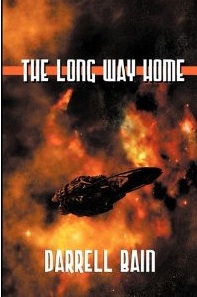
The Long Way Home

One of my favorite eBook authors is Darrell Bain. I think of him as the master of plots. Oh, there are some problems with his writing, primarily in the “show don’t tell” category, but this guy writes the most amazing yarns.

In the dedication of The Long Way Home, Bain recognizes three important Baen Books authors— David Weber, John Ringo, and Travis Taylor. And fans of their brand of science fiction will no doubt see that these authors influenced Bain in this space-based tale. Weber writes military science fiction on a grand scale; Ringo puts the grunt into military fiction, and Taylor is a rocket scientist who can also spin a good space opera. Bain doesn’t do any of those quite as well as these guys, but he does blend the elements quite well.

The plot is not unusual, with opening scenes of an exploratory vessel far from home, and a first contact mission gone awry. But instead of one or two explorers meeting a premature end, as happens in James Alan Gardner’s Expendable series, there is a massive loss of life and starship, and a small “longboat” known as “The Hurricane Jack” is left to ferry the survivors home. And it isn’t a short journey, hence the title. There are many obstacles, and the conflict is almost non-stop, between the “monkeyclaw” ship following the survivors, and the internal debates over matters in the tightly packed small ship. The mission is now to save the survivors and warn the human population about the vicious species they wished they had left behind. As a small vessel, the longboat must stop to scavenge material, and every stop has some built-in danger. Unlike some writers, Bain is not afraid to kill off his characters, which ramps up the peril factor.

Fans of space exploration stories should enjoy the action-packed suspenseful voyage of “The Hurricane Jack” in Darrell Bain’s The Long Way Home.

eReader update

Some years back, I purchased a Palm device as an eBook reader. Oh, I might not have chosen it if the only thing it could do was display books, but it does more than act as a reading device. For half a decade, I have read scores of eBooks and used the Palm for my calendar, quick notes, and as a portable phone/address book. At the time, I thought spending a hundred and fifty bucks was a bit much for it, but in the long run, I have enjoyed cheaper books, being able to read at night, and less junk in my purse. Nowadays, it will die after just a couple of hours of reading, and battery life has always been a problem. In the past few months, the cover has worn out, the charger won’t work so I have to use the USB port to recharge it, and when I pull it out, folks look at it the way folks in the eighties would look at an eight-track tape deck. Like other fans of eBooks, I am looking for a replacement reading device.


Being an Apple aficionado, I view the iPhone as a good candidate. Like the Palm, an iPhone would serve multiple purposes. But, that small screen won’t be much better than what I have now, and newer should be markedly better, don’t you think?  No doubt, well-heeled eBook readers who like Apple products will probably opt for the iPad, and that is the most appealing alternative. But, it won’t fit in my purse, and while it is a real computer, it won’t really replace my Macbook, so I can’t see spending the bucks for one of those.


Amazon has been perfecting, and dropping the price of the Kindle. The second generation device isn’t as butt-ugly as the first one, but I am not ready to buy one just yet. Amazon’s content is probably better than most, which is a better selling point than the reader itself. If I were a student again, having to read large textbooks, the oversized version would catch my attention, but black and white magazine content is so retro.


I considered the eBookman, marketed by Fictionwise, five years ago, and there are a few of those still around. But its successor is the Nook, a WiFi capable dedicated eBook reader sold by Barnes and Noble. The price of this device is currently $149. Since Fictionwise, my favorite eBook vendor, is now a BN.com subsidiary, moving my pre-purchased content should be easier if I decide on the Nook. Barnes and Noble has my sophomore novel, Trinity on Tylos, on sale for under three bucks. That’s a deal, folks! If other small press books are priced similarly, that would put new books into used book price range. Quite frankly, when just purchasing the content, and not the paper and cover, I think that a new eBook really should be less expensive than a new print copy, so plenty of low priced content is absolutely necessary. And, of the eBook readers available now, apart from Apple’s elegant designs, the Nook has the best form factor, too.