How to write a bad book review

DIYYep, that title was carefully phrased to have dual meanings. I’ve been a book reviewer and an author. Sometimes, as a book reviewer, I just didn’t like a book. That’s tough. Sometimes, as an author, readers don’t like what I have written, and that is tougher, because a one star review can cause book sales to plummet. Well, unless the reviewer is an obvious nut-case, and in that instance…it still hurts.

First, let’s deal with how to review a book that isn’t just want the reviewer/reader wanted. If writing for a site or magazine, the best thing is for the reviewer to just pass on it. Let’s face it, not everyone likes every book. Really. I’ve read classics and wondered, how the heck did this book even get published, much less remain after its fellows all ended up in the landfill? So, it really is best to pass it to another reviewer who might be more amenable to the book. But, if it is absolutely necessary to review it, begin with what isn’t wrong with it. Surely there is something— good prose, interesting setting, an absence of poor spelling and/or grammar. Find something good. Then, state the objection(s) clearly, and then explain the obvious— that others might not agree. If five stars are available, then rate accordingly, and there really should be more than one star clicked. Because whatever the reviewer found that was good probably warrants a second or even a third star.

A really, really bad book is going to be rife with problems— spelling, grammar, formatting; or lackluster characters, a plot that moves more slowly than molasses on a cold winter’s day; or even inconsistencies (such as a character with blue eyes in chapter 1 and brown ones in chapter 8). In such cases there is no need for the reviewer to get emotional and resort to “I”, “me”, or “my” because the author burdens the work with too much evidence that the book is indeed bad. There, and only there, might those one and two star reviews be warranted.

If the book is an eBook, and the reader purchased it from Amazon, there is a return feature. Did you know that? I didn’t, until recently. Anyway, the other day I returned a highly rated sci-fi novel. I did not write a bad review, because I wasn’t about to waste enough time to read it and then review it. Those who slog all the way through a Kindle title only to write a one star review must have intense masochistic tendencies.

Finally, I’ll deal with the second interpretation of my title. Sometimes readers do write really bad reviews. Readers (hopefully not reviewers) who write bad reviews seem to have a tantrum while sitting at the keyboard. The most prominent word in the review is probably a first person pronoun, such as “I” or “my” or “me” because such reviews are not written for other readers, but to express the emotions of the reviewer. In short, bad reviews begin with a lack of objectivity. Then the bad reviewer indulges in emotion, from boredom to revulsion, but the writer of the bad review seldom mentions any positive(s) in the book. Finally, writers of bad reviews usually need a reason for the hissy fit, so the review ends with a warning, guised as altruism to save potential buyers from a book that took months (or even years) to write and costs less than a Quarter Pounder with cheese.

Do it yourself book reviews are just as much a part of modern life as kids who commit suicide because they can’t handle what their mean peers write about them online. Authors just have to be tough.
Old News

Since the “new” version of my science fiction novel, Trinity on Tylos, has been repackaged for Kindle readers, I went looking for reviews from when it was first published— not the ones on Amazon, but the other ones. At that time, I sent out a lot of digital files, as well as a few print books, in hopes of getting some reviews. Here are some excerpts with links to the original posts:

Rob Preece of Books for a Buck stated: “Author Pamela J. Dodd builds on the conventions of old-time space opera (e.g., aliens wanting human women), creating a thoughtful vision of alien contact, of the Stockholm Syndrome, and of the both heroic and horrible attempt of one being to perpetuate his species, no matter what the cost. Dodd addresses these issues mostly in terms of relationships–especially the three way conflict between Venice, her human-husband Steve Dylenski, and Captain Azareel.”

Anita at The Romance Studio says in her review:The storyline is creative and filled with exciting action as one race fights another for their survival. Trinity of Tylos is a fascinating emotionally stirring space adventure that shows how far someone will go for someone they love.”

Jean at Fallen Angel Reviews was not only the first person to review the original novel, but she also gave it a “recommended read” accolade: “This is a great book for fans of science fiction and futuristic romance. I’m giving this story 5 angels and a Recommended Read, because it is so well written that it grabbed me at the beginning and kept me enthralled until the very last page.”

ToT_cover_final_webLG

Trinity on Tylos, Mulberry River Publishing edition

ToT_cover_final_webLGAfter six years with the original publisher, Trinity on Tylos is going to be available in a new edition, via Amazon’s Kindle store.  I’ve priced it at $2.99, the same price as my debut novel, The Gift Horse. For this new version, I went through a copy of the eBook and made every effort to eliminate some of the errors in the original. However, there are no substantial changes, as I was fairly content with it, apart from the proofreading, which was a problem with the original publisher.

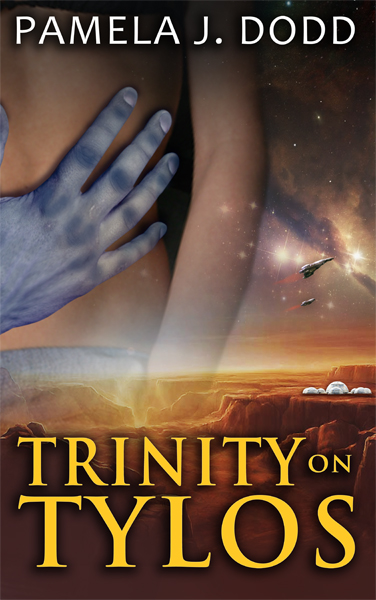
The new cover was designed by Dawn Seewer, who did the cover for The Gift Horse. The background depicts the landscape of Tylos IV, with the ships in the sky. The models in the foreground are Venice and Azareel, and I think the artist did a good job. A few of the readers of the original printed novel told me that the cover didn’t really convey the serious nature of the novel, so I hope that this new cover touches the bases.

For those who haven’t read it, here is the original synopsis that I used when shopping the manuscript:

What sacrifices must an officer make to save her shipmates from certain doom? Venice Dylenski, the young security chief of the colonizing ship, Excalibur, is faced with this dilemma after her captain makes a critical error in judgement in an encounter with an alien with superior fire power and a hidden agenda.

Trinity on Tylos begins as Venice experiences an embarrassing moment on a survey mission, one which rules out yet another planet as a hospitable home for their colony. While continuing its search, the Excalibur encounters the Archeons, an alien race characterized by gray-blue skin and a facility for language. The interchange results in Venice and a crewmate, Alathea Duke, being taken captive by the mysterious Archeon captain, Azareel. In short order, he informs them that they will play a critical role in revitalizing his dying race, that of surrogate mothers to genetically engineered Archeon offspring.

Venice, reluctant “to be the next Archeon soccer mom,” strives to escape, but her companion seems all too willing to cooperate with their captor. Thus the stage is set for multiple conflicts between human and Archeon, human and human, and humanoids verses the hostile environment of their new planetary home in the Tylos star system.

Trinity on Tylos has the elements of a good space opera: complex characters faced with myriad problems to solve, set in a future where man may have escaped the bounds of his solar system, but not the bonds of human emotions.

Rich Man’s War— a review

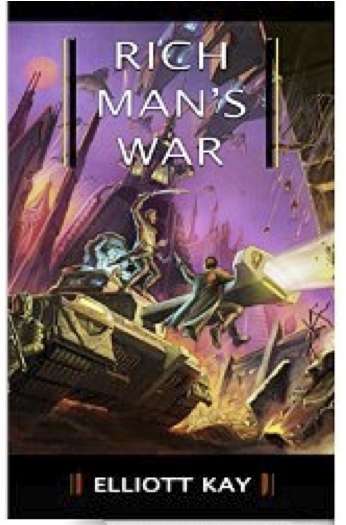
Rich Man's War cvrA couple of entries back I reviewed Poor Man’s Fight by Elliot Kay, and I really did like that book. Okay, in part, I liked it because it is in one of my favorite sub-sub-genres— a coming of age military science fiction story. But, that book was well-written and highly entertaining, and such books are sometimes too formulaic. Rich Man’s War is the sequel, and it does take up shortly after the events of the first novel in this series. The action, once it really gets going, is almost non-stop in PMF, but RMW is a more complex story, so it doesn’t move with the vim and vigor of the first one. Worse, it is quite easy to get bogged down in the “who is this part about, friend or foe” because the battles are large scale, so the cast of characters has grown exponentially.

Still, I am glad for the sequel to PMF. Somehow, readers just knew that Tanner Malone had a career ahead of him, and there is a natural desire to see the character evolve. Both Tanner and some subordinate characters from the first novel are important characters here, but in this entry, the corporations which have pretty much made Archangel inhabitants into economic slaves are the enemy. The plot development is organic, that is, what happens in this novel often has roots in the first one. I do not believe that RMW stands alone particularly well, so do read the first book first.

That said, I did enjoy the further adventures of highly decorated war hero Tanner Malone, and it is a good read if not a great one.

Leviathan review

Image

A couple of years ago, I purchased a copy of Scott Westerfield’s novel, intended for a young adult audience, for my son. Alas, he never read it, but that is not a judgment against the book, as my son tends to read books with video game tie-ins.

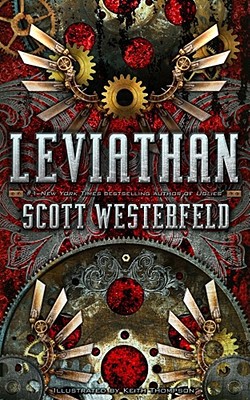
Since I was assigned a book presentation, (that’s a new term for report, y’all) I pulled Leviathan off the shelf. The book itself is inviting. The cover is amazing in its detail, and the form of the book is slightly non-standard, being just a bit taller and narrower than the norm. The paper is high quality, and the print is just a little wider than normal, which required adjusting the “leading” as the book was formatted for print.

Leviathan is an alternate history set in the era of World War I, written for a young adult audience in a genre known as “steampunk,” and is the beginning of a trilogy. The novel has two point-of-view characters, Aleksander Ferdinand, the (fictional) prince of the Austro-Hungarian Empire, who is forced to flee after the assassination of his parents, Archduke Franz Ferdinand and his wife, Sophie. The other point-of-view character is Deryn Sharpe, a commoner, a young woman who disguises herself as a boy so she may join the British Air Service. As the war unfolds, these characters provide insight into two forces in the war. The dualities do not stop there, however, for the British forces of this alternate history have bred various beasts to be both servants and machines of war, such as the Leviathan of the title. The Austro-Hungarian forces rely upon large mechanical warfare machines, such as the walker that Alek has been learning to pilot.

From the moment that young Alek is awakened by trusted old retainers, his story is suspenseful, but not unfamiliar. Count Volger guides Alek literally and spiritually toward a safe haven, as he pilots a huge walker, one of his army’s machines of war, as enemies of his father and of the empire seek to kill him. Alek is not on a hero’s quest so much as he is making the transition from innocence to experience. Nevertheless, there are times when he is heroic, such as his efforts to assist the stranded crew of the Leviathan, when it is wounded and lands near his hideaway in Switzerland.

Young Deryn, too, is on a journey, and while her adventures are also important to the plot, there is far more humor in her part of the story, as her character is propelled though the air via the large creature/ship of the title. The British forces use any number of genetically altered beasts as machines of war. Also, through Deryn, Westerfield makes some pertinent comments on the nature of humanity, such as her weary observation that the young airmen “endlessly competed to see who could spit farther, drink rum faster, or belch the loudest.”

By and large, I found this novel to be well crafted, but there are a couple of annoyances. First, the author substitutes words, such as “barking” for another four-letter word that is universally used as a vulgarity these days. Secondly, the initial swapping back and forth between point-of-view (POV) characters was a bit distracting, but after the first chapter, each POV character is on stage until the next chapter.

Westerfield alternates his POV characters in each chapter until the two meet upon a barren snow covered mountain, roughly half way though the 400 plus page novel. Alek saves Deryn from being trapped in the snow; then she promptly turns him in to her superiors. He is briefly held prisoner, but the British forces have far more to worry about than a mysterious young man from a mountain village. Ultimately, Alek is released so he can assist the crew of the leviathan, so the prince of Austro-Hungary and the crew of the great ship must cooperate to escape from the approaching German forces.

Westerfield’s Leviathan begins with a gripping first chapter and enough action to keep most readers entertained. Although I have not read much young adult literature, this author’s skill is such that I just might read more of his work.

Studying English in the Post Test and Term Paper Era

This is a follow-up to my last post, obviously. My online course is in full swing, and the syllabus was not a shock, because I have been involved in post secondary education in recent years, but it was a bit disconcerting. My course will be graded on forum entries, book presentations (reports), think pieces (term papers by another name) and the now ubiquitous annotated bibliography. No tests at all.

My husband asked, “Are you just doing 100% busy work?”

I said, “Yes” but he is male and I like to keep things simple for him.

Mostly, this course is busy work. Going to grad school nowadays seems to be a training ground for production of organic fertilizer. There is, however, some reading which is rather interesting, especially since the book reports are to be over young adult novels. Mostly, I skipped that sort of reading when I was the appropriate age, so apart from an occasional “coming of age” story, I have read little YA stuff.

To say that I am looking forward to these works is over-stating my position, but the assignments will force me out of my comfort zone a bit, and that is useful.

Still, I was always a good test taker, and I will miss having the opportunity to show what I know.