Star Wars: The Force Awakens

Since Star Wars The Force Awakens has broken lots of records for attendance, there are no doubt too many audience reviews for mine to matter. There are several elements that make this a film worth watching, and fans are mostly happy with it, at least in part due to the items (in my own order of excellence) enumerated here:

#1 The Score! John Williams’ score was instrumental in turning the original Star Wars from a mere comic book B movie into a box office bonanza. For the other films his compositions have kept the audience entertained, and Williams’ music is just as important here ever. For those not into classical music, the technique he uses is called leitmotif, wherein each character or plot device has it’s own musical theme, all interwoven into the whole. This is an operatic technique that helps the audience be even more emotionally involved the happenings on screen. It’s very cool, and it works beautifully in Episode VII.

#2 The respectful treatment of the aging stars of the original series. Although there is considerable exposition prior to the appearance of the famous trio, each character is given his (or her) moment on screen. The audience has a chance to see what’s happened during the passage of time, and the situation of each is organic in regards to their characters and situation way back when the Jedi returned in Episode VI.

#3 The new characters are interesting. Writing is hard work, and creating characters that readers (and/or viewers) care about can be difficult. In Poe Dameron, Rey, and Finn, the writers have given us a new generation of action characters. Hey, there’s even a cool new droid, BB-8. Compared to the characters in Episodes I, II, and III, these new guys are…oh, let’s be real. There is no comparison with those films. The new kids seem to be worthy successors, however. The actors do an excellent job of bringing them to life, too.

#4 Real “special effects” rather than CGI. Don’t get me wrong, computer generated effects have their place. But when Yoda ceased to be a puppet and became a glowing figure out of a computer game, his personality shifted from cute and quirky to something less interesting. This Star Wars has the look and feel of the original, but with more money. No doubt the prop masters were kept very busy during filming, but there is a difference when the actor is doing lots of stuff against a green screen vs. real props and sets.

#5 Good vs. Evil is central to the story line. For audiences to care, the good guys have to be mostly good, but have enough flaws for us to identify with them. The bad guys should be so bad that even Oprah wouldn’t try to understand them, instead she’d just shoot ’em.

The links are present for those who want to know more about certain aspects of the film, but that’s my take on the new Star Wars movie, which I recently saw with hubby and our young adult son.
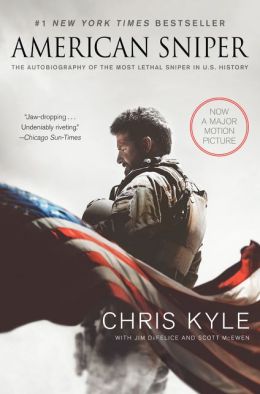
American Sniper— the book

American Sniper by Chris Kyle coverOkay, I admit, I have a tendency to do certain things backwards. Hubby laughs at this one: whenever I pick up a magazine, I thumb through and begin reading somewhere near the back. I sometimes do that with catalogues, too. Why? Because the snazzy pictures are in the front, and the words are in the back. I like words.

American Sniper, the movie, is in theaters in my area of the country as I write this, which means it is the perfect time for Pam to read the book! Chris Kyle’s exploits are apparently quite controversial, based on the reaction to the film, but I did not find it so much controversial as conversational. After I finished, I felt like I has spent a while talking with this Texas cowboy turned Navy Seal, who loved guns and his country enough to go back into a war zone, over and over.

Why is Kyle’s career a controversy? There are those who feel that Americans were invaders in Iraq. Okay, I see that. A little bit, anyway. Any war on foreign soil will have that aspect. And there are those who feel that being a sniper, hiding behind a big rifle with a bigger scope, is a cowardly way to fight. That I don’t get, at all. Guerilla warfare is not new. And, in the war in Iraq, with insurgents attacking government installations and convoys, having a sniper on every tall rooftop made a lot of sense. As he often puts it in the book, Iraq was a “target rich” environment. His recorded number of “kills” is far above any other sniper, and he is matter of fact in explaining that his accomplishment was in part due to being in the thick of things for four deployments.

Kyle’s story, which begins during his childhood in Texas, is entertaining and quintessentially American. When he discusses the war, it is the voice of a military man, explaining what happened from his point of view. Also of interest are brief interludes where his wife, Taya, discusses what was happening from her perspective. This gives the story more depth because modern warfare can happen so far away that the combatant’s home country is isolated from the realities of war. The price paid by the family is made quite real through her observations.

If you haven’t read Kyle’s autobiography, you might want to give it a try. Although it becomes a bit repetitive, because what he did on a day-to-day basis didn’t change all that much, his voice is strong throughout the book, and Chris Kyle was a man’s man in a country that has, by and large, gone soft.

Middle School Mentality

Since the video of bus monitor Karen Klein was posted on YouTube, there has been much written about the incident, but not much written about the mentality of the students who tormented her. If you haven’t seen the video or read any of the news stories associated with it, a brief summary of the incident is in order. In a video shot by a fellow student, a group of boys are heard calling an older female bus monitor fat, discussing what it would be like to stab her, and saying that her family would want to commit suicide because of their association with her. Klein does dissolve into tears, but never strikes back at her juvenile tormenters.

As a former teacher, and one who spent years working with students in the middle grades, I sadly state that this video is not so shocking to me. First, I will state that although I was sometimes the target of some taunts, my position as a teacher gave me more authority, and so I never dealt with anything so horrible. But, that said, parents and the public must understand the “middle school mentality” does include more than a bit of viciousness. More than once, I have described middle school students as being similar to a pack of rabid dogs. Individually, they are usually okay, but when grouped together, it is not uncommon to get some really bad chemistry. If there is an age where homeschooling is more appropriate, I believe it is the middle grades. When kids lose their need to impress adults, but before they become accountable, there is a danger zone, and grades 5-9 tend to be the rough ones, for the students as well as for the teacher and staff members.

My own children suffered bullying at that age; in fact, I was blessed to have a husband with a high enough position in the community that he could literally call up the superintendent of schools and ask him to personally intervene in a bad situation that was causing our daughter to go through emotional turmoil.

I have little doubt that the parents of those students in the video do not have to endure constant profanity and threats at home. Actually, I would imagine that the parents were probably shocked at the video of Klein being tormented. While the parents are partially responsible, the students are of an age to take responsibility for their actions. However, putting such students with so little control together, and giving those in authority no real power to keep the students in line, is the real problem.

If these students were in a homeschool, being responsible to one or two adults, and entrusted with assisting younger students, they simply would not get into a situation where they would have nothing better to do than torment others. Anyone who had read Lord of the Flies knows that it is not a new problem.

I’m sorry for Karen Klein, but not shocked. She has stated that if she had retaliated, she would have been fired. If any aspect of this incident is shocking, it is that society doesn’t realize what goes on when middle school mentality is allowed to run amok.

If It Bleeds, It Leads

One of my sisters is a journalism major, and when discussing television news, she often laughs and says, “Oh, if it bleeds, it leads!”

Television is such a visual medium that, by its very nature, can’t objectively report news. As a journalism major, who has dabbled in the field but seldom actually made a living in it, my sister once told me that she records the evening local news, two hours per day, each week, and reviews it in an hour or two on Saturday morning. She’s right, of course, the stories and film clips are recycled so often that there are only enough actual new items to fill a two-hour per week broadcast. My sister’s method makes for much more balanced coverage of the “news” since she is not bombarded by the same stories over and over. Just like viewing a commercial for a candy bar three times an hour can lead to a trip to the store for chocolate, seeing the same news clip once an hour for three days can make a natural disaster into Armageddon.

Worse, there are many news stories which ought to lead, but recently, the most visual (and loud, of course) stories were the “lead” items.

Charlie Sheen, with broken teeth and loud expressions of ego-centric rage, was the lead story for a few days. Important? Too those with only a few portions of gray matter still functioning, perhaps.

The New York City bus crash? A human tragedy, to be sure, but it was leading because it was bleeding. No doubt the driver was tired and dozed off. It probably happens every day, somewhere, but because there were many folks on the bus, it was visually stunning, so it became a lead story.

Japan’s earthquake aftermath should be a “lead” story. But, the constant emphasis on the “nuclear” disaster is a bit misleading, if you’ll pardon the pun. There is not going to be a Chernobyl situation in Japan, because the nuclear reactors there were built to withstand most problems, and the containment devices are working fairly well, given the trying circumstances of the earthquake and tsunami. If Japan had used coal or oil to generate electricity, there would have been problems with that as well. The microscope of television news is making the problem(s) associated with radiation appear much, much worse than they actually are. Right now, the Japanese need clean water, food, and shelter; and hopefully, Americans will do what they usually do, and provide aid to a nation in need.

There is much good going on in the world, but it doesn’t bleed, therefore it does not lead. For example, legislatures across this country are attempting to deal with illegal immigration by enacting laws which attempt to verify citizenship (and therefore harass non-citizens) and those actions are misguided. Most of us “Americans” came from somewhere else and became Americans. On my way to work, I pass by a church which has a huge sign out front, touting “Free Classes in English and Citizenship.” That church, with its parking lot filled with cars of those who want to become citizens, is doing more to help the immigration problem by helping assimilate immigrants than all of the legislatures combined. But the efforts of these kind Christians won’t make the news, because doing good is not a lead story.

By Pamela/Pilar Posted in news