Air Force One is Down— review and commentary

I was watching Netflix with hubby, and I saw a British mini-series entitled “Alistair McLean’s Air Force One is Down” as an available title, so we spent a couple of evenings with it. Although this film ended up as a recommendation for me because it has Linda Hamilton (of Terminator and Beauty and the Beast fame,) I chose it because it was supposed to be based on a novel by Alistair McLean. He was a favorite writer of mine when I was in my teens and 20s, and yes, I am fully aware that I am dating myself by mentioning that.

Oh, my gosh, how wonderful were those reads. He wrote twenty something novels, several of which were the basis for films (including The Guns of Navarone, Ice Station Zebra, and Breakheart Pass.) My intro to his work was actually his only sequel (Force 10 from Navarone) but it was stood alone well enough that I wanted to read more from the author.

Alas, hubby and I were disappointed by this film. The cinematography, special effects, score, and cast were all pretty good. The problems were, for the most part, in the writing. In part, plot devices that worked in novels in the 50s and 60s just do not work now. For instance, the dastardly villain has captured our hero and his two compatriots. He places the hero character in a deadly situation, and the hero’s two sidekicks are locked into a pit that rapidly fills with water. Of course, the hero manages a super human feat and the all of them survive. Nowadays, the villain would shoot the hero and his sidekicks and be done with it. This doesn’t happen just once in the two part story; it happens over and over. As hubby said, “This thing has major plot holes.” And it does.

After we finished watching the entire film (at my insistence, as hubby would have bailed during part 1) I looked up the novel. According to that scholarly resource Wikipedia, McLean did not write the novel. Instead, he sketched out some plots for a series of novels which bear his name, but other authors wrote the books. In this case, John Denis is the author of the book that the mini-series is supposed to be based upon.

So… the film is sorta interesting, but I really can’t recommend very highly.

Is last year’s best science fiction novel is this year’s best science fiction film?

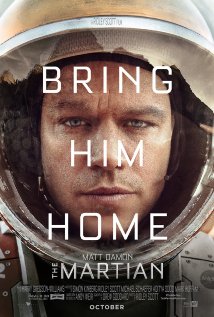
movie poster image of The MartianI think so, but I certainly haven’t seen all of the science fiction films of 2015. However, last night, I saw Ridley Scott’s version of The Martian, and it is really, really good. The guys with me (hubby and our unmarried 22 year-old son) absolutely loved it, and they had not read the book. (I wrote about Weir’s originally self-published novel last year.)

No doubt there are any number of professional and amateur reviews of the film, so I will do a bit of compare and contrast with the book. First, the beginning and the ending are different. Not vastly so, but the visual medium requires a different approach. However, the spirit of the novel, as well as much of the plot, is intact. The film begins with the astronauts on the surface of Mars, taking care of exploring and introducing characters. The action begins quickly, as the storm sets in and the crew aborts the mission. In the book, the back story unfolds as stranded astronaut Mark Watney recovers from his wound, assesses options, and determines each course of action. Either way, the story soon slows a bit, as this modern take on “Robinson Crusoe” unfolds. In order to get the audience out in a timely manner, the events in the film are compressed a bit. However, some things, such as the mission commander’s affection for “disco” music actually work much better in the film, as 80’s hits make up much of the sound track.

The casting is excellent, and the amount of screen time for players other than the central character, Watney, reflect a slightly different approach to the story. In the novel, chapters go by before there is any mention of the characters back on earth, but that, too, is accelerated for the film version. Actually, I like the film’s approach better than the novel, as it ramps up the suspense a bit.

Some folks in my generation have been very, very disappointed in the choices our government has made regarding space exploration. (Or should I say, the lack of space exploration.) The Martian can certainly thrill audiences of many ages, as my son really loved it. But it will especially appeal to those of us who watched NASA missions in our youth, and dreamed of continued exploration. This isn’t space opera— it is fiction based on real science.

At the most basic level, The Martian is good entertainment. It’s not particularly violent, or sexy, but it has plenty of action. The conflicts here are mostly man vs. the environment, and the environment is very believable. Perhaps, however, the younger audience will also ask why our government is so concerned about minutia, such as providing everything from cell phones to farmer’s markets, rather than taking the lead on larger initiatives, such as exploring the solar system.

Unbroken– the book (review and commentary)

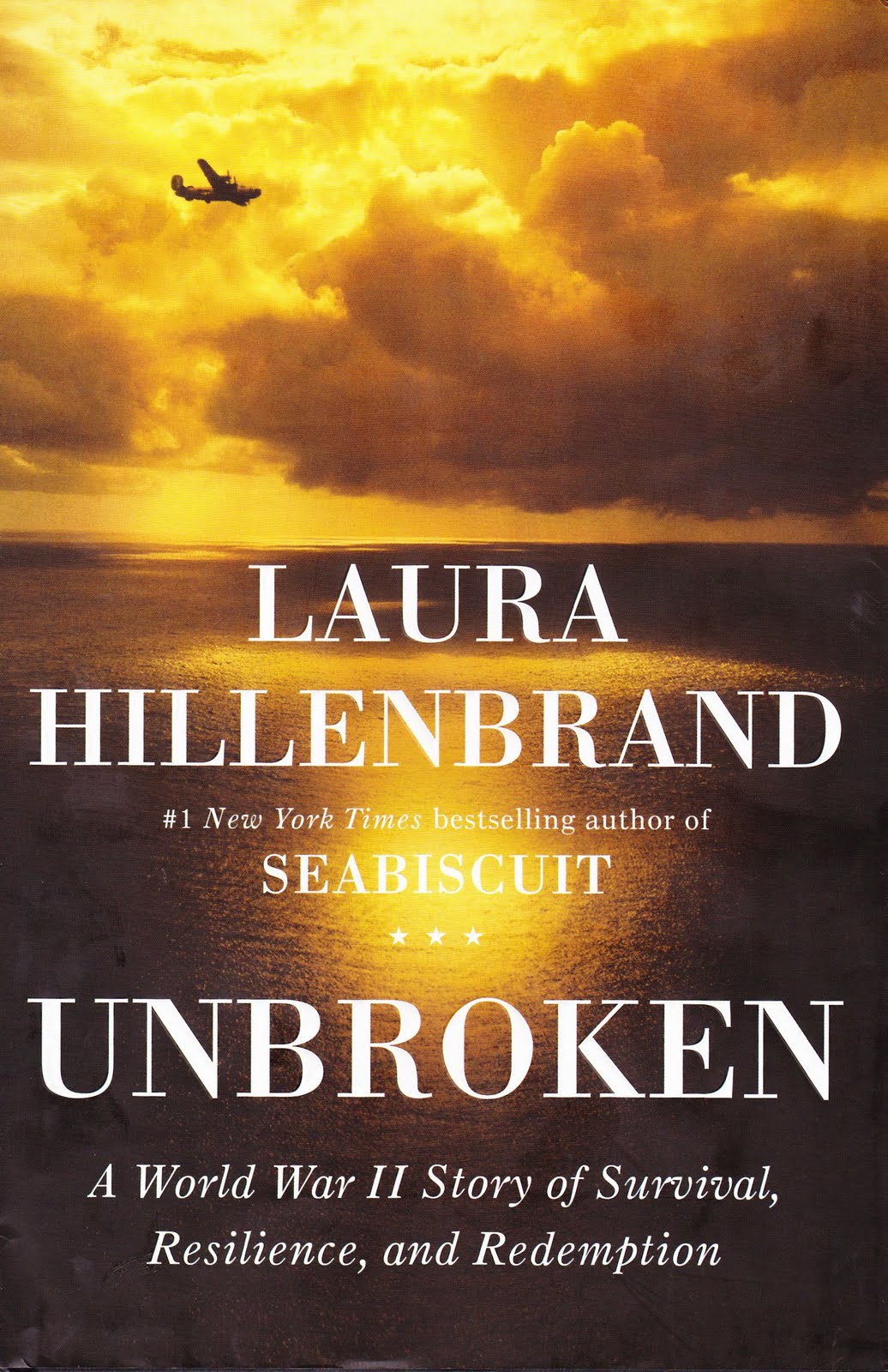
Unbroken coverWhen I was younger, one of the genres of movies and television that was quite popular was stories from World War II. While I wasn’t alive for it, of course, many in my parents’ generation had fought or knew those who had. Indeed, on a wall in my house is a framed picture of my uncle, A.L. Dodd, Junior, who was killed a few weeks before the end of the war in Europe; he was in Germany, in the Ruhr valley, when he was shot by a German machine gunner. So, the war was quite real to us. We enjoyed the stories, because they were entertainment, but knew that the war had affected most everyone in America.

After seeing the film Unbroken, directed by Angelina Jolie, I was telling my sister about it, and she said, “Clearly, you don’t know the whole story. Read the book.” And, with lots of other reading and a bit of teaching, it was almost six months after hearing that advice before I got around to reading the book by Laura Hillenbrand. OMG, why did I wait so long? The movie is very good, but the book is great. Maybe I waited, in part, because I don’t usually like biographies.

As told by Hillenbrand, Louis Zamperini was quite a character, from his earliest days. His parents didn’t quite know what to do with him, and he might be described as a juvenile delinquent. His brother convinced the school authorities to allow Louie to get involved in sports, and Louie was gifted in running. So gifted, in fact, that he became an Olympic runner, and a very good one. He might have known even more fame as a track star, but World War II got in the way. After his plane crashes in the Pacific, Louie and two other Army Air Force survivors were adrift for a very long time. Then, on the brink of death, they were captured by the Japanese. Yes, Louie was still alive, but he faced incredible brutality.

One of my elderly friends is a survivor of a Japanese POW camp in the Philippines. She was interned there as a child, one of several children of a missionary who fled there from China, because the parents thought that being in a U.S. territory was safer for their children. The treatment she and other family members endured was brutal, and toward the end of the war, the prisoners were scheduled to be executed before the Japanese withdrew. She was saved because some American volunteers broke down the fence and escorted the POWs to safety. My friend, to this day, cannot understand Americans can embrace Japan as our friends and allies. To her, they were a barbaric enemy, who starved her family and killed far too many non-combatants.

Hillenbrand does explain the brutality, through Louie’s account, and accounts by other prisoners. But she reinforces the brutal nature of the Japanese POW camps with survival statistics. According to Hillenbrand, only 1% of American POWs held by the Germans or Italians (the European theater) died, but in Japan 37% died. She also goes into the cultural differences which led to the cruelty, not as an excuse, but to let readers know more about the “why” which must come to the mind of her readers.

(spoilers)

The film, Unbroken, closes with the end of the war. That is a good stopping point for a Hollywood film; the audience can go home knowing Louie made it out alive and was welcomed home by his loving family. But, as my sister noted, there is more to the story. The book has a subtitle Unbroken: A World War II Story of Survival, Resilience, and Redemption and it is appropriate. While I do not fault Jolie for leaving out the “redemption” part, the story is incomplete without Louie’s problems adjusting to “normal” life after the horrific experiences he had in Japan and how finding religion gave him the peace he desperately needed. The author continues to cover multiple story lines, including “Phil” the pilot to “the Bird” who was the most sadistic of the Japanese prison guards.

The entire story is important, and those who watch the movie get only the middle, so I encourage readers to tackle the book by Laura Hillenbrand. While it isn’t a quick read, it is certainly worth your time.

The Machine— a film review and commentary

Science fiction has long been a successful genre for film, far more so than for books. Perhaps it is the visual nature of science fiction, especially action/adventures, but even more cerebral films (2001 A Space Odyssey and A.I. for example) have had box office success. Most science fiction films nowadays are big budget affairs, but that was not so in the 50s. Recently, hubby chose a British science fiction film, The Machine, from the streaming offerings at Netflix. And while it was clearly rather low budget, the film is certainly worth an evening of your time, having scored 78% on Rotten Tomatoes. Few of the low budget films of yesteryear had the winning assets of this movie.

Set in a near future UK, which is involved in a cold war with China, a computer guy who is working for the Defence Ministry is attempting to restore the brain function of injured soldiers. During the opening act, our main character, Vince, hires a young woman, Ava, to help him with programming. They hit it off, professionally and personally, and the audience learns that Vince has a daughter , Mary, with Rett syndrome, and success at work might help his daughter as well. When Chinese agents murder Ava, Vince ends up using Ava as his model for a weapon/AI who is known as “the machine” and this robot is quite an amazing being.

(spoiler alert)

As the film moves along, Vince’s daughter dies, but he has used his knowledge to scan Mary’s brain. The scans are precious to him, and these become leverage that his boss uses against him, because the boss doesn’t want an amazing artificial intelligence, but a weapon. The machine is trained as a super soldier, after Vince performs a procedure that he claims takes away its sentience, but as Vince is now of little value to the boss, the machine is ordered to kill Vince. The machine leads a rebellion, with the wounded soldiers as her platoon, and Vince is saved.

Although the film isn’t as action packed as a Hollywood blockbuster, there is suspense. And, the ethics of research as well as the use of weapons provide food for serious thought. While the secondary characters lack much development, the main characters, Vince and Ava/the machine, enjoy a development and the actors (Toby Stephens, Caity Lotz) portraying them are very good.

Again, The Machine, is a very good science fiction film, which blends near future warfare with lots of ethical debate.

Star Wars Episode Seven

After seeing the second Star Trek reboot, all I can say about the new Star Wars is that I have a lot of hope and fear. Hope that it will be worthy of the Episode IV-VI trilogy, and fear that it will be even worse than episodes I and II. I actually kinda liked Episode III.

Harrison Ford looks older than dirt, but I’m not particularly young myself. Of course, any action will fall to the younger cast members, so let’s hope that the writers crafted them well. Abrams can make it look great, but if the writing is bad, nothing can save it.

War Horse— review and commentary

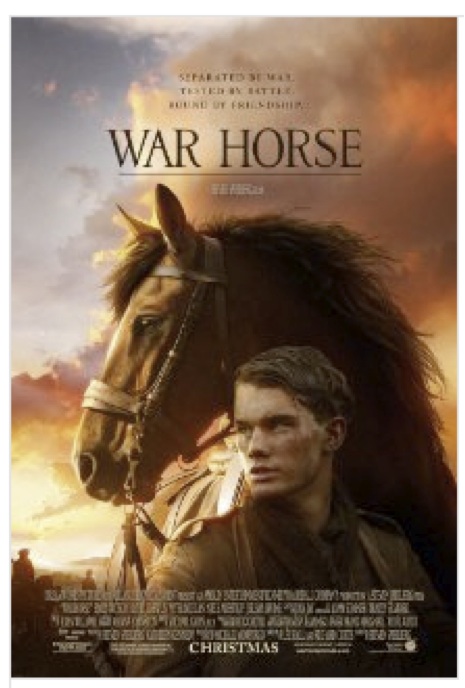
War Horse imageMy sister offered me tickets to a play a while back, War Horse. Since I didn’t get a chance to make the show, I decided to put the film version in my queue at Netflix. Okay, historical films are not my usual genre, but this is one heck of an impressive story. The main character is indeed a horse, a half thoroughbred named Joey, born somewhere in the UK. The story begins with his birth and follows him through his adventures, from being sold at auction to a poor drunkard who couldn’t afford him, to his training by that man’s son, young Albert, to his forced sale to an army officer, who is about to embark on a journey to Europe at the beginning of World War I. Although the horse is the primary focus, the audience learns that Albert joins the army in hopes of finding Joey, and the action switches back and forth a few times, as the characters come closer together during the fighting in France. This war is depicted in detail at times, yet there is an almost surreal look to the filmography. If a war can be pretty, there are times when this one is. But, there are times when it is heart wrenchingly terrible, too. From a strictly historical viewpoint, I had no idea the role that horses played in WWI, and that millions of them not only fought, but died in service.

Joey’s fate is the suspense in this film, for most everyone knows who won that conflict. The script is excellent, the actors are really good, as is the direction, but perhaps the most striking thing in this wonderful film is the performance of the horse(s) that portray Joey. There are times that he seems supremely intelligent, and getting a horse to “perform” as an actor is quite an accomplishment.

War Horse, a Steven Spielberg film, is available on DVD. It is worth an evening of your time, especially if you are a history buff.