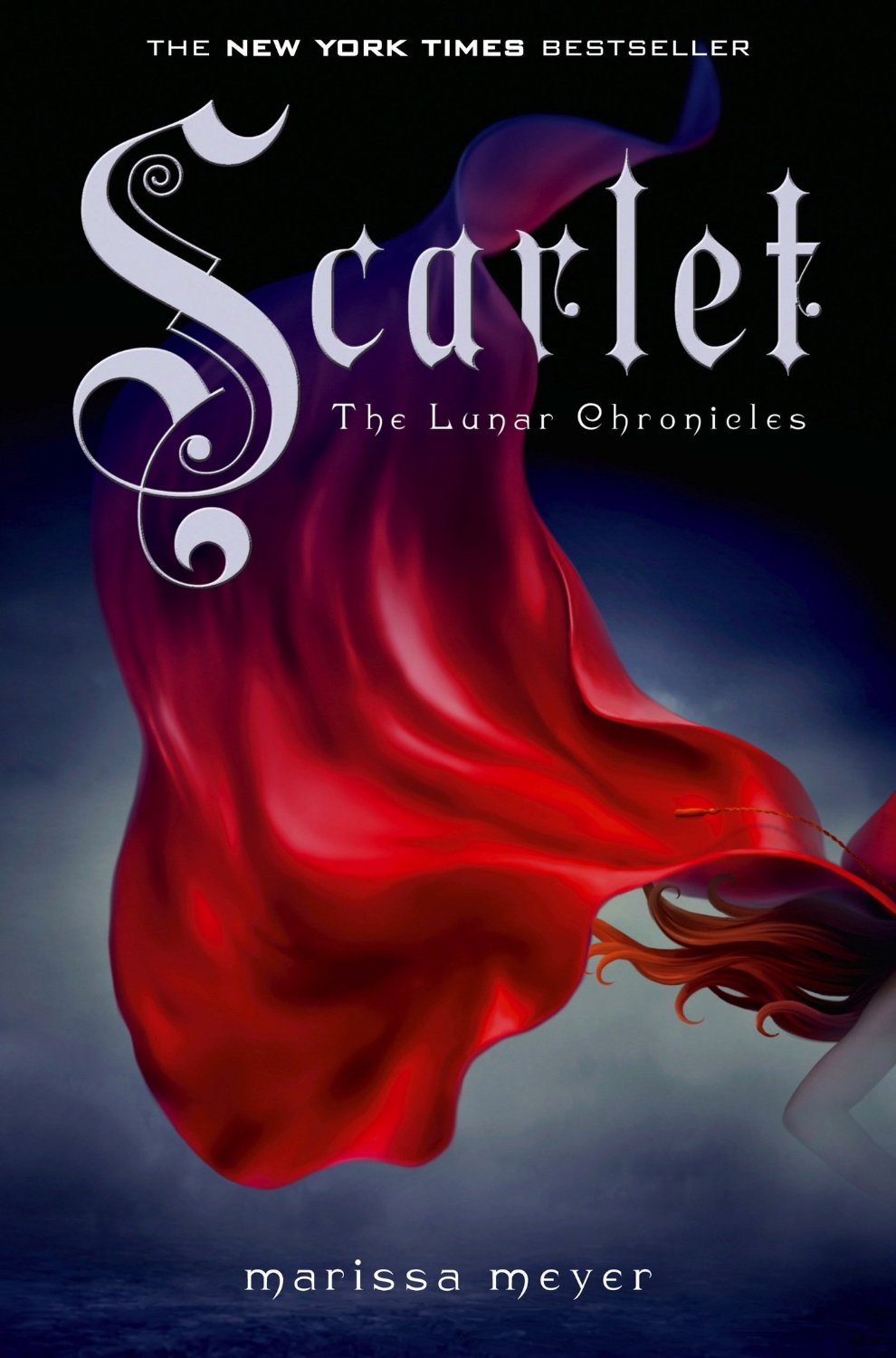
 A while back, I wrote a review of Marissa Meyer’s Cinder, which begins a series the author calls The Lunar Chronicles. After I bought it, I did not read it, but put it off for a while. I like science fiction and have no problem with YA titles, but it sounded kinda weird. Once I read it, I did like it. I really liked it, actually. And, once again, I bought the next installment, but put it off while I read another book (Darrell Bain’s The Frontier Rebellion). Then, a few weeks back, I clicked on the cover of Scarlet, and I will admit that I was not entranced after the first chapter, but I pushed myself, and the book did pick up. If you begin and wonder if it is book extolling the virtues of organic gardening, just hold on. Scarlet is a worthy tale, but I will offer a warning to readers—it would be quite confusing to a someone who did not read Cinder first. The story of Scarlet, who abandons the family farm to search for her lost grandmother, is so intertwined with Cinder’s continuing adventures that it is far better to begin with that book and then pick up this action packed story. If this were just the story of Scarlet and Wolf, I would not give it a five star review, but when I reached the end of Cinder, Meyer was clearly not finished, so I was expecting to see her again. Perhaps not so much of her, but that is actually a plus. Now, the character of Scarlet is interesting, and there is plenty of suspense as she struggles to find her grandmother before something really bad happens, but I especially like the multilayer enigma of Wolf. Even more than the first book, this one has the trappings of a gritty urban fantasy, with science fiction elements, and a bit of romance, too. Many times, I have stated that the best fiction is aimed at younger audiences, and this novel is more evidence of that. I noticed that Cress is now available, so I will buy it soon.
Category fiction
The Long Way Home
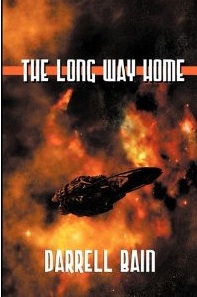 One of my favorite eBook authors is Darrell Bain. I think of him as the master of plots. Oh, there are some problems with his writing, primarily in the “show don’t tell” category, but this guy writes the most amazing yarns.
In the dedication of The Long Way Home, Bain recognizes three important Baen Books authors— David Weber, John Ringo, and Travis Taylor. And fans of their brand of science fiction will no doubt see that these authors influenced Bain in this space-based tale. Weber writes military science fiction on a grand scale; Ringo puts the grunt into military fiction, and Taylor is a rocket scientist who can also spin a good space opera. Bain doesn’t do any of those quite as well as these guys, but he does blend the elements quite well.
The plot is not unusual, with opening scenes of an exploratory vessel far from home, and a first contact mission gone awry. But instead of one or two explorers meeting a premature end, as happens in James Alan Gardner’s Expendable series, there is a massive loss of life and starship, and a small “longboat” known as “The Hurricane Jack” is left to ferry the survivors home. And it isn’t a short journey, hence the title. There are many obstacles, and the conflict is almost non-stop, between the “monkeyclaw” ship following the survivors, and the internal debates over matters in the tightly packed small ship. The mission is now to save the survivors and warn the human population about the vicious species they wished they had left behind. As a small vessel, the longboat must stop to scavenge material, and every stop has some built-in danger. Unlike some writers, Bain is not afraid to kill off his characters, which ramps up the peril factor.
Fans of space exploration stories should enjoy the action-packed suspenseful voyage of “The Hurricane Jack” in Darrell Bain’s The Long Way Home.
Where are all the science fiction readers?
 I recently read a post on SFReader/SFWatcher stating that there are only 20,000 regular readers of science fiction. That’s fewer folks than live in my home county here in Georgia, making this a really astonishing statistic. The webmaster at SFR/SFW is now paying for movie reviews, in hopes of growing the website. No compensation is offered to reviewers of novels, of course.
When I was taking Mythology in Literature during grad school, one of our texts was by Joseph Campbell, who says that science fiction is mythology for modern people. If science fiction is so important culturally, why aren’t more people reading it, and what might attract a larger readership?
In 2004, Business Week ran an article entitled ScFi: Novel Inspiration which lists four valid reasons for reading science fiction. They include looking for new inventions, understanding the social consequences of invention, learning the lexicon of the future, and inspiring young minds. As America stagnates, and it really is doing just that, I wonder if our lack of wonder is at fault.
While science fiction does more than explore invention, that is one important aspect of it. A website called Technovelgy.com lists almost two thousand ideas which began within the pages of science fiction. Most people know that Captain Nemo’s ship beneath the sea predates the submarine, but how many folks know that Verne also predicted live news conferences, retro-rockets, and was the first to postulate that space travelers would have to deal with being weightless?
One of my favorite SF authors, Robert A. Heinlein, employs 3-D television, exoskeletons for the military, and smart lanes on the highway. All of these are in the later stages of development, and will be as much a part of our future as the “pocket phone” (which he used in “Assignment in Eternity” in 1953) is today.
Recently Fortune magazine published an article about the dearth of math and science students in the United States. Of the 8,000 students who graduated from U. S. colleges with a Ph.D in engineering this spring, two-thirds were foreign nationals. Just a few years ago, most of those students might have stayed in America, but today, the majority will return to their home countries, because the opportunities to use the skills they just learned are there, and not here.
“The fastest-growing college majors in America as of 2007, says the U.S. Education Department, were parks, recreation, leisure, and fitness studies, as well as security and protective services.” (Fortune, July 29, 2010) As Americans turn their collective backs on science (and science fiction) our nation will continue down the road to economic ruin.
In my research on why readers don’t enjoy science fiction, a number of reasons were mentioned, including:
“It’s too hard to read.”
“The future in science fiction literature is too dark.”
“The science is bad.”
All of those reasons might have some merit, but there is a reason, which should have no merit, that I encountered while promoting Trinity on Tylos: There is a social stigma associated with reading science fiction. Ouch!
Oddly, people who see movies such as Avatar, The Dark Knight, or Jurassic Park don’t seem to feel that society is shunning them when they view science fiction on the big screen. In fact, many of the top grossing films of all time are either science fiction, fantasy, or have some ties to speculative literature. Now, the question is, how do we get those youngsters to make the leap from looking, to reading, and on to inventing?
That question is far more important than expanding market share for science fiction, which is stuck at a mere six percent of book sales. What America must accomplish, to expand the job market and our economy, is to expand the minds of our younger citizens. Science fiction should have a role in that, but someone, somewhere, must introduce it to them, and the earlier, the better.
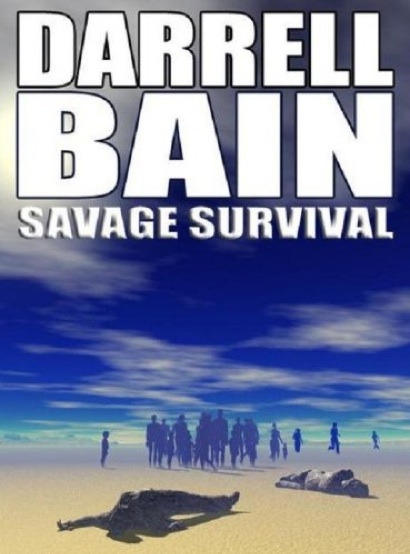
Review of Savage Survival
 When many people view an author as just fabulous, that writer sells boatloads of books. Remember when everyone was reading the latest Stephen King? Other authors write memorable books, but they only do it once— Margaret Mitchell and Harper Lee come to mind. Some writers are prolific, but it seems impossible to remember the plot of any specific book. Numerous such authors are still writing, but I am reluctant to name a living one, since I really don’t want to make my readers angry. So, I will list a prolific author who probably won’t complain, since she is no longer writing— Barbara Cartland. She wrote over six hundred novels, but I can’t recall any standouts.
Then there are some obscure writers who ought to be less so, and Darrell Bain is one of them. I’ve read several of his yarns, and they are invariably memorable. Savage Survival is typical Bain— something extraordinary interrupts ordinary, and characters rise to the occasion, or they don’t. I’ve seen grace under pressure— my mother was almost always cool and competent, regardless of her circumstances. My husband has that same quality— he manages the most difficult of situations without unnecessary drama. Such people have character, and I greatly admire that quality.
In Savage Survival, the main character, Lyda Brightner, is eleven years old. Yes, she comes of age, rather quickly, but she remains vulnerable enough for readers to be empathetic to her. Various adults interact with Lyda as the story unfolds, but the focus is always on her. Not since Oliver Twist have I followed a youngster through so many trials. Like Dickens’ classic tale of social inequality, Bain’s story is about the crucible of humanity under extreme pressure, but it is also about how people can either make bad times better or worse. There is something distinctly old-fashioned in Bain’s themes, and I don’t intend that as a criticism. In Bain’s books, he tells you who is good and who is bad, and those who are evil suffer for their wrongs, usually at the hands of the hero. Pretense, which is an integral part of modern life, is quickly exposed in Bain’s pressure cooker, and Lyda has no qualms about dispensing justice. Such authenticity is only found in fiction these days, which is ironic, isn’t it?
The story is science fiction, but it is soft-scifi, because Bain never bothers explaining how anything works. Instead, he spends most of the novel showing how people react to it. With my fairly busy schedule, I often begin a book and I’m still working on it a week later. Others are more compelling. Savage Survival took me about 24 hours, and that is only because I do have to sleep sometime. Lyda Brightner got under my skin in such a way that I just had to know how it was all going to play out.
I read the eBook version, but I believe the publisher, Double Dragon, also put a few hundred into print. Whether you choose electrons or ink and paper, I highly recommend Bain’s books, and this particular title is quite worthy.

