Terms of Enlistment

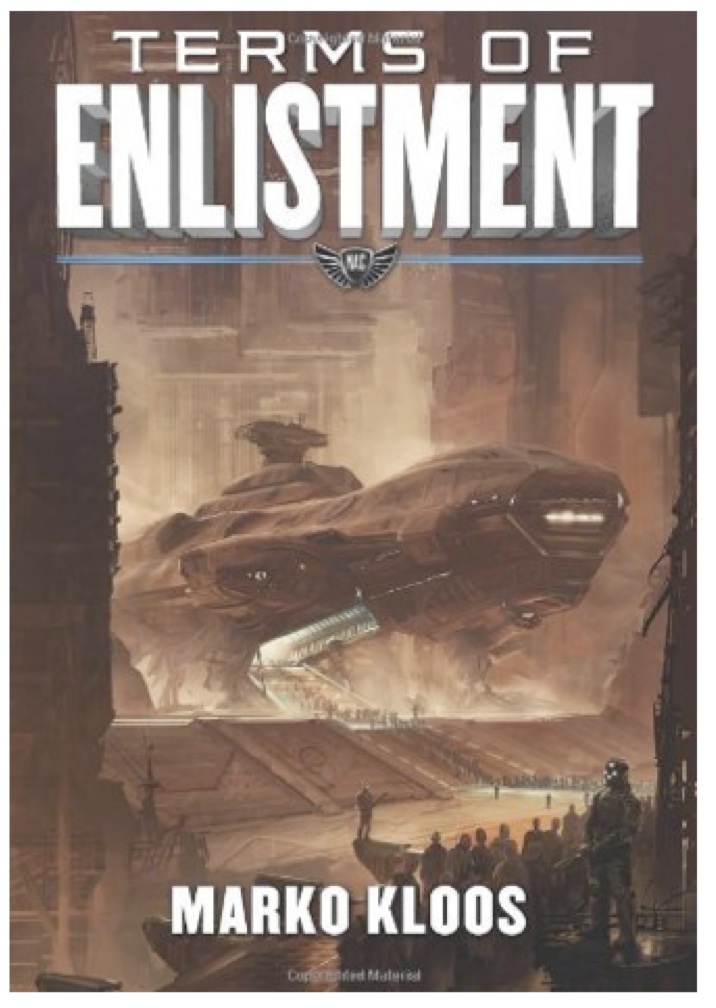
Cover art of Terms of Enlistment by Marko Kloos

Space Opera!

Okay, I’ve never “served” as military folks put it, but I really enjoy reading about the exploits of those who have done so. Perhaps due to watching the exploits of astronauts with military titles in my youth, I still believe that the military will play some role when (or if) mankind actually goes into space and establishes colonies on other worlds. In my own Trinity on Tylos my main character, Major Venice Dylenski, has a military background, but I viewed her as a bit like “Captain” Miles Standish might be viewed in American history. He’s a military guy who is there for security, and my character is the security chief, because someone ought to be in charge of that when landing on uncivilized planets.

In Terms of Enlistment, by Marko Kloos, the military is far more than security; it is the force that keeps the homeworld (earth) and colonies safe. Andrew Grayson is the main character; he grew up in a welfare section of Boston. Desperate to leave the vicious cycle of generations on public assistance, he joins the military. Okay, that is hardly a new plot line, but as Kloos paints his picture of Grayson’s world, readers can easily believe this dystopian view of the “North American Commonwealth.” As a new NAC recruit, Grayson is under quite a lot of pressure. Failure in any area, from taking orders to passing tests, will cause him to “wash out” and go right back to eating welfare rations and watching his folks succuomb to treatable illnesses. Thus, there is an additional layer of suspense added to the usual risk/reward of enlistment. Once our hero gets through basic, he can expect a five-year hitch, then go back home with cash, and education, and a fresh start.

(spoiler alert)

However, once Grayson gets through basic, instead of being posted to a naval (spacegoing) vessel, he is placed into the TA (territorial army) and tasked with policing the very sorts of places that he sought to leave. However, as the yarn rolls along at its brisk pace, Grayson faces domestic enemies with courage and is able to use his heroism under fire to wangle a transfer to the space navy. Once there, he hopes to be set for his five year enlistment, but an alien species invades, and he has many more opportunities to be heroic, and less and less to return home to, as the government pours all of its resources into saving the colonies, leaving the homeworld to become barely habitable.

While it doesn’t break much new ground, Terms of Enlistment does an excellent job of entertaining the reader. The  main characters are more than stereotypes, and the world building is quite good. I’ve already re-upped for the second novel in the series (Lanes of Departure) and am enjoying it, too.

Terms of Enlistment is a bit like Heinlein’s Starship Troopers, but with less of Heinlein’s political agenda. Fans of space opera and/or military fiction would be wise to check out this well-written novel. Oh, and it is rather long, so for $3.99 it really is a bargain, too.

How to write a bad book review

DIYYep, that title was carefully phrased to have dual meanings. I’ve been a book reviewer and an author. Sometimes, as a book reviewer, I just didn’t like a book. That’s tough. Sometimes, as an author, readers don’t like what I have written, and that is tougher, because a one star review can cause book sales to plummet. Well, unless the reviewer is an obvious nut-case, and in that instance…it still hurts.

First, let’s deal with how to review a book that isn’t just want the reviewer/reader wanted. If writing for a site or magazine, the best thing is for the reviewer to just pass on it. Let’s face it, not everyone likes every book. Really. I’ve read classics and wondered, how the heck did this book even get published, much less remain after its fellows all ended up in the landfill? So, it really is best to pass it to another reviewer who might be more amenable to the book. But, if it is absolutely necessary to review it, begin with what isn’t wrong with it. Surely there is something— good prose, interesting setting, an absence of poor spelling and/or grammar. Find something good. Then, state the objection(s) clearly, and then explain the obvious— that others might not agree. If five stars are available, then rate accordingly, and there really should be more than one star clicked. Because whatever the reviewer found that was good probably warrants a second or even a third star.

A really, really bad book is going to be rife with problems— spelling, grammar, formatting; or lackluster characters, a plot that moves more slowly than molasses on a cold winter’s day; or even inconsistencies (such as a character with blue eyes in chapter 1 and brown ones in chapter 8). In such cases there is no need for the reviewer to get emotional and resort to “I”, “me”, or “my” because the author burdens the work with too much evidence that the book is indeed bad. There, and only there, might those one and two star reviews be warranted.

If the book is an eBook, and the reader purchased it from Amazon, there is a return feature. Did you know that? I didn’t, until recently. Anyway, the other day I returned a highly rated sci-fi novel. I did not write a bad review, because I wasn’t about to waste enough time to read it and then review it. Those who slog all the way through a Kindle title only to write a one star review must have intense masochistic tendencies.

Finally, I’ll deal with the second interpretation of my title. Sometimes readers do write really bad reviews. Readers (hopefully not reviewers) who write bad reviews seem to have a tantrum while sitting at the keyboard. The most prominent word in the review is probably a first person pronoun, such as “I” or “my” or “me” because such reviews are not written for other readers, but to express the emotions of the reviewer. In short, bad reviews begin with a lack of objectivity. Then the bad reviewer indulges in emotion, from boredom to revulsion, but the writer of the bad review seldom mentions any positive(s) in the book. Finally, writers of bad reviews usually need a reason for the hissy fit, so the review ends with a warning, guised as altruism to save potential buyers from a book that took months (or even years) to write and costs less than a Quarter Pounder with cheese.

Do it yourself book reviews are just as much a part of modern life as kids who commit suicide because they can’t handle what their mean peers write about them online. Authors just have to be tough.

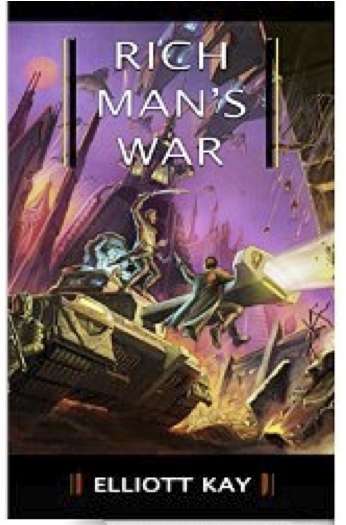
Rich Man’s War— a review

Rich Man's War cvrA couple of entries back I reviewed Poor Man’s Fight by Elliot Kay, and I really did like that book. Okay, in part, I liked it because it is in one of my favorite sub-sub-genres— a coming of age military science fiction story. But, that book was well-written and highly entertaining, and such books are sometimes too formulaic. Rich Man’s War is the sequel, and it does take up shortly after the events of the first novel in this series. The action, once it really gets going, is almost non-stop in PMF, but RMW is a more complex story, so it doesn’t move with the vim and vigor of the first one. Worse, it is quite easy to get bogged down in the “who is this part about, friend or foe” because the battles are large scale, so the cast of characters has grown exponentially.

Still, I am glad for the sequel to PMF. Somehow, readers just knew that Tanner Malone had a career ahead of him, and there is a natural desire to see the character evolve. Both Tanner and some subordinate characters from the first novel are important characters here, but in this entry, the corporations which have pretty much made Archangel inhabitants into economic slaves are the enemy. The plot development is organic, that is, what happens in this novel often has roots in the first one. I do not believe that RMW stands alone particularly well, so do read the first book first.

That said, I did enjoy the further adventures of highly decorated war hero Tanner Malone, and it is a good read if not a great one.

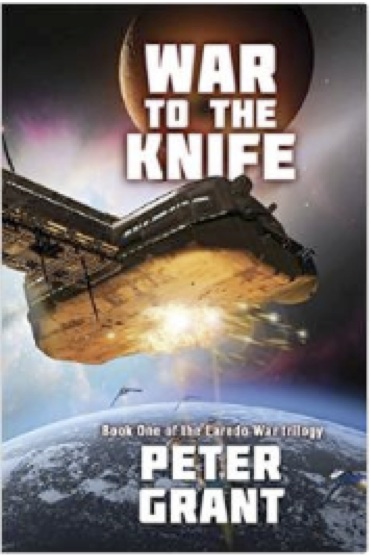
War to the Knife— a review

War to Knife cover

Since I have a break at work, and it is really hot in Georgia, I’ve been reading. My latest Kindle eBook is War to the Knife, by Peter Grant. I gather that this is a first installment in a series, and in a way it reminds me of early David Weber or John Ringo, but on a smaller battlefield. Once I got past the “old west” opening, I really began to identify with the stubborn band of rebels. They fight, but they pay dearly, too. I once heard David Weber talking about his Honor Harrington series, and how her heroism is “bought with bitter coin” and that also describes this story. The combatants die, and in a gory fashion, so there is plenty of that gritty realism. However, the author switches between the point of view of the rebels and that of an officer on the other side, which does remind me, once again, of Weber. By seeing both sides of a war, even when one is clearly the enemy, there is a better understanding of the price paid by winners and losers.

The author gets a little too into explaining some things, such as the ordinance, but that’s just personal taste. I tend to be more into how the characters feel than how many missiles it takes to blowup whatever, but other readers might want to more about the size of the warhead. But, the ingredients of a good military/space war story are present: a great cause, likable heroes, dastardly but not insane enemies, and plenty of weapons. However, the name of the enemy, Bactria, doesn’t work for me. It sounds like a topical antibiotic or something.

Still, I liked this story quite a lot and the story is, for the most part, well-written and edited. Nowadays, so many people are self-publishing via Amazon that there are quite a few poorly written and edited books, so I begin with reading the negative reviews. If there are several that point out grammar, spelling, and consistency issues, then I keep looking. The reviews for this book are positive, and I agree with most of them. War to the Knife is a very good read, and I ended the story wanting to read the rest of the series.

Star Trek Into Darkness— yes, another review!

More than two years have passed since I went to see a movie at a theatre. Oh, I have watched films, of course, but Netflix and Amazon Prime are my usual ways to see movies these days. For the new Trek flick, I made an exception.

Mostly, I enjoyed this new entry into the universe of Star Trek. While I am old enough to have seen Shatner and Nimoy doing the original series first on its first run, I fully understand that if Trek is to reach current audiences, then it had to go through the reboot process. That, of course, means that many of the characters and/or situations will be revisited, but they will be “different” in some manner. And so it is with this yarn.

Here is the usual spoiler alert.

The opening is entertaining, but it trivializes Kirk’s decision to save Spock, while it presents a spectacle for the eyes. Almost immediately, Kirk is busted from Captain to cadet, which is hardly how the military works. After a crisis that is really not all that major, Kirk is promoted to first officer, and after his mentor is slain, he’s back to captain. This is in the space of a few minutes of screen time, and not a lot longer than that in real time.

There is a scene on Kronos, the Klingon home world, but these fierce warriors have little to do, which is a disappointment. In the Star Trek universe, Klingons are awesome, but not in this film. After capturing the evil Mr. Harrison, Kirk assaults him with his fists. Yeah, he is the commander of the gi-normous star ship in the opening scene, but he resorts to fisticuffs.

I could go on, but I think I have given sufficient evidence for my complaint about this film. Do understand that it is well-cast, exciting, and a visual feast. It pays homage to TOS, which is pleasing to older fans, and I count myself among them.

Over a decade back, I read Donald Maass’ How to Write the Breakout Novel. In this highly instructive book, Literary agent Maass lets aspiring novelists in on several techniques for success, but one of the most important is to make every crisis a bigger threat, to make every hero larger than life. For a novel to “breakout” it must raise the stakes.

Kirk and company seem to have lowered them in this film. Before it was released, there was some discussion of using terrorism as a plot device, as it seems to be an over arching theme for our world. Since entertainment is one of the chief exports of our country, it is important that movies, even Trek, sell tickets worldwide and not just stateside. But, by blowing up a Star Fleet “Archive” and shooting up a meeting of Star Fleet brass, rather than threatening a planet, a star system, or a galaxy, this film does the opposite of what Maass advises aspiring novelists. It certainly does not raise the stakes.

Worse, the movie shifts away from an important premise that comes straight from Trek creator Gene Roddenberry, who was oft quoted as “looking for intelligence on the other side of the television screen.” Trek fans will have plenty of lines and situations to revisit in this tale, but little to stimulate their brains. That is unfortunate, because this film succeeds in many areas. Writing is just not one of them.