Star Trek as the Mother of Invention

iPad/Padd

This is an odd post for Mother’s Day, but it is tough to discuss it without writing about my mom, myself, or other family members.

But, as one who appreciates gadgets, I am grateful to science fiction authors for dreaming up some of the useful objects that we take for granted. Like other science fiction yarns, Star Trek is a mother of invention.

The original series of Star Trek was telecast in the mid-60s, and there were not many computers around. Those that were in existence then were low in processing power and huge in size. They recorded data on large spools of magnetic tape. During its three-year run, the characters on STOS used objects which resembled computer disks. They also used wireless (blue-tooth) ear phones, projectile free weapons, and even flip open communicators that look quite similar to Motorola’s flip phones.

In my youth, I just thought that science fiction writers were a bit prophetic. However, more reading has helped me understand that SF writers may be helping fulfill the prophecies in their fiction. Among the most ardent fans of SF on the page and one the screen are engineers and scientists, and they derive some of their inspiration from SF. So, the reason we have flip phones is because an engineer saw Captain Kirk chatting with his ship, and decided to build a device which can actually do that.

Since the Enterprise was only a space-going vessel, characters used shuttlecraft to make some short trips down to planets, and this concept no doubt inspired the name and some functionality of the space shuttle fleet which came along a few years after the series ended.

Technical inspiration did not end with the original series. When Roddenberry’s Star Trek, the Next Generation aired, the entire ship ran via touch interface. I can’t view a rerun of STNG without seeing technical concepts which have made the jump from screen to reality. Notable STNG inventions in everyday use include their oft used PADD, which clearly helped inspire today’s iPhone and iPad. The frequently used touch panels have inspired many kitchen gadgets, too. My microwave, my stove, and my dishwasher all use multi-colored touch pads, just like the USS Enterprise NCC 1701D.

The Borg of STNG and Star Trek Voyager relied heavily on nano technology. That is an up and coming method of enhancing everyday objects. Recently, I saw a pair of men’s pants which professed to have a nano stain fighter woven right into the fabric.

Star Trek gave us five different television series, and the tech of Trek continues to inspire engineers and scientists to create more and better gadgets. In fact, you may have given one to your mom today.

EPub, Kindle, and a new to me author

My iPad does many things, and it has become my reader of choice. After playing with it for a day or two, I began downloading eBook reading “apps” and right now, Kindle for iPad is beating out iBooks. In part, that is due to the vast selection of books at Amazon, but in part, it is due to the way Amazon can zero in on what I enjoy reading.

Within the last couple of weeks I have read two novels by D. A. Boulter, both purchased from Amazon. Indeed, Amazon Digital Services is listed as his publisher. For $2.99 one would be hard pressed to find a better novel than his Courtesan. Now, readers of romance or erotica, do not get excited. It isn’t that sort of book at all. If anything, it reminds me of early Elizabeth Moon space operas, and that is a complement. As the story opens, Jaswinder Saroya is on the run. The author sprinkles in enough back story to create suspense, but not so much as to give away his plot line too soon. There are not so many scenes and characters that a reader has to work too hard, either. I suppose I would have to call this lighter science fiction. But, the plot would be just as welcome in a more tech savvy thriller, and I rather liked it just the way it unfolded.

Having enjoyed Courtesan so very much, I went back to the Kindle store and purchased a book which seemed to inhabit the same “universe” but with different characters, Pelgraff. This one was also entertaining, but I did not find it to be as much fun to read as Courtesan. If anything, the world building in Pelgraff is better, because it is set on that planet, whereas, Courtesan is set mostly onboard a space going vessel. But the characters are not nearly so engaging in Pelgraff, and the plot is mostly fight, withdraw, fight some more. Still, it is a war story, so that is how it goes.

I’m sure I will read more of D.A. Boulter, but for now, I am rating Courtesan four and a half stars and Pelgraff is a solid three star read. Either one is well worth the asking price, and with an eBook, there is nothing to sell at a yard sale or try to trade at the used book store.

I am loving the iPad, and I would like to see my own works in ePub format so that other eBook readers will be able to enjoy them.

Bible Babel— a review

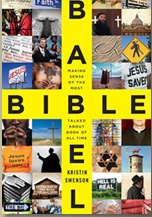
Last Christmas, one of my sisters gave me an autographed copy of Kristin Swinson‘s latest book, Bible Babel, Making Sense of the Most Talked About Book of All Time. Professor Swinson’s goal is to make some sense of what the Bible says, and what people say about it. That’s an almost impossible task, but the author makes a good effort, and the result is a highly readable book with a really interesting cover. One of my favorite passages is in the introduction:

“…many think that the Adam and Eve story in Genesis equates its talking snake with Satan, that the fateful fruit was specifically an apple, and that to this day men have one less rib than women. None of these are true…”

Some books are to be read at a fast pace, such as the latest thriller on someone’s best seller list, but others are worthy of more thought, and Bible Babel falls into that category. With a blend of pop culture usage (think DaVinci Code in the movies), and common concepts and misconceptions used as a springboard for topics, the author attempts to blend history, linguistics, scholarly research, and the good book itself to explain what it says, and why everyone seems to think it says something else. The table of contents reflects the varied topics she addresses, including “As It Is Written” History and the Bible….” and “Quotes and Misquotes….” and even “Flora, Fauna, Etcetera….”

As one of the best selling books of all time, and one of the least read, the Bible is constantly alluded to, but many of those who say, “it says in the Bible ________” could not give a book, chapter, and verse for the rest of the sentence. That’s because their “reading” isn’t reading at all, but they have heard something, somewhere, which was purported to have come from the Bible. Those readers who believe, for instance, that the Bible says, “God helps those who help themselves” are not Bible readers, but are instead, have been educated by proxy. Bible Babel is written for such readers, as an introduction to what the Bible does say, and in what context. Those who have read and studied the Bible may be bored with passages which explain that the Jewish Bible is the basis for the Christian Bible, or that Paul is the author of much of the New Testament. And those Christians who believe that Jesus spoke in Elizabethan English, as recorded in the King James Version, will be a bit disappointed as well.

But, for those who are religious, the author is quite respectful. For those who are skeptical, there is plenty of fuel for their skepticism. While I fall into the former category, my brain is still working, so I enjoyed both aspects of this book. If you have ever wondered why the scripture seems to be in conflict with itself, at least some of the time, or if you simply want to know more about one of the foundations of western world literature, then do read Bible Babel. Just carve out some time, because, like its subject matter, it is worthy of more than a casual reading.

By Pamela/Pilar Posted in writing

Reading (rather than writing)

Since my last post, I have been reading, reading, reading. First there were research papers, and while that is work, it is work I mostly enjoy. Over the four going on five years I have taught at the post secondary level, I have read papers on welding, auto repair, hair coloring, the history of perfumes, heat pumps, dirigibles, the physics of guitars, and even drag racing. There is much to learn in life, and those who stop learning must be really sad people. Anyway, I learn quite a lot when I read student papers.

When the quarter break came, we did some historical traveling, including a visit to the “Little White House” in Warm Springs, and the POW museum at Andersonville. At each of these spots, there are, of course, many many plaques and brochures to read, so I just kept on with my reading. Among the things I needed a refresher on were the vast number of progressive programs which began under FDR, including the “Rural Electrification Act.” Most everyone associates social security and with Roosevelt’s New Deal, but how many realize that without his direct input, farmers might have gone for many more decades without affordable electrical power? Another stop was the Currahee Military Museum in Toccoa, Georgia. There, visitors can see a number of artifacts from WWII, including a reconstructed stable, which housed troops in England, prior to the invasion of Normandy.

Also, a writer’s group in North Georgia has asked me to judge a category in their annual contest, which means more reading. While these entries won’t be like my research papers, I do look forward to reading the submissions.

Yes, I am really behind on writing, but I’ve been reading like crazy, and some writing will follow. (I hope so, anyway.)

By Pamela/Pilar Posted in writing

If It Bleeds, It Leads

One of my sisters is a journalism major, and when discussing television news, she often laughs and says, “Oh, if it bleeds, it leads!”

Television is such a visual medium that, by its very nature, can’t objectively report news. As a journalism major, who has dabbled in the field but seldom actually made a living in it, my sister once told me that she records the evening local news, two hours per day, each week, and reviews it in an hour or two on Saturday morning. She’s right, of course, the stories and film clips are recycled so often that there are only enough actual new items to fill a two-hour per week broadcast. My sister’s method makes for much more balanced coverage of the “news” since she is not bombarded by the same stories over and over. Just like viewing a commercial for a candy bar three times an hour can lead to a trip to the store for chocolate, seeing the same news clip once an hour for three days can make a natural disaster into Armageddon.

Worse, there are many news stories which ought to lead, but recently, the most visual (and loud, of course) stories were the “lead” items.

Charlie Sheen, with broken teeth and loud expressions of ego-centric rage, was the lead story for a few days. Important? Too those with only a few portions of gray matter still functioning, perhaps.

The New York City bus crash? A human tragedy, to be sure, but it was leading because it was bleeding. No doubt the driver was tired and dozed off. It probably happens every day, somewhere, but because there were many folks on the bus, it was visually stunning, so it became a lead story.

Japan’s earthquake aftermath should be a “lead” story. But, the constant emphasis on the “nuclear” disaster is a bit misleading, if you’ll pardon the pun. There is not going to be a Chernobyl situation in Japan, because the nuclear reactors there were built to withstand most problems, and the containment devices are working fairly well, given the trying circumstances of the earthquake and tsunami. If Japan had used coal or oil to generate electricity, there would have been problems with that as well. The microscope of television news is making the problem(s) associated with radiation appear much, much worse than they actually are. Right now, the Japanese need clean water, food, and shelter; and hopefully, Americans will do what they usually do, and provide aid to a nation in need.

There is much good going on in the world, but it doesn’t bleed, therefore it does not lead. For example, legislatures across this country are attempting to deal with illegal immigration by enacting laws which attempt to verify citizenship (and therefore harass non-citizens) and those actions are misguided. Most of us “Americans” came from somewhere else and became Americans. On my way to work, I pass by a church which has a huge sign out front, touting “Free Classes in English and Citizenship.” That church, with its parking lot filled with cars of those who want to become citizens, is doing more to help the immigration problem by helping assimilate immigrants than all of the legislatures combined. But the efforts of these kind Christians won’t make the news, because doing good is not a lead story.

By Pamela/Pilar Posted in news

Blooms and Trash

Wow, I had forgotten just how many days have passed since my last entry. Nothing’s wrong, but I have had a busy quarter at school, so I my reading has been rather limited. Soon, I will have another book review, but in the mean time, I will share one of my activities. 

Since I know that good health requires exercise, I have been going outside in our early spring weather. The daffodils are blooming nicely, and the vinca has never looked better. Our three Bradford pear trees are about to make a wonderful showing, as is the tulip tree. But, after the winter, I always end up with some chores, such as cutting back the junipers and crepe myrtles, picking up sticks, and in front of our house, picking up the trash. Yes, trash. I have the misfortune of living on a main road (didn’t used to be) and folks do litter.

I’ve picked up many “scratch off” lottery tickets, but I kinda hate to complain, since Georgia’s lottery funds the vast majority of technical school student tuition. Complaining about those would be rather like biting the hand that feeds, and I have better sense. Wadded up wrappers from Mickey D’s are usually in the trash bag as well. Makes me wonder what is it about Mickey D’s customer base that makes them trashier than the rest of the fast food nation. As usual, I found a couple of styrofoam cups clinging to the weeds near the woods. There are usually some receipts, flyers, and an occasional home burned CD. Actually, it is interesting, because I read the trash. I read everything, and my students are usually amazed that I read every word of their papers.

My favorite bit of recent trash was a pharmacy bag from a nearby Kroger. One of my fellow Jeffersonians, whom I do know slightly, tossed away his Cialis paperwork. He’s probably in his sixties now, so I guess he needs a little help. Well, I hope he and the lady of his choosing had a nice weekend.

By Pamela/Pilar Posted in writing