The Brilliant Mr. Jobs is gone

Once, at a family gathering, my nephew the IT dude told me that he would not hire me, because I am not technologically proficient. He is a Microsoft guy, and I am a Mac user. Thankful that I wasn’t looking for a job, I just smiled and changed the subject.

Steve Jobs, co-founder and visionary at Apple, has been behind so many technical devices and concepts that I and countless others use every day. My nephew was right— I live and work in a technologically sophisticated world, with little understanding of exactly how all of this stuff functions. Mr. Jobs and company created the devices, the software, and the slick interfaces that have made it just as easy to operate computers, music players, smart phones, and other items without being able to crawl under the hood and fix them. Just as I drive my Honda, without knowing its valve clearances and final drive ratio, I can create a web page, edit a movie, or share music without understanding the inner workings of my iPad, Mac, or Airport Express. The beauty of all things Apple is that they operate intuitively, with no need to read the manual or hire a member of the Geek Squad.

During his career, Steve Jobs has repeatedly been able to see what people wanted, then create devices that did those things. Moreover, his company went beyond that, and created hardware and apps which I didn’t even know I wanted— until I saw them in action.

I am saddened that his family lost him at such an early age, 56, and I am also sorry that his passionate vision has been cut short. Just today, Apple announced the introduction of software that lets customers verbally interface with the newest iPhone, a technology that promises to change everything, one more time. And in Apple stores across the globe, customers are seeing this new feature, and thinking, what will they think of next?

Ironically, a more important question might be who will think of these new things, now that the “insanely great” Steve Jobs is no longer with us?
By Pamela/Pilar • Posted in writing

A Galaxy Unknown, and some of its sequels

My iPad is a fun way to read books, and I like the Kindle app better than iBooks. In part, that is due to the wider selection of titles, but it is also the actual reading experience of the Kindle that I enjoy. After I read a few books by Amazon published author D. A. Boulter, I sought another science fiction author who is not published by a “big” publisher. I began a series by Thomas DePrima, which begins with A Galaxy Unknown. This book has many reviews on Amazon, and the sheer number of reviews, along with the description, led me to purchase it.

DePrima’s novel is far from original, but that is not necessarily a criticism. There are only so many plot devices, and space operas have certain limitations. Actually, I liked the blend of action and description. Other reviewers seemed to find the dialogue more annoying than I did, but the author’s insistence on using specific height when introducing his fairly large cast of characters is quite annoying. Other descriptors, such as eye color, hair color, skin tone, and whether or not the character likes “fries with that” would be welcome. I read four books in the series, and the author never stops using height as his favorite method of description. Far worse, the author insists on retelling the story every time the characters do. Without all the repetition, A Galaxy Unknown would probably be a tight 100,000 word read.

Still, the main character has her charms. Yes, the heroine is a bit like Honor Harrington, but even at the outset of David Weber’s series, Honor is taking her first command, whereas Jenetta Carver is a lowly ensign when the first novel begins. Of course, Jenetta is not going to remain lowly for long, and the breakneck pace of this first story is refreshing, if one judges space opera by Weber’s lengthy and increasingly action-starved yarns.

As I read the second, third, and fourth books in the series, I became less enchanted with DePrima’s space opera. Jenetta Carver is a fabulous heroine; and her permanent youthful looks and ever changing DNA, along with plenty of villains to defeat, keep her from being boring. I desperately wanted to like the sequels, because I did enjoy the first entry in the series, but the second volume just has too many admirals heaping too much admiration upon her. Yes, I know one must suspend disbelief to enjoy a good space opera. I have no problem with that, but Jenetta is too apt to be worshiped by her superiors as by her subordinates. I can only stand a page or too of hero worship at a time, especially when it is by older guys who should be both arrogant and curmudgeonly.

Even the introduction of more characters and settings in the third and fourth books, including more villains, does not give Jenetta and her sisters sufficient challenges to create suspense. One of the main reasons to read fiction is to watch the characters solve problems, and this is the core issue with this author’s work. Jenetta is too perfect. The reader knows that Jenetta will win the battles via her brilliant strategy, crew and superiors alike will worship her, and she will get another promotion by the end of the novel.
Of course, I could have quit reading before the fourth installment. No one made me buy books two, three, and four. Unfortunately, I did like the first book enough that I kept hoping that the author would regain some of the freshness of A Galaxy Unknown. Alas, it never happened, and I wasted eighteen bucks on the sequels.
Readers of Visions and Revisions should realize this is merely the opinion of afive-foot nine reader, teacher, and author. Based on the reviews on Amazon, there are readers anxiously awaiting book eight in the series. I am looking for another new writer.

One More Commentary on 911

Most sources of information are having some sort of commemoration of the ten-year anniversary of the terrorist attacks on September 11, 2001. And, like many people, I have thought about where I was as I heard the news. I’d been at a Bible study, and had no idea that there had been an attack until I heard my sister’s voice on my answering machine, telling me to turn on my television.

Even after all this time, I do remember our conversation that day, and in the days right after the horrific events. As the wife of a private pilot, and as a woman who has taken enough flying lessons to have done solo flights, my sister’s perspective was a bit different, because what amazed her as much as anything was the swift shutdown of American air space. Because the FAA did not know the extent of the plot, they did the only logical thing, and that was an immediate halt on take-offs, and for those in the air, the instructions were to set down at the closest airport and stay there.
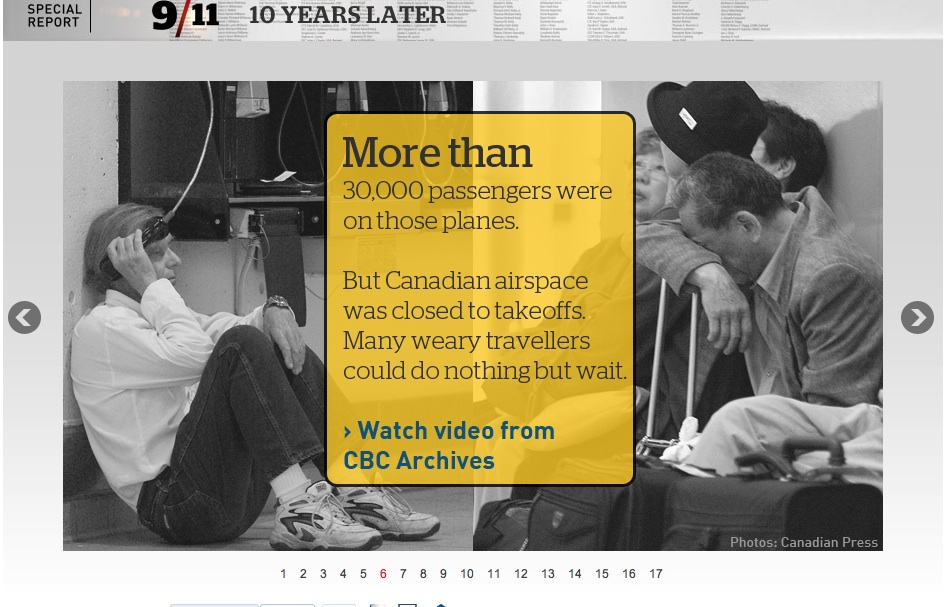
The United States of America has numerous airports, and some of the busiest air space on the planet, but that all came to a stop on 9/11 Therefore, the international flights bound for the U.S. had to land elsewhere. Some 200 flights, with roughly 30,000 passengers, landed in Canada. One town, with a population of 10,000 had 6,500 unexpected visitors land, and those visitors were not going to be leaving in just a few hours, either. There is a feature on the CBC website which follows some of the stories, and the new friendships, which resulted from the extended sojourn that many of those passengers had in Canada, a decade back.
The Osama bin Laden plot did succeed, for the most part, because the only plane which did not destroy its target was the one that crashed in Pennsylvania. The story doesn’t end there, fortunately. Based on the choice of targets, one goal for the terrorists was the shut down of the American economy, and it did not happen. Yes, the stock market closed for a few days, and business slowed for a bit, but our way of life did not change substantially. In fact, bad banking practices and real estate development gone wrong have done far more damage to the U.S. economy than the terrorist plots did.
Instead, for a time, Americans joined together, with patriotism trumping partisanship, and Americans were more appreciative than they had been. And, apparently many of them found some new friends across the northern border.
 
By Pamela/Pilar • Posted in writing

Best Buy or Worst Buy?

Last week, I needed to recycle a television. Our local government sponsors recycling, and they’ll take old paint and motor oil, but they won’t take a television. Knowing that e-waste is a huge problem for our planet, I got hubby and son to put the malfunctioning behemoth in my van, to the only local spot for television recycling— Best Buy. It took talking to five different people to get the television out of my van and into the store, because each person I spoke with told me to see someone else.

After I finally got my ten dollar “gift card” which is what I got when I paid ten dollars in federal reserve notes for them to take the television, I looked for something to buy with it, because I didn’t know anyone that I dislike enough to give them a gift card from BB. Finding anything to buy was really difficult, it seems that Best Buy really doesn’t have many good buys. I asked yet another of the blue clad employees, if there might be a cheaper case for an iPad than the thirty dollar one I finally found. The response was, “You just said Apple and ‘cheap’ in the same sentence. Hah!” I guess they don’t like Apple products. Or price conscious customers. So, I took the case to check-out. After all, it was only twelve dollars more than at Amazon, so it was one of the better buys in the store. It snapped on as it should, and since it has no electronic parts, it should serve its purpose.

Actually, I am just glad that I didn’t need a repair. Over the years, I have been fortunate that my Apple products don’t need much repair, and when they do, the Geek squad doesn’t work on Apple computers. Thank goodness.

Any of you seen this one yet?

Computer Repair expose

Or this one?

Computer Repair expose

Or this one?

By Pamela/Pilar • Posted in writing

Another Bookstore Goes Away

Once again, it is time to say goodbye to a bookstore, and if one of the “big guys” had to go away, I am sorry that it is Borders. Their store in Athens, Georgia, was one of my favorites. The customer service was always good, and the store was in a great location.
As I have noted in previous posts, the new way to read is the ebook. I am actually surprised that it took this long for the ebook to finally fulfill its destiny. Previous readers, including the Rocket eReader, the similar EBookman, and the Palm, were all were capable of displaying a variety of books, but the new generation of reading devices, including the Nook, the Kindle, and the multipurpose iPad have made reading ebooks so convenient that even beautiful stores with good coffee, friendly faces, and ample parking are not going to be enough to keep them in business.
A decade ago, I first learned about the problems with print publishing from long-time literary agent Richard Curtis. As a first-time attendee at the Harriet Austin Writer’s Conference in Athens, I was in a bit of awe as Curtis described the vast number of books which are printed but never sold. Some of these are recycled into pulp after sitting in a warehouse, but many of them go out to stores then come back in as “remainders.” There are other models for selling books, including print-on-demand, but the larger houses do waste a lot of paper and ink.
Bookstores, by and large, do not pay for the books on their shelves, but those volumes are on “loan” from large publishers. When customers buy the books, a part of the money goes to the store, part goes to the publisher, and a wee bit goes to the author. If a customer browses in the store, then buys the book for his eReading device (whichever one) then the publisher gets more money than with print, unless the book price is substantially less. And, depending on the price paid, the author gets a wee bit or a wee bit more. Either way, the physical store gets zip. While I am sure some customers were still buying printed books, and maybe a coffee or a gift, there just were not enough of them to keep the Borders chain afloat. Business people who are writing about the situation mention that Borders, which was selling CDs and DVDs just a few years ago, was slow to realize that video and music were moving to online delivery. Now, books take their place alongside film and music. There will still be some good independent bookstores, I hope, and Barnes and Noble has its Nook and Fictionwise eBookstore, so it may survive the downward trend in print sales. I suspect the next casualty will be Books a Million.
While I will certainly miss Borders, I did not buy much there. I guess that makes me one of the many reasons that it went bankrupt. So, I will be buying the next novel I read for the iPad. Just like the last few that I read.
Coming soon— a review of a SF series by Thomas DePrima.

The Last Shuttle Launch

The last space shuttle launch occurred last week. Although NASA claims to be working on a new vehicle, it is years (or decades) away from launching, if it does launch at all.

Having grown up during the space program’s heyday, I see this as just another symptom of America’s declining health. A Democrat president declared that America would not be left behind in the conquest of space, and through administrations led by both parties, NASA put men and satellites into orbit, then sent men and machines to the moon.

As a percent of total federal dollars spent, the space program peaked in 1966, at 5.5% of all U.S. spending. Three years later, I, along with most other Americans, sat spellbound as the first men stepped onto the surface of the moon. Critics of the space program would probably say we got some pictures and a few rocks out of the deal (and we did) but myriad technologies were first used in the space program, including the foundations of modern computers and software. Each year, NASA publishes a list of “spinoff” technologies, by-products of space related tech. If there had been no space program these technologies would either not exist, or would have developed later:

• cordless tools
• memory foam
• gps navigation
• medical implants, including some artificial joints and cochlear implants
• polymers used in firefighting gear
• advanced firefighting oxygen delivery systems
• lithium batteries (yes, like the ones in your phone and in your computer)
• LEDs and LCDs
• industrial robots

There are many more, some of which my spotty understanding of science does not let me fully understand, but suffice it to say that even social program loving critics of NASA probably enjoy talking on cellular phones, watching satellite television on LCD screens, and finding their way with gps navigation.

If this program has been so valuable to our nation, why is it in decline? Perhaps, because the government caters to the selfish. Critics of NASA tend to say something like, “Let’s solve our problems here, before we go into space.” So, the United States government has put more and more dollars into the hands of the so-called poor, the educators, and buying medical care for an aging population.

Despite being the source of new technologies and national price, NASA seems to be in a death spiral. From that high point of 5.5% of federal revenues, NASA was down to .58% in 2007. Current spending on our space program is roughly equal to what was spent in 1960. To put that in perspective, the cost of social security was 30 times greater than NASA’s costs in 2007.

Social programs, although well-meaning, have ruined certain segments of American society, and turned the greatest generation into the “gimme” generation. No outlay of funds is sufficient to provide the poor with what they want. Only work can do that; but with a sputtering economy and a no confidence vote from business, there are fewer and fewer jobs. Elected officials tend to vote to please the electorate which put them into office, and government paychecks trump rockets.

With the space shuttles decorating museums, what will happen to the satellites that provide us with spying capabilities, gps navigation, and Entertainment Tonight? As long as the satellites remain functional, we won’t know the difference. But, with no means of launching new satellites, we will be like Cuba. In Castro’s country, streets are dotted with fifty year old America autos, because there are no new ones coming into the country. After NASA, our satellites will be just like those ancient autos.

Maybe my children will see the first Martian colonists. Or maybe, they won’t see anything, because the satellites will have fallen from the sky.

By Pamela/Pilar • Posted in writing