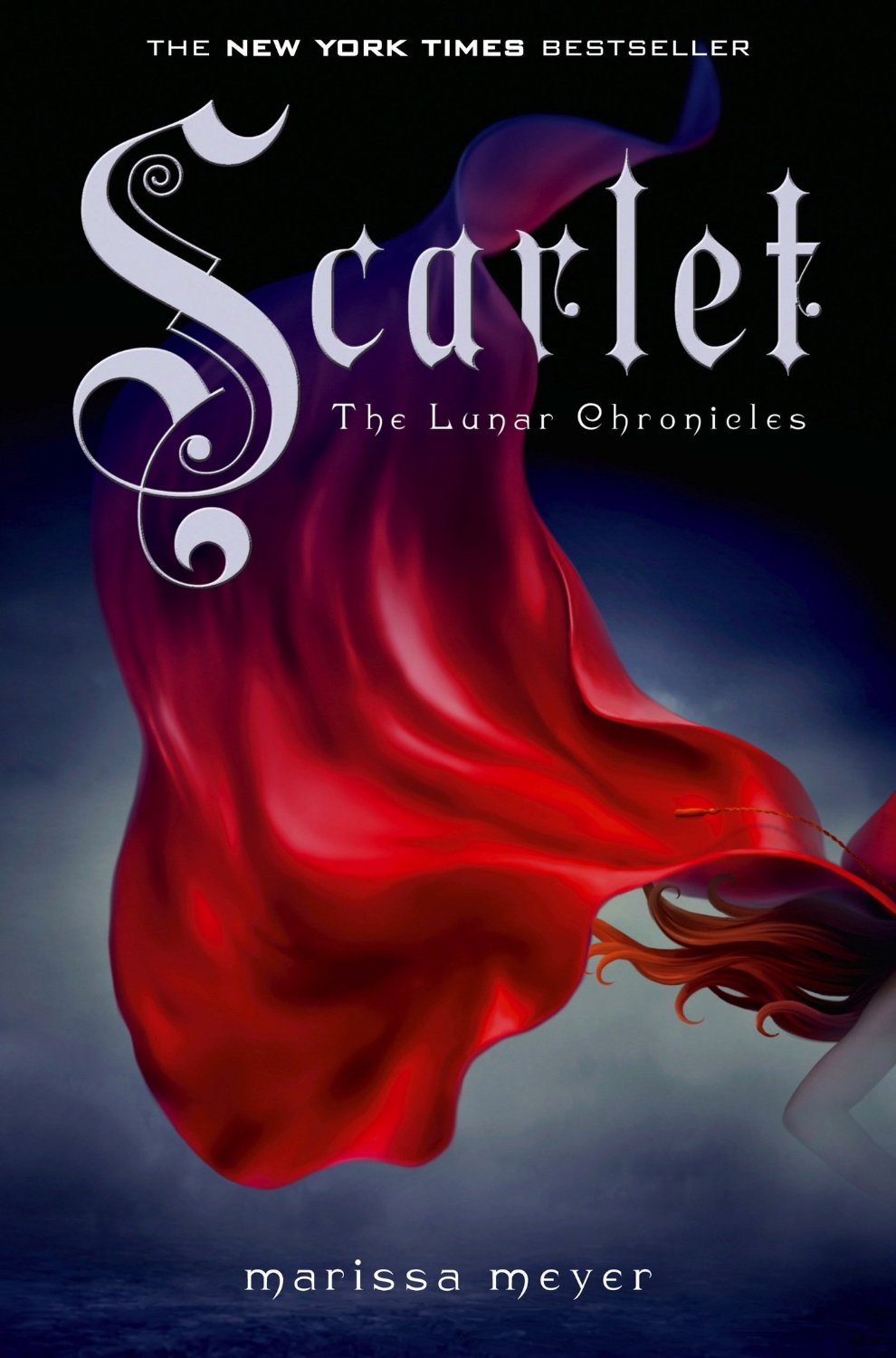
 A while back, I wrote a review of Marissa Meyer’s Cinder, which begins a series the author calls The Lunar Chronicles. After I bought it, I did not read it, but put it off for a while. I like science fiction and have no problem with YA titles, but it sounded kinda weird. Once I read it, I did like it. I really liked it, actually. And, once again, I bought the next installment, but put it off while I read another book (Darrell Bain’s The Frontier Rebellion). Then, a few weeks back, I clicked on the cover of Scarlet, and I will admit that I was not entranced after the first chapter, but I pushed myself, and the book did pick up. If you begin and wonder if it is book extolling the virtues of organic gardening, just hold on. Scarlet is a worthy tale, but I will offer a warning to readers—it would be quite confusing to a someone who did not read Cinder first. The story of Scarlet, who abandons the family farm to search for her lost grandmother, is so intertwined with Cinder’s continuing adventures that it is far better to begin with that book and then pick up this action packed story. If this were just the story of Scarlet and Wolf, I would not give it a five star review, but when I reached the end of Cinder, Meyer was clearly not finished, so I was expecting to see her again. Perhaps not so much of her, but that is actually a plus. Now, the character of Scarlet is interesting, and there is plenty of suspense as she struggles to find her grandmother before something really bad happens, but I especially like the multilayer enigma of Wolf. Even more than the first book, this one has the trappings of a gritty urban fantasy, with science fiction elements, and a bit of romance, too. Many times, I have stated that the best fiction is aimed at younger audiences, and this novel is more evidence of that. I noticed that Cress is now available, so I will buy it soon.
Category writing
Voyage Through the Stars—and Back in Time!

My husband stumbled upon an episode of “Star Trek Continues” and after just a few minutes, we were hooked. This upscale “fan film” site is really something to see. There are only a couple of full episodes, but a fully funded Kickstarter campaign from last year should fund at least a couple more episodes. We really liked the loving homage of this effort. Seeing new episodes with the same music, similar storylines, familiar costumes and props, and amazingly original looking sets make this nothing like the “reboot” movies.
These free online videos, which do include some shorter “vignettes” are made by a not-for-profit-entity, filming in Kingsland, Georgia, in a warehouse with 10,000 square feet of sets built to look just like the sets from 40+ years back. The actors do not just dress and look somewhat like the original series characters, but add their own interpretations as well. And, get this: the actor portraying Chief Engineer Scott is James Doohan’s son, Chris. That casting choice is far more authentic than the reboot’s Simon Pegg. Kirk is portrayed by Vic Mignogna, a voice actor and director, and Todd Haberkorn is Spock.
At first, seeing these different actors portraying well known (and loved) characters seemed odd, but after a few minutes, we were more interested in the story line than the actor’s faces and voices. There are some new characters, too, as the premise is that STC is telling the tales from years four and five of the “five year mission” that was only three years long in the original series. Had the series continued, no doubt new characters would have come along, so this concept works well.
Fans of TOS should check out Star Trek Continues, because it is quite entertaining. My husband and I are hoping for many new episodes. And, as residents of Georgia, we are wondering if they are going to have another open house, as they did a couple of years back. I’d love to see those sets!
Little Girl Blue— the Life of Karen Carpenter
 I’ll admit it, I am getting old. And, apparently, revisiting topics from one’s youth is an interest that older folks have. In the years right before his death, my dad would come home after a lively session at the senior’s center, watch a rerun of Gunsmoke on television, and take his afternoon snooze. While I remember Gunsmoke (along with Sky King, Fury, Roy Rogers, and even Bonanza) I have no desire to revisit them. However, I have a number of Carpenters CDs, because their music is still musical to me. I don’t like to watch the videos (and there are a boat load on YouTube) because their hairstyles and clothing remind me of just how long it has been since those tracks were recorded.
Because she knows how much I love the Carpenters music, some years ago my sister gave me the official biography of the Carpenters by Ray Coleman, which I enjoyed. I’ve seen the tv movie version of their story, which is also on YouTube, along with a PBS special celebrating their music.
Due to inclement weather here in the south, I’ve had more time to read lately, and I stumbled upon a “new” biography, Little Girl Blue— the Life of Karen Carpenter, which was actually published four years ago. This one is “unauthorized,” thus promising to shed some light upon the parts of their story that the Richard Carpenter would rather not have publicized. In some respects, Little Girl Blue delivers.
Most people will want to read this book to know more about Karen (and Richard’s) lives and their music, but some will want to know more about Karen’s battle with anorexia nervosa, a disease that was almost unheard of when she died. Non-fans will probably find it odd that anyone even cares, some thirty years after Karen’s untimely death, but I didn’t care if they weren’t cool in the 70s, and I don’t care now, so I’m interested in their lives, their music, and only a little in the disease that killed Karen.
I’m torn, because in some ways Randy L. Schmidt’s bio, a rather odd combination of the duo’s lives and their musical successes and failures, does succeed, but sometimes it reads like gossip. That is due to his reliance upon “those who knew her.” There are pages and pages of documentation, so there was quite a lot of research that went into this book. But the sources of “new” information are friends and co-workers, some of whom seem glad to finally be heard.
I’m not famous, so no one is going to write my biography, but if someone did, and used Schmidt’s approach, it might read like this: “Pamela J. Dodd did not even use her husband’s name on her books, which infuriated his sister-in-law, who had this to say—” or “in an email a close family member quoted Dodd’s son as saying ‘Rob once said, “Moms the boss…what she says goes.” ‘ In other words, well documented opinions are still, well, opinions.
On the other hand, there are some really interesting revelations about Karen’s financial situation, such as their mother had a trusted friend handle the money and basically put the duo on an allowance, as if they were still in high school. When they finally hired a money manager, there were bank accounts all over the place, because the mother would deposit the maximum covered by FDIC and then open a new account in yet another bank. Even more interesting was the portrait of Karen’s husband as exactly what Karen feared: someone who married her for her money, not for love. The scene where Karen is on the phone, almost hysterical, because the dealer was repossessing the Rolls Royce that her husband had “given” her, lets readers understand her naivete, as well as painting Burris for the gold-digger that he surely was.
Reviewers of this book often focus on the in-depth examination of Karen’s anorexia, especially her relationship with her mother and brother, and some have said that Karen’s mother was unable to say, “I love you” to Karen. That scene takes place in the office of Karen’s therapist, apparently the only therapist that she consulted during an eight year plus struggle with eating disorders, wherein Karen’s mother, Agnes, wouldn’t cooperate with the therapist’s directive to tell Karen that she was loved. In that situation, I might have been both angry and embarrassed, so I have some sympathy for the mom.
Over and over, Schmidt’s book explains the tragedy that Karen’s life became, even before the seemingly inevitable tragedy of her death. If fame and fortune come too early, there can be a terrible price to pay. The entire Carpenter clan was simply not prepared for the success that Richard’s brilliant arrangements and Karen’s amazing vocals brought the family. While Karen paid the biggest price, the whole family suffered, and that is ironic, as well as tragic.
Rise of the Warrior Cop— a review
Real life horror stories abound in Radley Balko’s Rise of the Warrior Cop: The Militarization of America’s Police Forces.
An 11 year old boy, lying on the floor with family members, guns of SWAT team members pointed at their heads, is the subject of a drug raid. An itchy finger, and the 11 year old boy dies. No charges were brought against the family, because no crime had been committed, apart from the “accidental” shooting of the boy. His family was ultimately awarded three million dollars.
A 43 year old man, Richard Elsass, is sleeping in a trailer near his place of employment. A SWAT team member, clad in black, shines a light into the trailer, frightening the man, who shoots the police officer. SWAT team members return fire, killing the man. This drug raid could have ended peacefully, if the police had identified themselves and allowed Elsass to come out and talk. Instead, five years after the incident, members of Elsass family were awarded 150,000 dollars for the wrongful death of their loved one.
According to Balko, every day in American, innocent civilians are raided, and some of them die. Others are maimed, such as the girl who is burned when a “flash/bang” grenade sets her blanket on fire. Dogs are killed at an alarming pace, because an officer can kill a dog and never face any sort of reprimand.
This isn’t happening in some third world dictatorship. It is happening in America, because American politicians are allowing it to happen.
The Rise of the Warrior Cop does an admirable job of tracing the history of policing from ancient Rome until today. Several misguided policies have led to this deplorable situation, from the “war on drugs” to the release of military grade weapons to American law enforcement.
Everyone should read this book. It is really frightening, and it should be, because Americans have one heck of a problem—their police. People should contact their elected officials and demand reform. Really.
What citizens shouldn’t do is contact the police. ‘Tis sad, but I can’t recall anything good ever coming from an encounter with a policeman. What I didn’t know is how the “us” vs. “them” philosophy has totally eroded the concept of community policing.
Gravity— A Big Step Forward in Filmmaking
Since Gravity was nominated for 10 Academy Awards, one of our local theatres has given it a second chance on the big screen. I admit, it took a bit of insisting to get hubby to go. “What’s it about?” He asked, and when I explained it is about an astronaut who is trying to get home after a space shuttle disaster, hubby wasn’t interested. Yes, I know, it has a been there, done that plot. Having seen Apollo 13, and some lesser films, all with that same basic plot line, I did understand his lack of enthusiasm. Of course, Sandra Bullock isn’t as young as she used to be. And, once you have seen Star Trek or Star Wars, the space shuttle is just so primitive.
Many (mostly amateur) critics have listed all of the stuff that just couldn’t happen, from the lack of diapers on Bullock’s bod to the detachable helmet on the cosmonaut space suit. The lists are lengthy and many of the assertions that “it just wouldn’t happen like that” are correct. Even with all of that, I enjoyed the film. It is in (almost) real time, which is kinda cool. There are some killer f/x showing how things are in a weightless environment, and I do think that is the groundbreaking aspect of this film. It will make you believe, if only for a few moments, that you are in space, right alongside the stars (take that either way.) The dialogue is rather sparse, and sometimes just plain silly, but in real life people can say the stupidest things.
Any film that can get people talking about space exploration again is worth a look. This one does a remarkable job of making a perilous situation quite suspenseful, but with a sufficient glimmer of hope that the audience can hang on for a “happy” ending.
Perhaps it doesn’t deserve a 97% approval rating on Rotten Tomatoes, but it does deserve a look for any who wants to see what it is like in space.
Rogue Program by Darrell Bain
One of my favorite eBook authors is Darrell Bain, and his Savage Survival is one of his best yarns. So, when I noticed that Rogue Program was a sort of a sequel to SS I purchased it. (I linked my old review on Amazon to the previous title above, so I am not going to rehash the plot here.)
What Bain did with this one is similar to how David Weber decided to flesh out another of my favorites, wherein he took the fabulous Path of the Fury and added enough material to make a megabook, In Fury Born. Quite frankly, I never finished Weber’s rewrite, which contains a prequel. In Rogue Program, Bain does it the other way, the reader begins with a brushed up version of Savage Survival, and ends with additional material to form the sequel part.
I am not going to say that Bain ruined it, but I did have trouble finishing. Ironically, I enjoyed the opening section quite a lot, even though I had already read it. When he gets to the new material, the story keeps moving, but becomes rather boring. Scratch that; at times it is exceedingly boring, for when the survivors from SS return to earth, they more or less conquer it, and then they have to govern it. Here is my analysis of the book:
Surviving= excitement.
Conquering= some excitement.
Governing=boredom.
The price for each book is the same, so buy Rogue Program and read until you get tired of it. I’m betting most readers will give up two-thirds of the way through. I did finish, but it was a Herculean task.
 Visions and Revisions