I’m looking forward to the further adventures on Honor Harrington in this new medium.

I’m looking forward to the further adventures on Honor Harrington in this new medium.
Recently, I decided to catch up with the further adventures of Jenetta Carver (and her clones Christie and Eliza) by reading books 8 and 9 in the Galaxy Unknown series by DePrima. Book 8, Return to Dakistee, did not sound too entertaining in the blurb, but I have enjoyed the series so I decided to forge on, and I am glad I did. Like many series, the further along it goes, the more important it is to have read the previous books, and that is true of Return to Dakistee. The main character in this entry is not Jenetta Carver, who is off doing admiral things, but her clone, Christie, who is a mere Lt. Commander. In a way, this book is more interesting because a more junior officer has to please the officers over her as well as lead the ones below her in the hierarchy. And the ending is a bit of a shock.
In Book 9, Retreat and Adapt, the main character is again Jenetta Carver, who has been almost boringly successful in her leadership of Space Command forces. However, a new threat has taken out two of the “invincible” ships that Space Command relies upon, and Jenetta’s orders to the remaining forces are to avoid engaging the enemy, but keep tabs on them. While the Space Command forces are in retreat, it is up to Jenetta to come up with a plan, and she does. Will it work? Or will this new threat take over the known galaxy. That’s the suspense of this yarn, and I won’t ruin it for potential readers, but I will say that DePrima does a good job of looking back at history for his plotline.
My appreciation for indie authors is no secret, but I have seldom followed a series through nine books. Okay, I did read David Weber’s Honor Harrington series beyond that point, and I have read that many entries in the Miles Vorkosigan series by Lois McMaster Bujold. But those are written by great writers! Thomas DePrima isn’t in the same league. However, I have really enjoyed these tales by DePrima. Fans of space opera should certainly hop over to Amazon and check out the series.
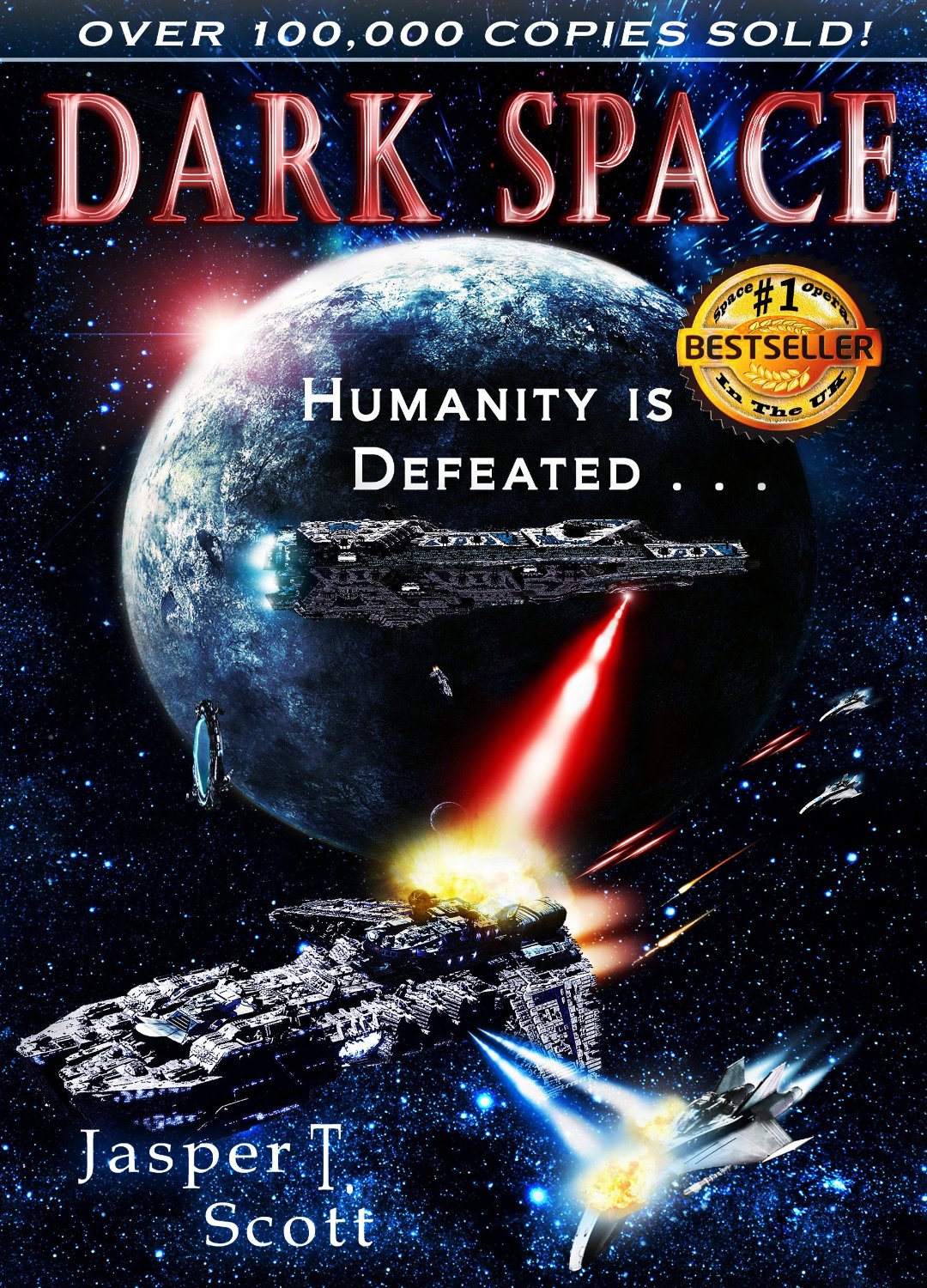 Recently, I read a space opera called Dark Space by Jasper T. Scott. Although this book didn’t grab me at the beginning, there were enough innovations to keep me reading. Many science fiction fans pay tribute (deliberately or unwittingly) to their screen favorites. This novel blends elements from Star Wars and Battlestar Galactica for sure. It begins “in medias res” with the main character involved in a star fighter to star fighter dogfight, and when it jumps back to the exposition phase, I decided that this novel too much like every other space opera in print and on the screen. However, the use of a “holoskin” to disguise the main character, essentially allowing him to impersonate someone else, is a nifty plot device. So is the use of a “neurochip” inserted into the brain of another character— leaving her appearance as it was, but giving her a whole new personality. In a universe with such devices, the reader (or characters) never seem to know who is friend and who is foe.
Much of the action of Dark Space is like the original BattleStar Galatica; star fighters and ships shooting. This can be fascinating (think David Weber) or just action packed. One reason Weber is fascinating is his ability to craft characters that the reader can love or hate. The core problem with Dark Space is that I just didn’t care who was gonna win those skirmishes.
Dark Space is predictable, except when it isn’t. And it is action packed, but a tad boring. The ending, instead of satisfying the reader, is a build up for part 2. So, I guess I’d give it three stars….
But it was free, and that’s a good price, no doubt because the author is willing to give it away in hopes of selling the sequels. I didn’t go for the second installment, however.
Fatal Boarding is better than the cover would suggest.
Recently, I read E.R. Mason’s science fiction novel, Fatal Boarding, via the Kindle app. As of this writing, it is a bargain because it is free. And, normally, if I don’t particularly like a freebie, I do not review it. I did review this one, on Amazon, and I am going to do so in a more elaborate manner here, because I did like it, but with reservations.
Why did I “buy” it in the first place? The cover is pretty bad, I think, but the number of reviews and stars is impressive. Also, you can’t beat free. So, I added it to my Kindle library, and I did manage to finish it, although I thought of abandoning the effort more than once. The main character isn’t likable, at least not a first, but he did grow on me. The situation is interesting, and the author does a good job of putting in details to help the reader visualize both settings and characters. Actually, the plot line isn’t all that fresh. However, just about every story has been told by now, so all we readers (and writers) have left is theme and variation.
Adrian Tarn, main character, is an experienced spacer, currently serving as security officer on a ship that has a boring task, mapping. He signed on because he lost too much money gambling, and at least a portion of his grumbling is probably intended as foreshadowing. Anyway, his rather boring job is interrupted when his ship goes a tad off course to investigate a derelict alien vessel. The reason this other ship is abandoned is a bit of a mystery, and solving this mystery becomes imperative when Adrian’s ship has malfunction heaped upon malfunction, apparently all due to the close proximity of the mystery ship. Then, folks start dying, as the title indicates. So, this is a space mystery, which evolves along expected lines, as Adrian and his fellows begin to figure out how and why both vessels are dead in space.
Overall, I did enjoy the story, but the most troubling aspect is the lack of proper grammar, spelling, and/or editing. As a writer, I know it is hard to catch every little thing, especially when working on one’s own manuscript. But, Fatal Boarding suffers myriad problems, making this a distracting book to read. The author confuses “loose” and “lose” several times, and there are missing quotation marks, missing commas, odd paragraphing, and other issues. At times, I had to back up to be certain what was happening or who was speaking.
Yet, 145 reviewers have rated this effort 5 stars, and another 87 give it 4 stars. That’s 228 more reviews than my space story, Trinity on Tylos, has garnered during 8 years of publication.
I’m doing something wrong….
Space Opera!
Okay, I’ve never “served” as military folks put it, but I really enjoy reading about the exploits of those who have done so. Perhaps due to watching the exploits of astronauts with military titles in my youth, I still believe that the military will play some role when (or if) mankind actually goes into space and establishes colonies on other worlds. In my own Trinity on Tylos my main character, Major Venice Dylenski, has a military background, but I viewed her as a bit like “Captain” Miles Standish might be viewed in American history. He’s a military guy who is there for security, and my character is the security chief, because someone ought to be in charge of that when landing on uncivilized planets.
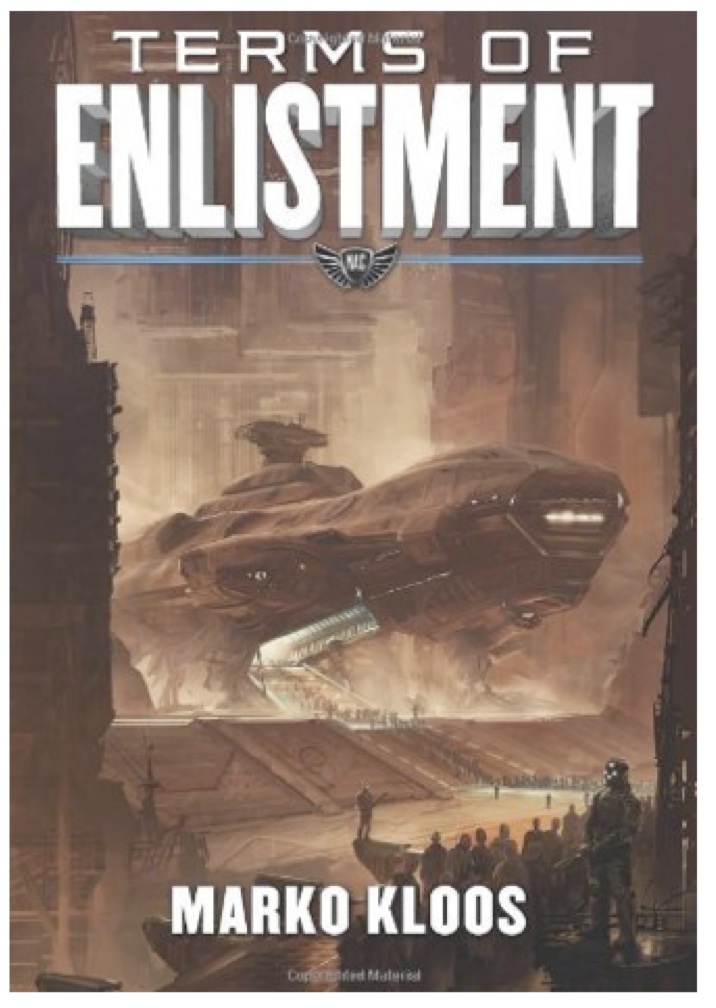
In Terms of Enlistment, by Marko Kloos, the military is far more than security; it is the force that keeps the homeworld (earth) and colonies safe. Andrew Grayson is the main character; he grew up in a welfare section of Boston. Desperate to leave the vicious cycle of generations on public assistance, he joins the military. Okay, that is hardly a new plot line, but as Kloos paints his picture of Grayson’s world, readers can easily believe this dystopian view of the “North American Commonwealth.” As a new NAC recruit, Grayson is under quite a lot of pressure. Failure in any area, from taking orders to passing tests, will cause him to “wash out” and go right back to eating welfare rations and watching his folks succuomb to treatable illnesses. Thus, there is an additional layer of suspense added to the usual risk/reward of enlistment. Once our hero gets through basic, he can expect a five-year hitch, then go back home with cash, and education, and a fresh start.
(spoiler alert)
However, once Grayson gets through basic, instead of being posted to a naval (spacegoing) vessel, he is placed into the TA (territorial army) and tasked with policing the very sorts of places that he sought to leave. However, as the yarn rolls along at its brisk pace, Grayson faces domestic enemies with courage and is able to use his heroism under fire to wangle a transfer to the space navy. Once there, he hopes to be set for his five year enlistment, but an alien species invades, and he has many more opportunities to be heroic, and less and less to return home to, as the government pours all of its resources into saving the colonies, leaving the homeworld to become barely habitable.
While it doesn’t break much new ground, Terms of Enlistment does an excellent job of entertaining the reader. The main characters are more than stereotypes, and the world building is quite good. I’ve already re-upped for the second novel in the series (Lanes of Departure) and am enjoying it, too.
Terms of Enlistment is a bit like Heinlein’s Starship Troopers, but with less of Heinlein’s political agenda. Fans of space opera and/or military fiction would be wise to check out this well-written novel. Oh, and it is rather long, so for $3.99 it really is a bargain, too.
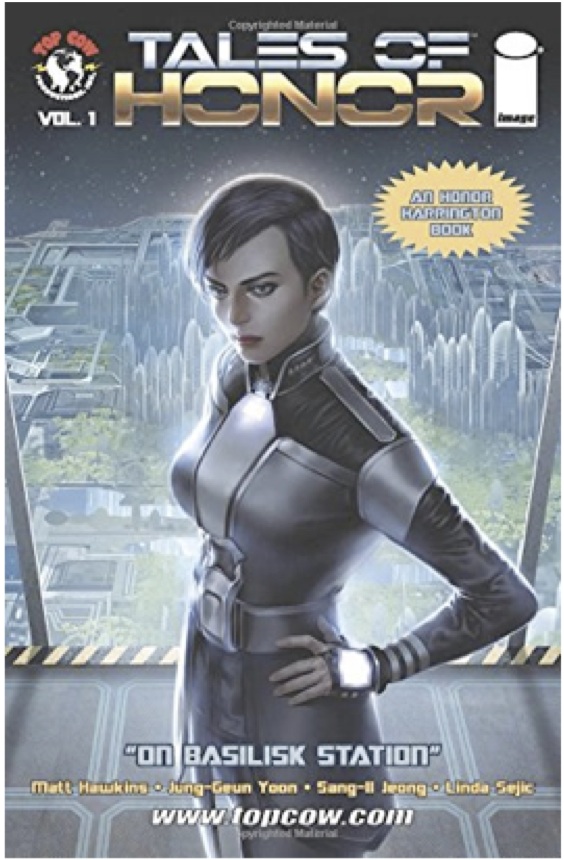 As a fan of David Weber, I have been most interested in the new venture he has with Evergreen Studios to turn the adventures of his flagship character, Honor Harrington, into a series of comic books, a video game, and eventually, a movie series. I seldom play video games, so I won’t comment on that aspect, but re-imagining the characters in a semi-manga set of comics is an interesting approach to creating a wider audience for Weber’s work.
I purchased the actual book (a larger paperback) rather than the eBook, because I wanted to examine the work closely and perhaps share it. I’ve read (and re-read) the books, so I am not the intended audience. Fans of Weber’s prose are probably going to be disappointed, because there are not many words in these books. Comics (graphic novels?) are quite different from prose, and Weber uses lots of words. However to bring Honor off the page and onto film will require story boards, so I am viewing this book, and those that hopefully will come later, as elaborate story boards. Weber has a full page introduction in this book wherein he asks fans to be open-minded about the new approach to his work.
On Basilisk Station has a good bit of exposition, and while interesting, it isn’t as tense as some of the later novels, so I found it interesting that Tales of Honor, Volume I begins “in medias res” with the situation at the end of book seven (In Enemy Hands) as the framework for book one. Certainly this approach ramps up the suspense, as Honor faces torture and execution, and remembers these earlier events, because her previous exploits are what led to her capture by the Havenites.
A few posts back, I included some art by a cover artist who really captures the Honor Harrington of my imagination, and this Top Cow/Evergreen Studios version is quite a bit different. Still, art conveys meaning in a different manner than words, and just having visuals of Honor and her universe may alienate some fans, but will hopefully attract others.
Do I like this book? Well, not really. I very much prefer the original. But is it bad? Nope, it isn’t. Honestly, the comic novel manages to get across quite a bit of the original, in very few pages. The pictures are not cartoons, but have quite a bit of detail. Especially interesting are the panels which explain how propulsion and weapons work in Honorverse. Weber always mentions the devastation of warfare, but the visuals here are more dramatic than words alone. My main problem with Tales of Honor is the problem that fans often have with films—a disconnect between what I previously imagined and what I am seeing. This version of Honor is less beautiful, more menacing, and less subtly nuanced than the one in my imagination. And, the Nimitz in this book is unrecognizable. Really. Are these problems created by the artists, or by my lack of an open mind?
As of this writing there is only a one-star review on Amazon, written by a disgruntled fan who is also experiencing this closed-minded disconnect. Hopefully, that will change, because for Honor to become a film heroine, the comic books will need to find more receptive audience. And, I believe Honor’s exploits would make one heck of a good series of movies, so I am gonna hop over to Amazon and leave a review.
 Visions and Revisions