Old News

Since the “new” version of my science fiction novel, Trinity on Tylos, has been repackaged for Kindle readers, I went looking for reviews from when it was first published— not the ones on Amazon, but the other ones. At that time, I sent out a lot of digital files, as well as a few print books, in hopes of getting some reviews. Here are some excerpts with links to the original posts:

Rob Preece of Books for a Buck stated: “Author Pamela J. Dodd builds on the conventions of old-time space opera (e.g., aliens wanting human women), creating a thoughtful vision of alien contact, of the Stockholm Syndrome, and of the both heroic and horrible attempt of one being to perpetuate his species, no matter what the cost. Dodd addresses these issues mostly in terms of relationships–especially the three way conflict between Venice, her human-husband Steve Dylenski, and Captain Azareel.”

Anita at The Romance Studio says in her review:The storyline is creative and filled with exciting action as one race fights another for their survival. Trinity of Tylos is a fascinating emotionally stirring space adventure that shows how far someone will go for someone they love.”

Jean at Fallen Angel Reviews was not only the first person to review the original novel, but she also gave it a “recommended read” accolade: “This is a great book for fans of science fiction and futuristic romance. I’m giving this story 5 angels and a Recommended Read, because it is so well written that it grabbed me at the beginning and kept me enthralled until the very last page.”
ToT_cover_final_webLG

Trinity on Tylos, Mulberry River Publishing edition

ToT_cover_final_webLGAfter six years with the original publisher, Trinity on Tylos is going to be available in a new edition, via Amazon’s Kindle store.  I’ve priced it at $2.99, the same price as my debut novel, The Gift Horse. For this new version, I went through a copy of the eBook and made every effort to eliminate some of the errors in the original. However, there are no substantial changes, as I was fairly content with it, apart from the proofreading, which was a problem with the original publisher.

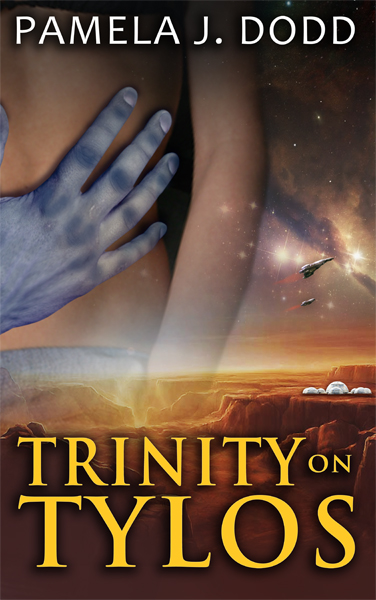
The new cover was designed by Dawn Seewer, who did the cover for The Gift Horse. The background depicts the landscape of Tylos IV, with the ships in the sky. The models in the foreground are Venice and Azareel, and I think the artist did a good job. A few of the readers of the original printed novel told me that the cover didn’t really convey the serious nature of the novel, so I hope that this new cover touches the bases.

For those who haven’t read it, here is the original synopsis that I used when shopping the manuscript:

What sacrifices must an officer make to save her shipmates from certain doom? Venice Dylenski, the young security chief of the colonizing ship, Excalibur, is faced with this dilemma after her captain makes a critical error in judgement in an encounter with an alien with superior fire power and a hidden agenda.

Trinity on Tylos begins as Venice experiences an embarrassing moment on a survey mission, one which rules out yet another planet as a hospitable home for their colony. While continuing its search, the Excalibur encounters the Archeons, an alien race characterized by gray-blue skin and a facility for language. The interchange results in Venice and a crewmate, Alathea Duke, being taken captive by the mysterious Archeon captain, Azareel. In short order, he informs them that they will play a critical role in revitalizing his dying race, that of surrogate mothers to genetically engineered Archeon offspring.

Venice, reluctant “to be the next Archeon soccer mom,” strives to escape, but her companion seems all too willing to cooperate with their captor. Thus the stage is set for multiple conflicts between human and Archeon, human and human, and humanoids verses the hostile environment of their new planetary home in the Tylos star system.

Trinity on Tylos has the elements of a good space opera: complex characters faced with myriad problems to solve, set in a future where man may have escaped the bounds of his solar system, but not the bonds of human emotions.

Rich Man’s War— a review

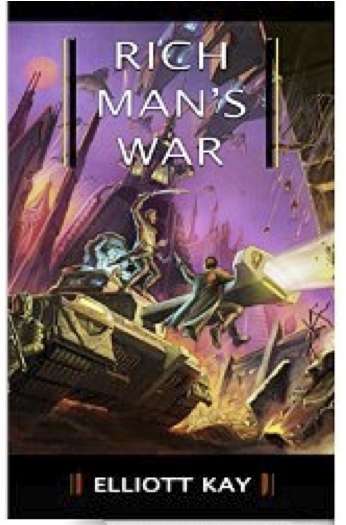
Rich Man's War cvrA couple of entries back I reviewed Poor Man’s Fight by Elliot Kay, and I really did like that book. Okay, in part, I liked it because it is in one of my favorite sub-sub-genres— a coming of age military science fiction story. But, that book was well-written and highly entertaining, and such books are sometimes too formulaic. Rich Man’s War is the sequel, and it does take up shortly after the events of the first novel in this series. The action, once it really gets going, is almost non-stop in PMF, but RMW is a more complex story, so it doesn’t move with the vim and vigor of the first one. Worse, it is quite easy to get bogged down in the “who is this part about, friend or foe” because the battles are large scale, so the cast of characters has grown exponentially.

Still, I am glad for the sequel to PMF. Somehow, readers just knew that Tanner Malone had a career ahead of him, and there is a natural desire to see the character evolve. Both Tanner and some subordinate characters from the first novel are important characters here, but in this entry, the corporations which have pretty much made Archangel inhabitants into economic slaves are the enemy. The plot development is organic, that is, what happens in this novel often has roots in the first one. I do not believe that RMW stands alone particularly well, so do read the first book first.

That said, I did enjoy the further adventures of highly decorated war hero Tanner Malone, and it is a good read if not a great one.

War to the Knife— a review

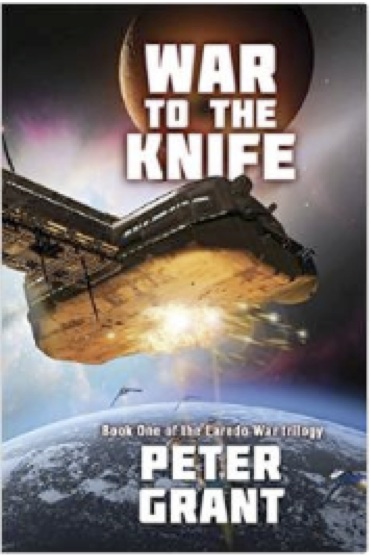
War to Knife cover

Since I have a break at work, and it is really hot in Georgia, I’ve been reading. My latest Kindle eBook is War to the Knife, by Peter Grant. I gather that this is a first installment in a series, and in a way it reminds me of early David Weber or John Ringo, but on a smaller battlefield. Once I got past the “old west” opening, I really began to identify with the stubborn band of rebels. They fight, but they pay dearly, too. I once heard David Weber talking about his Honor Harrington series, and how her heroism is “bought with bitter coin” and that also describes this story. The combatants die, and in a gory fashion, so there is plenty of that gritty realism. However, the author switches between the point of view of the rebels and that of an officer on the other side, which does remind me, once again, of Weber. By seeing both sides of a war, even when one is clearly the enemy, there is a better understanding of the price paid by winners and losers.

The author gets a little too into explaining some things, such as the ordinance, but that’s just personal taste. I tend to be more into how the characters feel than how many missiles it takes to blowup whatever, but other readers might want to more about the size of the warhead. But, the ingredients of a good military/space war story are present: a great cause, likable heroes, dastardly but not insane enemies, and plenty of weapons. However, the name of the enemy, Bactria, doesn’t work for me. It sounds like a topical antibiotic or something.

Still, I liked this story quite a lot and the story is, for the most part, well-written and edited. Nowadays, so many people are self-publishing via Amazon that there are quite a few poorly written and edited books, so I begin with reading the negative reviews. If there are several that point out grammar, spelling, and consistency issues, then I keep looking. The reviews for this book are positive, and I agree with most of them. War to the Knife is a very good read, and I ended the story wanting to read the rest of the series.

Poor Man’s Fight— a review

While there are any number of space operas available via eBook, I enjoyed Poor Man’s Fight by Elliot Kay quite a bit. The formula is perhaps too much tried and true—yet another coming of age in the military story, but I thought the premise that sets the hero upon his path more thoughtful than many others. Our protagonist, Tanner Malone, is a good student and a nice guy; he’s about to graduate from secondary school. But, in this futuristic yarn, those who perform in a less than exemplary manner on a gi-normous one day test are going to owe a private corporation for their education. Tanner, upset by his dad’s bombshell that he and stepmom are moving off planet leaving him to be “on his own,” doesn’t do particularly well on the test. Owing several grand, Tanner does what any red blooded male teen would do—he consults a girl. (I speak from experience, as the mother of a young adult male.) Anyway, this young lady suggests that he enlist, so that the military will provide him with a home and a job, and that will enable him to begin to pay off the massive debt of his education. In short order, without consulting dad or stepmom, Tanner enlists.

Some other reviewers mentioned that the book’s set up wasn’t plausible. In a day when student loan debt is at all time highs, I actually thought the scenario of a teen trying to deal with crushing debt was the most realistic part of the story!

However, once Tanner gets into basic training, the action keeps readers entertained. His training is related in some detail, but, eventually, he graduates. Having dispensed with roughly half the novel, the author has to create a military disaster pretty quickly, so the hero has a chance to be heroic. I know, that sounds sarcastic, but it isn’t meant to be. By and large, heros are ordinary folks placed in extraordinary circumstances, and that’s what we have here. There’s plenty of heroism during the last third of the book.

Honestly, Poor Man’s Fight cost me some sleep. I just couldn’t wait to see how Tanner’s intense military training saved him (and lots of others) from the incompetence of his fellow navy types, as they are facing some really dastardly villains. And, once the last big scene began to unfold, the suspense ramped up even higher. I was not disappointed. Not at all.

So, if you like space opera, coming of age stories, or just a suspense filled yarn, try Poor Man’s Fight. It’s a bargain!

Scarlet (The Lunar Chronicles) review

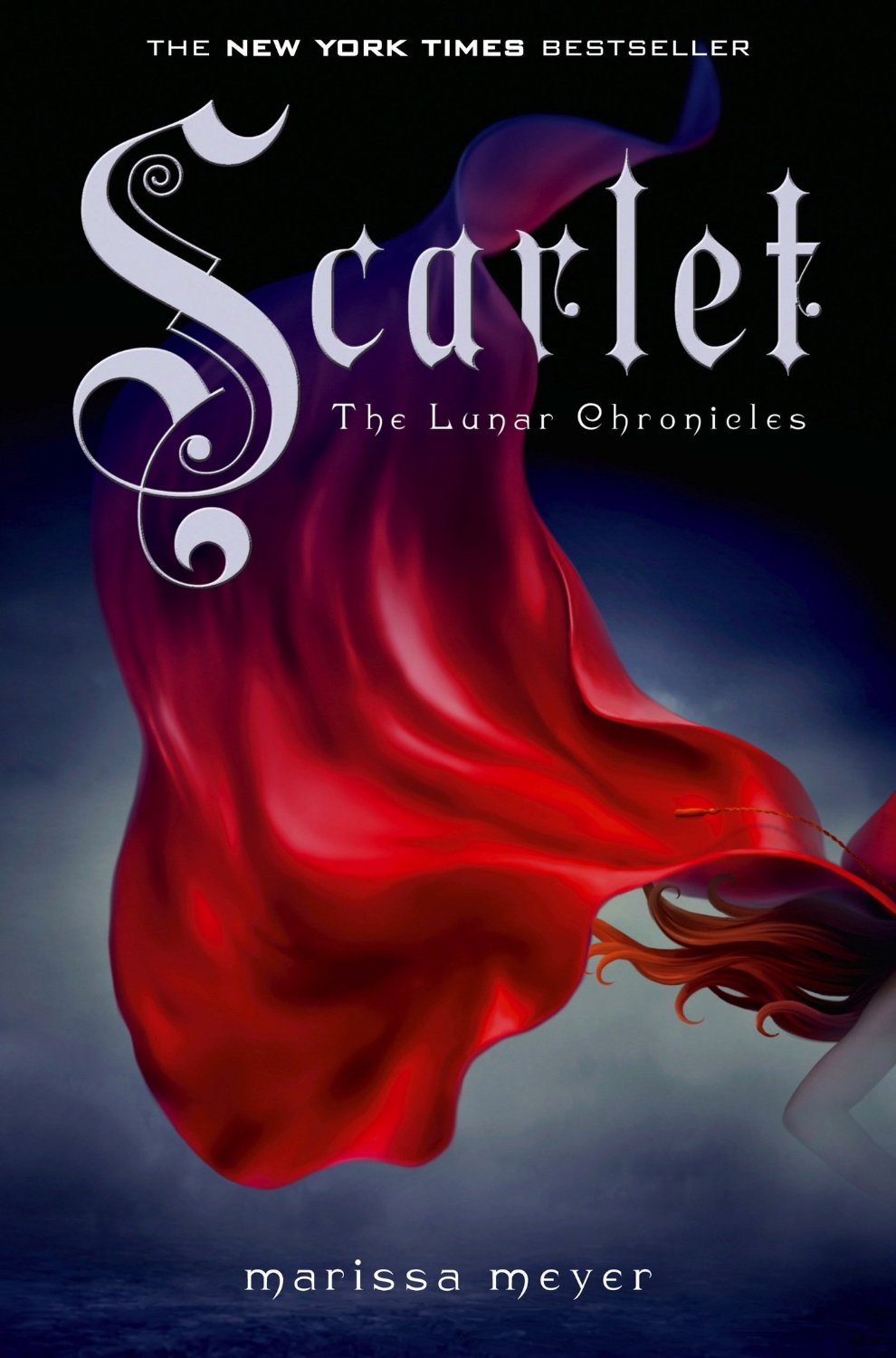
Image A while back, I wrote a review of Marissa Meyer’s Cinder, which begins a series the author calls The Lunar Chronicles. After I bought it, I did not read it, but put it off for a while. I like science fiction and have no problem with YA titles, but it sounded kinda weird. Once I read it, I did like it. I really liked it, actually. And, once again, I bought the next installment, but put it off while I read another book (Darrell Bain’s The Frontier Rebellion). Then, a few weeks back, I clicked on the cover of Scarlet, and I will admit that I was not entranced after the first chapter, but I pushed myself, and the book did pick up. If you begin and wonder if it is book extolling the virtues of organic gardening, just hold on. Scarlet is a worthy tale, but I will offer a warning to readers—it would be quite confusing to a someone who did not read Cinder first. The story of Scarlet, who abandons the family farm to search for her lost grandmother, is so intertwined with Cinder’s continuing adventures that it is far better to begin with that book and then pick up this action packed story. If this were just the story of Scarlet and Wolf, I would not give it a five star review, but when I reached the end of Cinder, Meyer was clearly not finished, so I was expecting to see her again. Perhaps not so much of her, but that is actually a plus. Now, the character of Scarlet is interesting, and there is plenty of suspense as she struggles to find her grandmother before something really bad happens, but I especially like the multilayer enigma of Wolf. Even more than the first book, this one has the trappings of a gritty urban fantasy, with science fiction elements, and a bit of romance, too. Many times, I have stated that the best fiction is aimed at younger audiences, and this novel is more evidence of that. I noticed that Cress is now available, so I will buy it soon.