 While I prefer more sophisticated military science fiction, readers of all ages should enjoy Cadets, which is an entertaining read. The story follows a group of cadets, who are forced into growing up quickly when a menace from outside the solar system wipes out virtually all of the Earth’s defense force. The characters are not as complex as those readers would find in a space opera by David Weber or Elizabeth Moon, but for the intended audience, this yarn is quite good. The military strategy won’t impress adult readers, either. Still, it is suspenseful, with a bit of Independence Day style peril. A good read, with no worries for the parents.
Category review
Investment Biker— a review
 While touring the Barber Motorsports Museum in Alabama, I came upon a display of two rather battered BMW touring bikes, on a round platform, with a sculpture of the world suspended over them. In a museum where even hundred-year-old motorcycles are preserved in showroom condition, these two road warriors stood out. The information spread around the platform indicated that the bikes were used by Jim Rogers and his companion, Tabitha Estebrook, as they went on an around the world trip, on motorcycles.
When I got home, I bought the book that Rogers wrote about his trip, Investment Biker. As a fairly young man who had made his money on Wall Street, Rogers takes his reader on a ride around the world, and into the world of finance. At first, I was rather annoyed, because I wanted to read about the bikes and the sights, but not about the price of commodities. However, as Rogers explained how his trip through Europe, Asia, Africa, Southern America, and other regions influenced his trading, I gained respect for his reasoning in investing in some areas, while steering clear of others.
That said, there are motorcycle tales aplenty, from having a hole in a piston welded in a remote village, because the closest BMW dealer was thousands of miles away, to spills along a road with gravel pieces the size of baseballs for a road surface.
Since this journey occurred a couple of decades back, there are sections which read more like history, such as his observations about why the Soviet Union appeared to be crumbling. And, I am sure that Rogers might want to retract some of his political predictions, should he ever have a second edition.
Still, I am really glad I read Investment Biker. Many of the reviewers on Amazon seemed disappointed that this book is about travel on a motorcycle, rather than investment advice. I wanted to read about adventure, and this book has plenty of that. Most of the moto-journalism I have read has been inferior. Rogers writes well, and his vision and experiences are inspiring.
Leviathan review
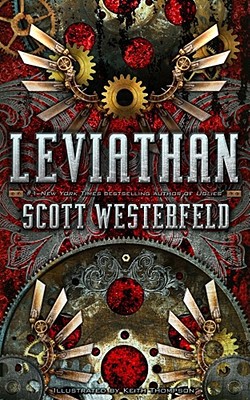
A couple of years ago, I purchased a copy of Scott Westerfield’s novel, intended for a young adult audience, for my son. Alas, he never read it, but that is not a judgment against the book, as my son tends to read books with video game tie-ins.
Since I was assigned a book presentation, (that’s a new term for report, y’all) I pulled Leviathan off the shelf. The book itself is inviting. The cover is amazing in its detail, and the form of the book is slightly non-standard, being just a bit taller and narrower than the norm. The paper is high quality, and the print is just a little wider than normal, which required adjusting the “leading” as the book was formatted for print.
Leviathan is an alternate history set in the era of World War I, written for a young adult audience in a genre known as “steampunk,” and is the beginning of a trilogy. The novel has two point-of-view characters, Aleksander Ferdinand, the (fictional) prince of the Austro-Hungarian Empire, who is forced to flee after the assassination of his parents, Archduke Franz Ferdinand and his wife, Sophie. The other point-of-view character is Deryn Sharpe, a commoner, a young woman who disguises herself as a boy so she may join the British Air Service. As the war unfolds, these characters provide insight into two forces in the war. The dualities do not stop there, however, for the British forces of this alternate history have bred various beasts to be both servants and machines of war, such as the Leviathan of the title. The Austro-Hungarian forces rely upon large mechanical warfare machines, such as the walker that Alek has been learning to pilot.
From the moment that young Alek is awakened by trusted old retainers, his story is suspenseful, but not unfamiliar. Count Volger guides Alek literally and spiritually toward a safe haven, as he pilots a huge walker, one of his army’s machines of war, as enemies of his father and of the empire seek to kill him. Alek is not on a hero’s quest so much as he is making the transition from innocence to experience. Nevertheless, there are times when he is heroic, such as his efforts to assist the stranded crew of the Leviathan, when it is wounded and lands near his hideaway in Switzerland.
Young Deryn, too, is on a journey, and while her adventures are also important to the plot, there is far more humor in her part of the story, as her character is propelled though the air via the large creature/ship of the title. The British forces use any number of genetically altered beasts as machines of war. Also, through Deryn, Westerfield makes some pertinent comments on the nature of humanity, such as her weary observation that the young airmen “endlessly competed to see who could spit farther, drink rum faster, or belch the loudest.”
By and large, I found this novel to be well crafted, but there are a couple of annoyances. First, the author substitutes words, such as “barking” for another four-letter word that is universally used as a vulgarity these days. Secondly, the initial swapping back and forth between point-of-view (POV) characters was a bit distracting, but after the first chapter, each POV character is on stage until the next chapter.
Westerfield alternates his POV characters in each chapter until the two meet upon a barren snow covered mountain, roughly half way though the 400 plus page novel. Alek saves Deryn from being trapped in the snow; then she promptly turns him in to her superiors. He is briefly held prisoner, but the British forces have far more to worry about than a mysterious young man from a mountain village. Ultimately, Alek is released so he can assist the crew of the leviathan, so the prince of Austro-Hungary and the crew of the great ship must cooperate to escape from the approaching German forces.
Westerfield’s Leviathan begins with a gripping first chapter and enough action to keep most readers entertained. Although I have not read much young adult literature, this author’s skill is such that I just might read more of his work.
The Long Way Home
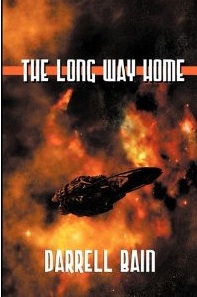 One of my favorite eBook authors is Darrell Bain. I think of him as the master of plots. Oh, there are some problems with his writing, primarily in the “show don’t tell” category, but this guy writes the most amazing yarns.
In the dedication of The Long Way Home, Bain recognizes three important Baen Books authors— David Weber, John Ringo, and Travis Taylor. And fans of their brand of science fiction will no doubt see that these authors influenced Bain in this space-based tale. Weber writes military science fiction on a grand scale; Ringo puts the grunt into military fiction, and Taylor is a rocket scientist who can also spin a good space opera. Bain doesn’t do any of those quite as well as these guys, but he does blend the elements quite well.
The plot is not unusual, with opening scenes of an exploratory vessel far from home, and a first contact mission gone awry. But instead of one or two explorers meeting a premature end, as happens in James Alan Gardner’s Expendable series, there is a massive loss of life and starship, and a small “longboat” known as “The Hurricane Jack” is left to ferry the survivors home. And it isn’t a short journey, hence the title. There are many obstacles, and the conflict is almost non-stop, between the “monkeyclaw” ship following the survivors, and the internal debates over matters in the tightly packed small ship. The mission is now to save the survivors and warn the human population about the vicious species they wished they had left behind. As a small vessel, the longboat must stop to scavenge material, and every stop has some built-in danger. Unlike some writers, Bain is not afraid to kill off his characters, which ramps up the peril factor.
Fans of space exploration stories should enjoy the action-packed suspenseful voyage of “The Hurricane Jack” in Darrell Bain’s The Long Way Home.
Review of Savage Survival
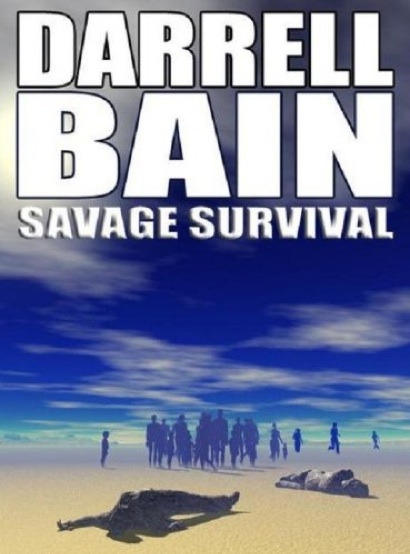 When many people view an author as just fabulous, that writer sells boatloads of books. Remember when everyone was reading the latest Stephen King? Other authors write memorable books, but they only do it once— Margaret Mitchell and Harper Lee come to mind. Some writers are prolific, but it seems impossible to remember the plot of any specific book. Numerous such authors are still writing, but I am reluctant to name a living one, since I really don’t want to make my readers angry. So, I will list a prolific author who probably won’t complain, since she is no longer writing— Barbara Cartland. She wrote over six hundred novels, but I can’t recall any standouts.
Then there are some obscure writers who ought to be less so, and Darrell Bain is one of them. I’ve read several of his yarns, and they are invariably memorable. Savage Survival is typical Bain— something extraordinary interrupts ordinary, and characters rise to the occasion, or they don’t. I’ve seen grace under pressure— my mother was almost always cool and competent, regardless of her circumstances. My husband has that same quality— he manages the most difficult of situations without unnecessary drama. Such people have character, and I greatly admire that quality.
In Savage Survival, the main character, Lyda Brightner, is eleven years old. Yes, she comes of age, rather quickly, but she remains vulnerable enough for readers to be empathetic to her. Various adults interact with Lyda as the story unfolds, but the focus is always on her. Not since Oliver Twist have I followed a youngster through so many trials. Like Dickens’ classic tale of social inequality, Bain’s story is about the crucible of humanity under extreme pressure, but it is also about how people can either make bad times better or worse. There is something distinctly old-fashioned in Bain’s themes, and I don’t intend that as a criticism. In Bain’s books, he tells you who is good and who is bad, and those who are evil suffer for their wrongs, usually at the hands of the hero. Pretense, which is an integral part of modern life, is quickly exposed in Bain’s pressure cooker, and Lyda has no qualms about dispensing justice. Such authenticity is only found in fiction these days, which is ironic, isn’t it?
The story is science fiction, but it is soft-scifi, because Bain never bothers explaining how anything works. Instead, he spends most of the novel showing how people react to it. With my fairly busy schedule, I often begin a book and I’m still working on it a week later. Others are more compelling. Savage Survival took me about 24 hours, and that is only because I do have to sleep sometime. Lyda Brightner got under my skin in such a way that I just had to know how it was all going to play out.
I read the eBook version, but I believe the publisher, Double Dragon, also put a few hundred into print. Whether you choose electrons or ink and paper, I highly recommend Bain’s books, and this particular title is quite worthy.
 Visions and Revisions