Old News

Since the “new” version of my science fiction novel, Trinity on Tylos, has been repackaged for Kindle readers, I went looking for reviews from when it was first published— not the ones on Amazon, but the other ones. At that time, I sent out a lot of digital files, as well as a few print books, in hopes of getting some reviews. Here are some excerpts with links to the original posts:

Rob Preece of Books for a Buck stated: “Author Pamela J. Dodd builds on the conventions of old-time space opera (e.g., aliens wanting human women), creating a thoughtful vision of alien contact, of the Stockholm Syndrome, and of the both heroic and horrible attempt of one being to perpetuate his species, no matter what the cost. Dodd addresses these issues mostly in terms of relationships–especially the three way conflict between Venice, her human-husband Steve Dylenski, and Captain Azareel.”

Anita at The Romance Studio says in her review:The storyline is creative and filled with exciting action as one race fights another for their survival. Trinity of Tylos is a fascinating emotionally stirring space adventure that shows how far someone will go for someone they love.”

Jean at Fallen Angel Reviews was not only the first person to review the original novel, but she also gave it a “recommended read” accolade: “This is a great book for fans of science fiction and futuristic romance. I’m giving this story 5 angels and a Recommended Read, because it is so well written that it grabbed me at the beginning and kept me enthralled until the very last page.”

ToT_cover_final_webLG

Trinity on Tylos, Mulberry River Publishing edition

ToT_cover_final_webLGAfter six years with the original publisher, Trinity on Tylos is going to be available in a new edition, via Amazon’s Kindle store.  I’ve priced it at $2.99, the same price as my debut novel, The Gift Horse. For this new version, I went through a copy of the eBook and made every effort to eliminate some of the errors in the original. However, there are no substantial changes, as I was fairly content with it, apart from the proofreading, which was a problem with the original publisher.

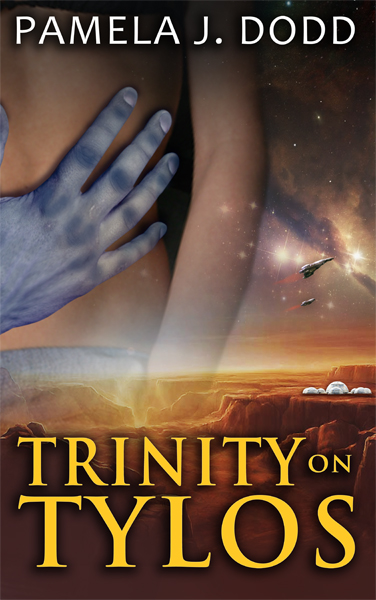
The new cover was designed by Dawn Seewer, who did the cover for The Gift Horse. The background depicts the landscape of Tylos IV, with the ships in the sky. The models in the foreground are Venice and Azareel, and I think the artist did a good job. A few of the readers of the original printed novel told me that the cover didn’t really convey the serious nature of the novel, so I hope that this new cover touches the bases.

For those who haven’t read it, here is the original synopsis that I used when shopping the manuscript:

What sacrifices must an officer make to save her shipmates from certain doom? Venice Dylenski, the young security chief of the colonizing ship, Excalibur, is faced with this dilemma after her captain makes a critical error in judgement in an encounter with an alien with superior fire power and a hidden agenda.

Trinity on Tylos begins as Venice experiences an embarrassing moment on a survey mission, one which rules out yet another planet as a hospitable home for their colony. While continuing its search, the Excalibur encounters the Archeons, an alien race characterized by gray-blue skin and a facility for language. The interchange results in Venice and a crewmate, Alathea Duke, being taken captive by the mysterious Archeon captain, Azareel. In short order, he informs them that they will play a critical role in revitalizing his dying race, that of surrogate mothers to genetically engineered Archeon offspring.

Venice, reluctant “to be the next Archeon soccer mom,” strives to escape, but her companion seems all too willing to cooperate with their captor. Thus the stage is set for multiple conflicts between human and Archeon, human and human, and humanoids verses the hostile environment of their new planetary home in the Tylos star system.

Trinity on Tylos has the elements of a good space opera: complex characters faced with myriad problems to solve, set in a future where man may have escaped the bounds of his solar system, but not the bonds of human emotions.

Going, going, almost gone

TrinitycoversmThe Whiskey Creek Press version of Trinity on Tylos is about to become a bit of a collector’s item. When it was first published, I was mostly pleased, although the final edits were rushed and far too many mistakes made it into the print copy. The paperback was not of the best quality, either. The ebook, at least the one I got from the now defunct Fictionwise, was far worse. What few royalty reports I received indicated low sales, and even lower royalties. At one point, I was getting seventeen cents per ebook sale, and a typical quarterly check was about five bucks.

When the book came out, in 2006, I sought out speaking engagements, author-guest slots at science fiction conventions, and I did quite a bit of internet promotional activity, hoping to help Trinity find an audience, and to do my part to help sell the book for WCP. By 2007, I realized that the sales were not going be as good as my self-published debut novel, so I spent far less time promoting it. But, WCP continued to be a disappointment, too. Just to get Amazon to list it, WCP required that I purchase two copies at full price; then, initially, the title was misspelled on Amazon’s website. Eventually, the print book was listed correctly, and I did have a couple of very good reviews on Amazon, as well as several from other sources. When Amazon’s Kindle format began to take on increasing importance, WCP indicated that eventually all of their titles would be available for the Kindle. While Trinity on Tylos was available for the Nook, it was never converted to Kindle format. My original contract was for two years, but I did not ask for my rights back, in part because I hoped WCP would eventually pay me more royalties, and that they would support the book. And, to be honest, I was very busy with my adjunct instructor job, as well as being mom to teenagers, so I didn’t push either promotion or accountability from WCP.

After years and years of zero communications regarding sales, I can only conclude that either there were no sales or WCP kept all of the royalties. I will never know which. I’ve maintained a website, with promotional materials, links to vendors, and so forth, at my expense, and I finally came to the conclusion that WCP was never going to pay me anything ever again. Anyway, I did ask to have my rights back at the end of last year, via email, and there was no response. I asked again recently, via snail mail, and while I still have not heard a word from WCP, I noticed today that Trinity on Tylos is no longer listed for sale by Whiskey Creek Press nor by Barnes and Noble. Amazon still has it for sale, but they list the one lonely copy, and I do remember that I paid for it in 2006. I’ll bet it is quite shopworn by now!

Fellow WCP authors are in a bit of an uproar, because WCP has been sold to a New York firm, Start Media. Some of those other authors have suggested that I self-publish it, as they are doing with their own books, and I have talked with Booklocker about doing the formatting and cover. Since I don’t have a clean copy of the manuscript, I’ll be doing some editing before doing anything else.

In the meantime, Whiskey Creek Press is going, going, soon to be gone. Various interent sites have chronicled the demise of this small press, and much of the dirt is recorded here. For whatever reasons, I’m sad, which is illogical, because the publisher hasn’t been paying me or even bothering to respond to email. And there is little solace in knowing that I am not the only author that they deemed not worth a simple email.

Bluegrass, Gospel, Pinto Beans and Cornbread


Image

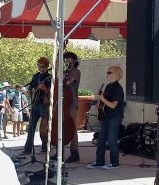
Moore Brothers band at Merlefest

Image

My sister invited me to go with her to an event known as “Merlefest” in North Carolina last weekend. We went, along with about 75K other folks, and it was a really amazing festival. She had told me quite a bit about it, and her pitch to get me to go (apart from a four day visit with her) was that I would learn a lot to help my son, the luthier. I did learn, although not so much about luthiery.

First, I learned that God is not out of fashion in the hills of North Carolina. One forgets how “politically correct” our world has become. At Merlefest, I heard all about God, via old-time gospel music (which I love) and many casual references. Here’s an example: In introducing a love song to “Mary” country super-star Alan Jackson said that his wife’s name is Denise, but that didn’t work in the song, so he figured that maybe she wouldn’t be mad if he used the name of Jesus’ mother. It was off-hand and natural. I liked his explanation as well as the song.

Second, I learned that it is possible to feed thousands efficiently with food that was both economical and reasonably healthy. There are several places for food at the festival, but the main one is the “food tent” across from the main stage. There was a booth that sold pinto beans and cornbread for $4. This meal was delicious and filling, and far better than the funnel cakes that I expected. Later, I ate a plate of grilled veggies and rice from another vendor, which was $5. And, my sister’s favorite was the booth run by the Boy Scouts, where they sold a “wing tray” of BBQ chicken for $4. All of these booths were run by local non-profits, so the food had “home made” flavor, too. Sister got a $5 ice cream at one of the commercial spots, but I preferred the more basic fare.

Third, I learned that some acts I would never have chosen to see were among the best. On the first night, I was looking forward to seeing Alan Jackson, but one of the lead in main stage acts was the Carolina Chocolate Drops. This string band was lead by one of the most gifted vocalists I have heard in years, and their performance was filled with energy and precision. Who would have thought that a trained opera singer would be fronting a bluegrass band? Other stand outs included a band (the Moore Brothers) who were 20, 16, and 11. And, my sister and I both loved the old-time sound of The South Carolina Broadcasters.

Lastly, I learned that the many of the festival folks were more tolerant of discomfort than I am. There was rain on day two, so we scuttled into an auditorium and stayed until the showers passed by, but others just found a tree or a tent for a few moments. On the third day, it was hot, and we left the “hillside” during the opening bars of the “album hour” because we didn’t like being fried. Apparently most of those perched on that steep hill stayed. Perhaps the oddest discomfort came from having the more expensive “reserved” seats. As the evening shows progressed, each group was louder than the one before. On the second night, our ear plugs weren’t enough, so we left early, and on the third night we ended up in folding chairs at the back, leaving our reserved seats empty. Some of the performers were asking people to move up to the reserved seats, so I gathered there was a sea of empty seats, which must have been disconcerting (pun intended) for the performers on stage.

The instrument sales tent was filled, with everything from high-end custom guitars to “vintage” instruments, such as a Silvertone guitar in need of a neck reset. I even met the owner of Deering Banjos, a company about to celebrate 40 years as the premier maker of banjos in this country. As for luthiery, two Virginia guitar makers, Wayne Henderson and his daughter Jane, did a presentation that was pretty darned interesting, especially  when he played his first guitar which sounds pretty good, despite the bullet hole in the back.

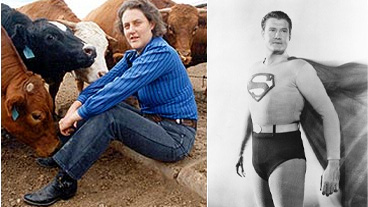
Two Reviews— Waiting for Superman and Temple Grandin

While I have made most of the money I have ever made (or ever hope to) in public education, I genuinely enjoyed and appreciated the expose of public education called Waiting for Superman. The film is captivating, and somewhat suspenseful for a documentary.

As it opens, viewers meet five young people, of different ages, genders, and ethnicities. Each one has hopes and dreams which can only be fulfilled by a proper education. And each one is in a school which feeds into a “failure factory.” That term is applied to high schools where most students either drop out or fail to have the right background to get into college and succeed there. The facts and figures are playfully represented, and the stories of the five subjects introduced early on unfold gradually, along with commentary from educators.

Viewers will take away different images, I am sure, but I certainly identified with the “hidden camera” video of a classroom where the students were in the back of the room, playing craps, while the teacher sat in front of the room, with a magazine, waiting for his time to be up. My husband found that footage to be shocking, but I did not. Certain classes are like that. Really. I know, because I used to work in a public high school.

My experience tells me what the filmmaker does, and that is the answer to education problems is to hire good teachers and only good teachers. A good teacher is indeed “a work of art.” Of course, making sure that only good teachers are employed in public schools would entail firing bad ones. The filmmaker explains how difficult it can be to fire a bad teacher, and he professes to have an answer for this problem. I enjoyed the film, including the solution part; but as an educator, I am also skeptical that the solution can be so simple. (No, I won’t say what it is, but I hope readers of Pam’s Pages will want to know and will watch Waiting for Superman.) As the film draws to a close, viewers get a glimpse of the future of each of the youngsters, with mixed results, of course.

On a recent evening, our whole family enjoyed the excellent biopic from HBO which explains the life and thought patterns of the most famous autistic person in America, Dr. Temple Grandin. Anyone who has dealt with autism, or merely wants to know more, should see this film. And anyone who likes a good story will probably be just as impressed with it. Clare Danes is simply amazing, as she becomes the namesake of the film, Temple Grandin, in her speech patterns, her mannerisms, and she does a fair job of suppressing her movie star looks to appear more like Grandin would have looked in her earlier years.

Dr. Grandin writes well, and I first learned about her via her articles on how autistic people think. But, before she was famous for speaking out about autism, she was famous for being an expert in animal husbandry, and this biography begins with her summer trip to her aunt’s ranch, which was the beginning of her intense interest in animals and how they think. Grandin believes that there are distinct similarities in the thought processes of animals and autistics, and that is in pictures. Indeed, she has authored several books, as well as becoming a college professor, and one of her books is entitled Thinking in Pictures.

There is quite a bit of humor in this film, as Grandin blunders through social situations, but there is plenty of heart, too, as she is befriended and mentored by various people. As a mother, I do identify with Grandin’s mother, ably portrayed by Julia Armond. There can be no greater task than that of the mother of an autism spectrum child.

Unfortunately, neither of these movies will attract the viewers of the latest sci-fi blockbuster, but they are such worthy films that I hope you’ll go rent them or buy them and then share them so their messages will be spread a bit farther.
Gone

Recently, during a session of blog and website housecleaning, where I was looking for dead links, a trend emerged. Some of my fellow authors, especially the younger ones, have deleted their blogs. Christina Barber’s “The Writer’s Crypt” seems to be history. Susan Grant ended her “Come Fly with Me” blog in favor of a news section on her website. A particularly good one, “Faster Than Kudzu“has also moved. Other blogs are on hiatus. No doubt more blogs will go away, because the online audience is moving toward different web addresses. For a time, My Space was popular, but no more. Right now, Facebook is the most important medium for many who want an online presence, but I suspect that it, too, will be supplanted by another form of communication.

Groups, such as the ones on Yahoo and Google, were big news a decade ago. While I am still connected to some of these “list/serve” sites, I’ve left a number of the groups I where I was once a member, and for most of the others, the “daily digest” is no longer in my inbox. Online forums are also fading away, albeit more slowly. I was once fairly active on the SFReader boards, but if I spend a lot of time doing online promotion and/or writing, I don’t do any real writing, and that is a problem. Other authors have mentioned that online promotion, although cheap, is expensive in terms of time.

My goal, at the beginning of”Pam’s Pages,” was to promote my writing, to connect with people as a “real person” with ideas and opinions beyond what I express in my fiction writing, and to have a place to float concepts before I put a great deal of time into writing more formally about them. In 2005, when I began this blog, publicity experts were touting frequent updates, perhaps daily, to keep a blog at the top of search results on Google. While I didn’t think daily would ever be realistic, I thought could manage once a week, and I have averaged that. But once a week, or even once a day, can’t compete with Twitter.

Lately, due to time constraints and social constraints, “Pam’s Pages” has leaned more toward book reviews, which is fairly easy for me, since would be unusual for my reading to amount to less than a book a week.

How ironic; thus, this blog an out-of-date means of communicating about an out-of-date hobby, reading.