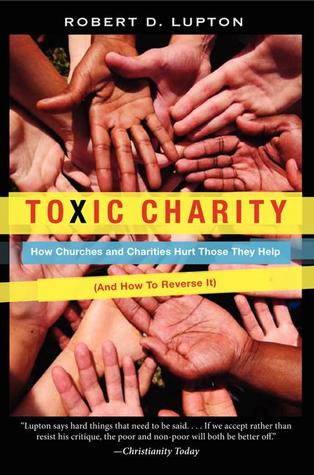
 A friend who works on the staff of a large church recommended this book to me, and while it lacks sufficient support for some of the concepts, the principles are sound. Basically, the title says it pretty well—whether just throwing money or a week of unpaid labor at poverty—this act of charity might do more harm than good.
Author Robert D. Lupton has plenty of experience in urban ministry, and he cites many examples from his experience in Atlanta, Georgia, which is where he lives and works. But, as I have seen lots of churches gather a group of volunteers for week long “mission trips” I was fascinated by the story of a church in Mexico that was painted six times during one summer, by six different sets of volunteers. Indeed, what the author terms “religious tourism” is big business. He states that in 2005, $2.4 billion was spent by 1.6 million Americans, who traveled abroad for short term mission trips. My favorite statistic: “The Bahamas, it is estimated, annually receives one short-term missionary for every fifteen residents.” Okay, I have never traveled abroad on a mission trip, but the Bahamas sounds like a great place to visit. (My daughter mentioned knowing of a local church that did a mission trip to Ireland. Sounds heavenly!)
Lest readers get the idea that all Lupton does is make the good hearted look either mis-guided or just plain stupid, he does mention that many people set out on these trips with good intentions. Then he explains that in the third world, a little bit of money spent properly can do quite a lot. He explains the use of “micro loans” which can give a struggling person a needed hand up. For example, a $50 loan to a woman in Nicaragua allowed her to buy a sewing machine so she could ramp up her production of baby clothes. Once she paid off the loan, she still had the increased earning capacity.
In the U.S. many churches and other charities give away certain items. One example was giving holiday presents to needy families, but the fathers in such situations are often embarrassed that they can’t match the generosity of the well meaning givers, and are thus emasculated in front of their wives and children. Another example was a food bank, wherein the recipients had come to view the handouts as entitlements, which the author then contrasted with a food co-op, where members paid a small ($3) membership fee, and the members then gathered food from free or discounted sources, set their own rules for distribution, and so forth. The co-op helped the members but did not demean them or destroy their work ethic.
Toxic Charity is a bit controversial, but the U.S.A. is one of the most generous nations which has ever graced this planet. Unfortunately, just throwing money at problems can actually make things worse. This book is a must read for anyone who is involved in charity work, faith based or not, because it explains the problem but gives some good guidelines for better ways to help without hurting the recipient or wasting effort and money.


 I have mixed emotions about this day, but I do like some of the promotions associated with it. There is a nifty kids’ consignment store over in Buford that is having a big sale today, urging their customers to buy used. For kids, that’s generally a win-win, as children’s clothing is often not worn out before it is out-grown, and as kids are hard on their clothes, cheaper options are better for play clothes. I noticed some emails from an
 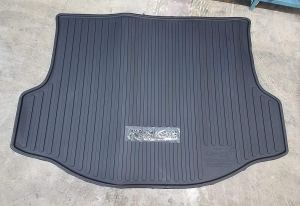 My oh my, WordPress didn’t like the spelling of “farkles.” That’s more of a motorcycle term, I suppose, but it basically means shiny stuff that might actually do something to help the vehicle. My rather limited research indicates that this is a portmanteau word, based on sparkle and function. When hubby gets a new ride, he often wants to invest in some
  (deeper and more sturdy than floor mats) and a Genuine Toyota Cargo Tray
 , which is also deeper than a mat, if not quite as heavy. While not exactly “shiny” these items are handsome and quite functional.
 My sometimes hated (but mostly beloved) minivan is no longer in my possession. After a few days of car shopping, I traded it in for a used Toyota. The van, a Honda Odyssey, was sixteen years old, so I suppose it was time. Still, it ran beautifully on the way to the dealership, so that drive was bittersweet. On the way, I passed by a yard sale, offering bikes and other things I might have purchased, because having things to do at Grandma’s house is where I am in life, but I didn’t stop, knowing that those items would probably not fit in the trunk of the sedan I was planning to purchase.
 Here in the south roofing tends to fail long before the “thirty…fifty” year supposed lifespan of the shingles. Our house has developed some leaks, so it is time for a new roof. And, as roofing is expensive, and the house is big, I talked with some friends and family about the roof before calling the first roofer. Everyone we talked to said that prices vary widely, so we should get multiple quotes, and we settled on trying to get three. That has been difficult.
 Visions and Revisions