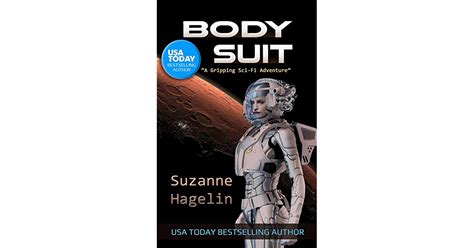
Body Suit by Suzanne Hagelin

Titles are important, as is the case with this trilogy opening novel’s title, but I almost didn’t read this one. Body Suit? Sounds like a fashion mistake from my youth. Once I began, the narrative style didn’t grab me from the outset, as the point-of-view characters switched back and forth between a soon to be indentured servant/colonist and a rather prissy seller of space suits. Hold on, y’all, because it gets better! Or maybe the author’s style grew on me. Anyway, the switching back and forth continues as the two-fold adventure develops, but each character fleshes out so well that I genuinely enjoyed each character’s time as POV.

The purchaser of the body suit, Silvariah Frandelle, initially travels to a space station called Guam, where she learns both how to navigate being a servant (called a Contractor in the book) and how to use the fancy body suit of the title, and then to Mars, as a miner at the new Resnik colonial facility. Back on Earth Walter Cuevas, who sold the suit for far less than its MSRP in exchange for some tips on how the suit performs, learns to act on the suggestions that the business savvy Sil Frandelle communicates to him. His fortunes grow by leaps and bounds as Sil helps him get lucrative advertising deals, then offers tips on which stocks to purchase based on her observations while in space.

Both Sil and Walter must deal with Artificial Intelligence entities, too. Sil is introduced to the Companion while on Guam, and the AI is also present with her on Mars. The Companion is really her Taskmaster, but the programmers chose a more benevolent title for the AI, as its job is multifunctional, assessing (or perhaps spying on) her, while also directing her industrial activities on behalf of those who own her contract. Walter, as he grows more wealthy entrusts Daisy, a personal assistant AI who is styled as a young female human, to assist him in his business matters as well as being a loyal and undemanding companion, unlike his ex-wife. But, like any program, even a personal assistant can be hacked….

There are almost too many minor characters to keep straight, quite a bit of action, and sufficient suspense to keep the reader swiping the pages. Sil’s stay on Mars only starts out boring. The plot moves along quite well, actually. I really liked this story, once I got into it, and I am tempted to buy the rest of the trilogy, although the book stands alone well-enough.

Body Suit is science fiction, obviously, but in the manner of great sci-fi, because it delves into some really controversial aspects of the role of artificial intelligence in society. As programs such as Chat-GPT are growing in popularity, the moral questions broached in this novel are timely. Without spoiling the suspense with specifics, the novel also touches on how eugenics might change society, too. But, more than that, there are some interesting word choices in this novel, which let the reader know that some thought went into this one! I highly recommend it.

Shaken (Quake Runner Book 1) by Kevin Tumlinson— brief review and commentary

This is a pretty good novel. The main character, Alex Kayne, is sassy, super smart, and just vulnerable enough to avoid the “heroine can’t die” syndrome that afflicts almost all comic book super hero characters, or Lara Croft (heroine of the Tomb Raider games/films). Alex is a fugitive computer whiz who needs something to do as she hides from all the forces who want to either kill her or “bring her to justice”, so she kinda does her version of “The Equalizer” in that she helps people who have a specific need. The needy person in Shaken is a surfer/marine biologist named Abbey, who lost an arm to an encounter with a shark. Abbey received a prototype bionic arm, in part due to her high profile injury, and someone stole it. The arm and it’s charger, gone. Who the heck steals a limb from an amputee? (Literate folks might respond with another story, “Good Country People” by Flannery O’Conner, but I digress.)

So, we have Alex Kayne, who manages to change her appearance, her lodging, her cell phone, and her method of transportation more frequently than anyone in any spy novel I’ve ever read. In this book, she is mostly hiding out in Disney World. Other characters include Eric Symon, the FBI agent who nearly nabs fugitive Alex, Abbey who needs her arm back, and a cast of suspects or villains, depending on how the mystery unfolds. The action in this novel is well told, and not quite believable, but that’s part of the fun of it all.

Readers who enjoy puzzles and/or action heroines and want to be entertained for an evening (or two) should try Shaken (Quake Runner Book 1.)

Now, for the commentary. This was my first book by Kevin Tumlinson, but I certainly intend to try another. At the end of this book there’s a note wherein the author explains that he didn’t plan to self-publish this novel, intending to put it in the hands of an agent. However, he thought better of it and put it into his self-publishing stable of products. For many authors (yours truly included) self-publishing is better, due to control of the process and potential financial gain. That decision is understandable, but when the author said he wrote the book in roughly 15 days, I was shocked. Shocked.

Y’all, fifteen days is like two weeks. I can’t edit a book in two weeks, much less go from beginning to end. Wow. I had a whole new perspective on the novel after that. I thought it was a good, if not spectacular read, with very few errors. However, the very idea that such a book could be dreamed up and written in such a short time is simply hard to believe. However, as the author of Ecclesiastes says, “There is no new thing under the sun.” Shaken is a bit like that, in that the elements in the story have been used before, but perhaps not in precisely this manner. The author’s website is a feast for those who want to know more about marketing and branding, especially marketing self-published novels. Clearly, Tumlinson is not just prolific, but also understands how to get the product to customers, too.

Halt and Catch Fire—a series to catch on Netflix

As we aren’t “cable” subscribers, sometimes we miss a show that was commissioned for a network. Halt and Catch Fire is such a series, as it was originally shown on AMC. Honestly, the title is so weird that I would have never given it a thought, but one of those “Best things to watch on Netflix” lists gave it a good review, so hubby and I decided to give it a go.

Of late, it has been our favorite binge-watch. Usually, I wait until finishing a series before reviewing it, but Halt and Catch Fire ran for four seasons, and we are mostly through season three, so it’s time to let y’all in on this excellent period drama.

First off, the title has something to do with writing computer code, but I don’t remember what it means (and it probably doesn’t matter). I like computers; I’m typing on a MacBook Pro right now! This show is about the computer revolution, and how you view it might depend upon your age. If you are younger, this show will be a bit historical. But, if you are a somewhat chronologically gifted, you probably remember the first computers. As a classroom teacher, I remember begging to put computers into my classroom so we could edit copy for the yearbook. Back in the 80s, editorial changes for typewritten copy were costing us hundeds of dollars per year, so I managed to get a couple of surplus Apple IIe computers. They had green flashing characters and those big floppy drives, but they saved us some dough and were my intro into the modern age of publishing. Then I got a Mac SE that used smaller disks. That little machine was bequeathed to use from an administrator who felt some pity for the plebes in the classroom, and it was so different that I took it home over the summer to learn how to use it. I digress, but the 80s is the era where HACF begins.

The characters who come together in the first episode represent various aspects of the nascent computer business. In season one, the show is set in Texas (the Silicon Plain) but the group moves to Silicon Valley in later seasons. Joe is the super salesman who cut his teeth at IBM and wants to create a better personal computer. Gordon is an engineer who already made a better computer, but since the machine failed, he’s slogging along at Cardiff Electric, a company that produces software for mainframes and tries to compete with IBM. His wife, Donna, is a brilliant computer developer who is relegated to support work at the Texas Instruments learning division, because she and Gordon need to feed their family. The catalyst for change is Cameron, a female college drop out who writes code better than Shakespeare wrote plays. Cameron is recruited by Joe to come to work at Cardiff Electric, where he’s a recent hire. The company manager, John Bosworth (Boz), is just trying to make the owner happy and is baffled by the changes that are coming to the company as these players all work together to build a better computer.

This show is well-written and well-acted by the ensemble cast. As I wrote that summary, it sounds a bit boring. Not! While there are a few technical aspects that are necessary in a show about the informational technology revolution, this is a show about people—their hopes, their ambitions, as well as success and failure of people and businesses. The series is a blast from the past in terms of technology, but seeing how these fictional characters helped create the computers that we tend to take for granted is both entertaining and compelling.

If you didn’t watch Halt and Catch Fire the first time, catch it on Netflix before it goes away!

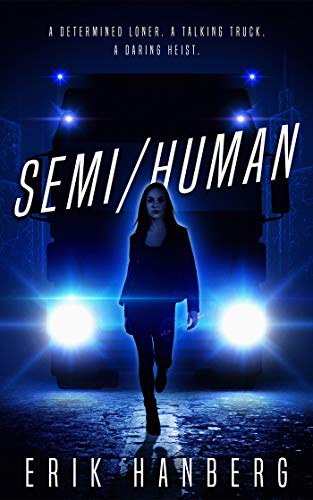
Semi/Human by Erik Hanberg—review and commentary

A Y/A science fiction yarn

As the pandemic has continued to plague businesses, many of them are accelerating their transition to robots and artificial intelligence, thus replacing or supplementing their all too frail human employees. Semi/Human is set in the near future, and in this novel Silicon Valley has finally written an adaptable code that makes most human employees obsolete. Vehicles drive themselves, dealers in Vegas are all robots, police have been replaced by armed drones, and so forth.

Main character Pen(ney) Davis is more than depressed, because like most other human jobs, her intern job at a Silicon Valley computer firm has been eliminated. However, Pen has come up with a less than practical scheme to steal a ridiculously expensive treasure from her former employer and get rich enough to care a lot less about being unemployed.

As Alexander Pope once observed, “A little bit of learning is a dangerous thing,” and recent intern Pen re-writes the code of a self-driving truck, intending to hijack it for a trip across the country, but ends up making the aforementioned truck autonomous instead. Fortunately for Pen, the truck, Lara B, is both friendly and grateful.

Lest I ruin this tale for readers, let me just say that this yarn is cogent, examining the societal damage which would ensue if gainful employment ceased, as well as the ethics of dealing with a self-aware, nearly omniscient super computer. There’s a dash of economic reality sprinkled in as well, because with no work, there’s no money coming in for the vast majority of the populace, so they end up fighting over whatever is left behind in the technological revolution.

There’s also more than a little suspense, as Pen and Lara B join forces to accomplish the original mission, wherein Pen hopes to acquire both riches and revenge in one fell swoop. Semi/Human is one of those rare books that blends a cautionary theme with an entertaining plot. Most of the characters are well drawn, and there is sufficient description of settings to keep the reader entertained but the plot never bogs down.

As a frequent reader of science fiction, it is rare for me to call a novel memorable, but for me Semi/Human is such a book. Perhaps I simply read it a the right time, or perhaps the book is really that good. If you like youthful, sassy heroines, self-aware computers (and trucks) along with a suspense filled story line, you really should try Semi/Human.

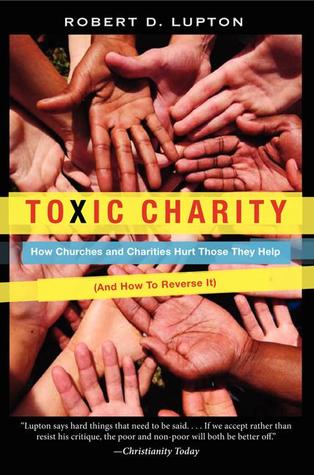
Toxic Charity: How Churches and Charities Hurt Those They Help— review and commentary

ToxicA friend who works on the staff of a large church recommended this book to me, and while it lacks sufficient support for some of the concepts, the principles are sound. Basically, the title says it pretty well—whether just throwing money or a week of unpaid labor at poverty—this act of charity might do more harm than good.

Author Robert D. Lupton has plenty of experience in urban ministry, and he cites many examples from his experience in Atlanta, Georgia, which is where he lives and works. But, as I have seen lots of churches gather a group of volunteers for week long “mission trips” I was fascinated by the story of a church in Mexico that was painted six times during one summer, by six different sets of volunteers. Indeed, what the author terms “religious tourism” is big business. He states that in 2005, $2.4 billion was spent by 1.6 million Americans, who traveled abroad for short term mission trips. My favorite statistic: “The Bahamas, it is estimated, annually receives one short-term missionary for every fifteen residents.” Okay, I have never traveled abroad on a mission trip, but the Bahamas sounds like a great place to visit. (My daughter mentioned knowing of a local church that did a mission trip to Ireland. Sounds heavenly!)

Lest readers get the idea that all Lupton does is make the good hearted look either mis-guided or just plain stupid, he does mention that many people set out on these trips with good intentions. Then he explains that in the third world, a little bit of money spent properly can do quite a lot. He explains the use of “micro loans” which can give a struggling person a needed hand up. For example, a $50 loan to a woman in Nicaragua allowed her to buy a sewing machine so she could ramp up her production of baby clothes. Once she paid off the loan, she still had the increased earning capacity.

In the U.S. many churches and other charities give away certain items. One example was giving holiday presents to needy families, but the fathers in such situations are often embarrassed that they can’t match the generosity of the well meaning givers, and are thus emasculated in front of their wives and children. Another example was a food bank, wherein the recipients had come to view the handouts as entitlements, which the author then contrasted with a food co-op, where members paid a small ($3) membership fee, and the members then gathered food from free or discounted sources, set their own rules for distribution, and so forth. The co-op helped the members but did not demean them or destroy their work ethic.

Toxic Charity is a bit controversial, but the U.S.A. is one of the most generous nations which has ever graced this planet. Unfortunately, just throwing money at problems can actually make things worse. This book is a must read for anyone who is involved in charity work, faith based or not, because it explains the problem but gives some good guidelines for better ways to help without hurting the recipient or wasting effort and money.

Why Fair and Square Pricing Fails

Purple and White Speech Bubble Clothing Logo-2I like for the price to be the price. But, I must be one of the few people who think that way. Fair and square pricing works for me: I can budget for what I need to purchase, and know when it is okay to splurge a bit. However, I have a dear friend who won’t buy anything unless she negotiates a better price. This practice is downright embarrassing at times. Recently, we were in a charity thrift store and she saw a large ceramic vase filled with fake flowers. (I know, taste varies.) Anyway, it was priced fairly, but she stood in line to ask a harried clerk to lower the price by $5. The clerk said, “The price is the price.” My friend walked away. “It’s a charity,” I reminded her. As we got into the car, my friend made up some excuse about the quality of the item. But, I know her. No discount, no sale is her motto.

I’ve sold items on eBay for almost a decade. But, recently, I’ve been rather frustrated with the “Buy it now or best offer” feature on eBay. As a seller, I prefer to list an item at the price I want for it, and my potential customer can pay for the item and the shipping (which isn’t free, so I never pretend that it is) or not. However, if sellers don’t activate “best offer” when creating the listing, eBay will do it later, and before long, I start getting half price offers. Yep, the default “best offer” setting is literally half price. I hate telling customers, “no.” And, I have learned that counter offers seldom result in a sale. Lately, I have been listing items a couple of dollars more than I normally would ask, then setting the best offer for the real price. Yes, the whole thing bothers me, but many, many shoppers want to feel that they got a discount, especially on really low priced items. I’ve literally gotten an offer of $2 on a genuine leather designer handbag.

And, this gotta have a discount mentality is not just for used items, such as the pre-owned books and garments that I generally list in my eBay store (The Alternative Article.) Remember the absolute disaster of “Fair and Square” pricing at J.C. Penney? Although I am not particularly fond of that merchant, I really liked their pricing when that experiment was underway. Apparently, I was alone, however. J. C. Penney customers stayed away in droves until the management jacked up the prices and paid newspapers to print coupons so customers could “save” 40% off.

It’s psychology. And it sucks.