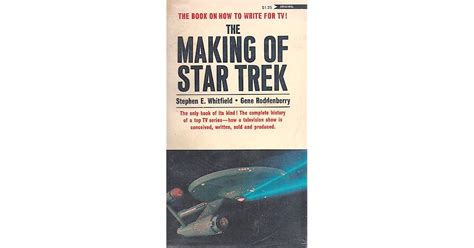
The Making of Star Trek by Stephen E. Whitfield—a retro review

Way long time ago, I borrowed a copy of The Making of Star Trek from a friend. After watching some episodes of The Original Series (TOS) on Pluto TV, I remembered the book, so I ordered a vintage paperback via eBay. Once I had it in hand, I could revisit a wonderful read, as well as wallow in some insider info once again. First printed in 1968, this book is both a history of Star Trek, with quite a few photos, and a “how to” guide to creating, producing, and writing a television series. However, as the book was written as the series was coming to a close, the legacy and cultural significance of Star Trek were not yet known to Whitfield (or Gene Roddenberry, who is listed as a co-author.) For more casual fans, there are other sources, from videos to more focused books.

When a ground breaking television series is created, there are thousand decisions to be made. From character names to methods of propulsion, this volume covers in detail how many of the concepts that make Star Trek work were developed, some visionary, such as the multi-cultural crew (unheard of in the mid-sixties) while others were merely practical, such as the “transporter” which was necessary as it would slow down the action if every port of call required a shuttle craft excursion (or worse, landing a huge space ship.) Within these pages are excerpts from memos to and from ST creator Roddenberry, quotes from NASA consultants, and preliminary sketches of possible ship configurations.

As this book was written alongside the filming of the series, there are glimpses of who wrote (and re-wrote) scripts, which actors were cast, and how the characters evolved. Letters from some of the actors, with insights into how their characters were to be portrayed, are included. Loosely organized chronologically, but with sections on such topics as “weaponry” and “the bad guys,” the reader sees how items familiar to TOS fans were developed over time.

Previously, I wrote a bit about a tour of The Neutral Zone Studios, where Star Trek Continues was filmed, and where fan films are still made. Our tour included some of the information in this book, but quite a bit of it was different, as the guides took a more hands on approach. Anyone planning a trip there might well read The Making of Star Trek prior to taking the tour. While the book does compliment Gene Roddenberry’s creative genius, many people helped create this vision of the future. Some of it has come to fruition (think folding cell phones) and some might never (Warp drive), but the influence that this one television series, which most deemed a failure when it ceased production, is difficult to minimize.

The Making of Star Trek is no longer in print, so it does require a bit of searching, but for fans, it is worth the effort.

The Neutral Zone Studios

Hubby and I decided to visit “The Neutral Zone” studios on one of their almost monthly fan appreciation weekends recently. Also, since these sets are rented out, the only time to see them is during scheduled events, so certainly see the calendar on the website prior to planning a visit.

The facility is actually a warehouse in Kingsland, Georgia, where the web series Star Trek Continues was filmed. The sets occupy a space just under 10,000 square feet, which is small by Hollywood standards, but the sets include many of the areas which would have been used on the original Star Trek series. While the original sets were destroyed more than fifty years ago, the blueprints are available, as are screen shots from the original series. The sets at The Neutral Zone were constructed over more than a year, then used for a while by the makers of Star Trek Continues. When CBS/Paramount decided to reboot Star Trek (making such series as DiscoveryPicard, and Prodigy) they basically told the folks making Star Trek Continues to wrap it up, so the sets became available for fan films. Indeed, it is possible to rent The Neutral Zone for an event or to make your own film, as long as the script meets the restrictions put in place by CBS.

The set visit begins with a guided tour. We began our tour with Ray Tesi, who currently owns the sets and manages the studio, then Vic Micnogna, who was the visionary behind Star Trek Continues, took over. Vic also plays Captain Kirk in the series, and if you haven’t seen it and are a fan, you really should take a look at the eleven full length episodes. Ray began with some background, then took us to engineering, then just across the entryway to the main ship, which is arranged in a circle, just like TOS. We visited sick bay, the briefing room, Captain’s quarters, the transporter room, auxiliary control, the Jeffries tube and brig, and the big finale is the bridge set. The guide(s) explained how the sets were built originally, and how the sets might be used in filming now. For instance, the Captain’s quarters, with a bit of redressing, can be any crew member’s quarters.

After the tour, with a bit of flexibility to avoid the next tour, attendees are welcome to take pictures. Just imagine, you, too can be pictured standing in the transporter room or on the bridge, either at the helm or even in the captain’s chair. We also purchased the entire series on DVD, and as Vic was there, he autographed the case for us.

Star Trek, even for non-fans, is a bit of a cultural phenomenon. Who doesn’t know such phrases as “Beem me up, Scotty?” For non-fans, The Neutral Zone is probably not a tourist destination, but for the thousands upon thousands of those who are fans of the original Star Trek series, the set tour is an amazing experience. I urge travelers to take a look at the websites for both The Neutral Zone and Star Trek Continues for a bit of research prior to scheduling a trip. As a fans of all vintage Star Trek series, including Star Trek Continues, this was a “must see” for us, and it did not disappoint.