 While I prefer more sophisticated military science fiction, readers of all ages should enjoy Cadets, which is an entertaining read. The story follows a group of cadets, who are forced into growing up quickly when a menace from outside the solar system wipes out virtually all of the Earth’s defense force. The characters are not as complex as those readers would find in a space opera by David Weber or Elizabeth Moon, but for the intended audience, this yarn is quite good. The military strategy won’t impress adult readers, either. Still, it is suspenseful, with a bit of Independence Day style peril. A good read, with no worries for the parents.
Category space opera
A Galaxy Unknown, and some of its sequels
 My iPad is a fun way to read books, and I like the Kindle app better than iBooks. In part, that is due to the wider selection of titles, but it is also the actual reading experience of the Kindle that I enjoy. After I read a few books by Amazon published author D. A. Boulter, I sought another science fiction author who is not published by a “big” publisher. I began a series by Thomas DePrima, which begins with A Galaxy Unknown. This book has many reviews on Amazon, and the sheer number of reviews, along with the description, led me to purchase it.
DePrima’s novel is far from original, but that is not necessarily a criticism. There are only so many plot devices, and space operas have certain limitations. Actually, I liked the blend of action and description. Other reviewers seemed to find the dialogue more annoying than I did, but the author’s insistence on using specific height when introducing his fairly large cast of characters is quite annoying. Other descriptors, such as eye color, hair color, skin tone, and whether or not the character likes “fries with that” would be welcome. I read four books in the series, and the author never stops using height as his favorite method of description. Far worse, the author insists on retelling the story every time the characters do. Without all the repetition, A Galaxy Unknown would probably be a tight 100,000 word read.
Still, the main character has her charms. Yes, the heroine is a bit like Honor Harrington, but even at the outset of David Weber’s series, Honor is taking her first command, whereas Jenetta Carver is a lowly ensign when the first novel begins. Of course, Jenetta is not going to remain lowly for long, and the breakneck pace of this first story is refreshing, if one judges space opera by Weber’s lengthy and increasingly action-starved yarns.
As I read the second, third, and fourth books in the series, I became less enchanted with DePrima’s space opera. Jenetta Carver is a fabulous heroine; and her permanent youthful looks and ever changing DNA, along with plenty of villains to defeat, keep her from being boring. I desperately wanted to like the sequels, because I did enjoy the first entry in the series, but the second volume just has too many admirals heaping too much admiration upon her. Yes, I know one must suspend disbelief to enjoy a good space opera. I have no problem with that, but Jenetta is too apt to be worshiped by her superiors as by her subordinates. I can only stand a page or too of hero worship at a time, especially when it is by older guys who should be both arrogant and curmudgeonly.
Even the introduction of more characters and settings in the third and fourth books, including more villains, does not give Jenetta and her sisters sufficient challenges to create suspense. One of the main reasons to read fiction is to watch the characters solve problems, and this is the core issue with this author’s work. Jenetta is too perfect. The reader knows that Jenetta will win the battles via her brilliant strategy, crew and superiors alike will worship her, and she will get another promotion by the end of the novel.
Of course, I could have quit reading before the fourth installment. No one made me buy books two, three, and four. Unfortunately, I did like the first book enough that I kept hoping that the author would regain some of the freshness of A Galaxy Unknown. Alas, it never happened, and I wasted eighteen bucks on the sequels.
Readers of Visions and Revisions should realize this is merely the opinion of afive-foot nine reader, teacher, and author. Based on the reviews on Amazon, there are readers anxiously awaiting book eight in the series. I am looking for another new writer.
EPub, Kindle, and a new to me author
 My iPad does many things, and it has become my reader of choice. After playing with it for a day or two, I began downloading eBook reading “apps” and right now, Kindle for iPad is beating out iBooks. In part, that is due to the vast selection of books at Amazon, but in part, it is due to the way Amazon can zero in on what I enjoy reading.
Within the last couple of weeks I have read two novels by D. A. Boulter, both purchased from Amazon. Indeed, Amazon Digital Services is listed as his publisher. For $2.99 one would be hard pressed to find a better novel than his Courtesan. Now, readers of romance or erotica, do not get excited. It isn’t that sort of book at all. If anything, it reminds me of early Elizabeth Moon space operas, and that is a complement. As the story opens, Jaswinder Saroya is on the run. The author sprinkles in enough back story to create suspense, but not so much as to give away his plot line too soon. There are not so many scenes and characters that a reader has to work too hard, either. I suppose I would have to call this lighter science fiction. But, the plot would be just as welcome in a more tech savvy thriller, and I rather liked it just the way it unfolded.
Having enjoyed Courtesan so very much, I went back to the Kindle store and purchased a book which seemed to inhabit the same “universe” but with different characters, Pelgraff. This one was also entertaining, but I did not find it to be as much fun to read as Courtesan. If anything, the world building in Pelgraff is better, because it is set on that planet, whereas, Courtesan is set mostly onboard a space going vessel. But the characters are not nearly so engaging in Pelgraff, and the plot is mostly fight, withdraw, fight some more. Still, it is a war story, so that is how it goes.
I’m sure I will read more of D.A. Boulter, but for now, I am rating Courtesan four and a half stars and Pelgraff is a solid three star read. Either one is well worth the asking price, and with an eBook, there is nothing to sell at a yard sale or try to trade at the used book store.
I am loving the iPad, and I would like to see my own works in ePub format so that other eBook readers will be able to enjoy them.
The Apocalypse Troll and other stories
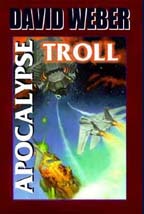 I really like David Weber’s military science fiction. A few thousand fans of this sub-genre seem to like it as well; his books, even the ones which are ridiculously swollen with unnecessary and/or undesirable content, sell well. He has also partnered with other authors, including Eric Flint and Steve White, which helps lengthen his list of published novels.
My introduction to his work was a rough go, however. The science fiction book club was touting his In Enemy Hands, which is fairly far into the Honor Harrington series, but I began with that one, not realizing that I had to catch up. There were several times I nearly abandoned it; but about three quarters of the way in, I realized this was indeed a fascinating tale; albeit one which could have been told without quite so much detail. Intrigued, I read a couple of his stand-alone novels, The Path of the Fury and The Apocalypse Troll. While featuring hardware and propulsion concepts, more than characterization, these yarns did not require any backstory, and that helped. After I finished those, I read the Honor Harrington series, from the beginning. The first book is not particularly interesting, being mostly a set up for the series, but the series hits a good stride with books two through six. The seventh book, Echos of Honor also has its moments, but the page counts grow and the synopsis gets shorter with each successive installment. I read most of the series, but I think I have been reading on At All Costs, which may or may not be book twelve, for a couple of years and I have yet to finish it. Instead, I go back and re-read earlier titles.
Some of Baen’s earlier Weber titles, including The Apocalypse Troll, are available as eBooks, and I have been re-reading it. Yes, it is perhaps less polished than some of his more recent offerings, but it is also far less bulky than his newer work. No, he still doesn’t really write many multi-dimensional characters. Still, I enjoyed it. No one else seems to have the ability to write large scale battle scenes, but Weber does. He also has a firm grasp of the problems and possibilities of technologically driven warfare. Too many writers of space opera write about conflict one-on-one, because that is easier. In Star Wars, there may have been a lot of blasts, but the camera follows Luke and Han, and everything else is a backdrop. That is both cheaper and easier. However, any civilization which moves to the stars will have multiple ships, weapons, and drive mechanisms. Weber writes about those situations, and when Weber is finished with a battle, the casualties are in the thousands. That is what real war is, and it will be in the future.
So, the bottom line is that fans of futuristic writing may or may not like Weber, but most fans of military science fiction do, because he delivers large scale entertainment. Readers should sample the early stories, like The Apocalypse Troll or Path of the Fury, or at the beginning of one of his many series, rather than diving in the middle, however.
Troll is the story of a twenty-fifth century monster unleashed on our current earth, with only one surviving warrior from the future to tackle it. When researching the published reviews, I read that this novel was the first David Weber wrote, but it was published long after he had become established as a writer. So, while still Weber, the complexity is not so vast, and there are not so many references to politics, which is a major flaw in some his Honorverse works. But not everyone agrees that The Apocalypse Troll is a winner, so here is a link to a differing opinion of this novel over at RPG.net.
Girl Gone Nova— Review
 Since I read Pauline Baird Jones’ The Key, I have been waiting for this book. One reason I read eBooks is that I enjoy stories which are more “novel” than the novels published by the big guys. I happened upon The Key when it was atop the list of science fiction books at Fictionwise, and I read it and re-read it. One of the more charming aspects of The Key is the POV character, Sara Donovan, a “kick their trash” fighter pilot.
While set in the same universe, Girl Gone Nova is not exactly a sequel. Instead, we have another main POV character who interacts with some of the supporting cast from The Key. Delilah Oliver Clementyne (Doc) is indeed a doctor. But she is also a military troubleshooter who specializes in doing the impossible. A couple of years or so after Donovan returns to earth, things are in such a mess that Doc is despatched to do her version of Mission Now Possible. Her outlook is a bit darker than Donovan’s, but she is quite entertaining, nevertheless. The plot involves political intrigue, first contact with aliens, and multiple timelines. Jones bills this book as fantasy, and since it is intended to be contemporary, but all of a sudden we have interstellar propulsion, I guess that qualifies as fantasy. There aren’t any trolls or sparkly vampires, but for me, that’s a plus. I’d much rather have spaceships, aliens, and nanotechnology, and this series has all three.
Girl Gone Nova is available in print and eBook form, and it is a fun yarn for light summer reading.
 Visions and Revisions