 When I was a kid, I read The Heart of a Dog, a collection of short stories by Albert Payson Terhune, over and over. The collection of seven stories is good for adults more so than children. One of the things I did when I first began teaching was to read to my middle school students, and I did read a story, The Meanest Man, from this book to them. Although it was first published in the 1920s, these stories are still very interesting.
All of the stories feature a different member The Sunnybank Collies, and the stories have various themes. One tale of survival, “One Minute Longer,” has a plot wherein a young man gets trapped in some icy water and his life depends on the efforts of his collie friend, Wolf, managing to this convey the situation to the adults back home. This story holds up quite well for modern readers, and it has been used in reading anthologies in the past, but the references to hunting and guns wouldn’t make it past modern censorship. In “Youth Will Be Served” the reader follows the difficult decision of dog show judge Angus McGilead, who wants to award the best in show prize to the old favorite collie, Bruce, but realizes that the young collie Jock, sired by Bruce, should win. Yet, the decision is his, and his alone. Okay, this sounds so boring, but it isn’t because the author does a great job of describing every aspect of the dog show, along with criteria used by dog show judges to pick the best of the best.
“The Meanest Man” is my favorite story. It is about a farmer, Link Harris, a well-trained collie, Chum, and the dog catcher, Eben Shunk. Even those who haven’t read it will know who the meanest man is, but the way that Link and Chum deal with him make this story very amusing, if rather dated. Anyway, my students liked it quite a lot, and according to my notes (still in the book) it takes 45 minutes to read aloud.
I’ve linked to the Kindle edition of this book, because it is a very good deal. The copy of The Heart of a Dog that I have looks like the one pictured, because it was issued by a children’s book club. If you are ever antiquing and see one of these editions, grab it, because the illustrations are cool, too.
 I’m always writing something, but I don’t always publish what I write. Sometimes I write letters (sent and unsent) or emails or fragments. I suppose most people do that. But, I also have manuscripts in progress, and sometimes I get bogged down with those because I truly don’t know if there would be any interest in them. So, I am going to try posting a few excerpts, and if the traffic and/or comments indicate interest, the encouragement might be enough to push me out of procrastination and into finishing mode.
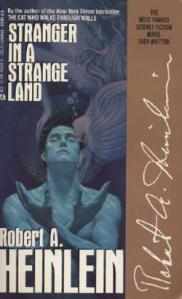 As a youngster, I loved science fiction. From being a little kid watching Fireball XL5 on television to reading the novels of
  at the cinema while in college (gosh, I’m old, right?) I really loved sci-fi. Actually, I still do, but this is a blast from the past post, so here goes.
 is considered a turning point into adult fiction because this novel begins his exploration of themes that appeal to a more mature audience, including libertarian politics. Perhaps modern readers wouldn’t realize it, but the powered body armor in Starship Troopers was one of those prescient inventions that makes reading and watching science fiction so important to the development of technology.
 was published a couple of years after Troopers, and while less “realistic” the novel takes some giant leaps into thematic explorations. The novel deals with the life of one Valentine Michael Smith, the first human born on Mars, and because he was orphaned he was reared by the natives of that planet, and later brought back to earth as a young adult human who knows absolutely nothing about his home planet or its inhabitants, hence the title. This situation is a fabulous set up for what science fiction does best: explore what makes humanity work (or not.) I used to read this novel annually, and I have never tired of it, because there are so many themes. Indeed, while doing a master’s degree in English, I wrote a pretty decent term paper on the topic of how Heinlein uses the world savior theme in the novel, and didn’t get thrown out of my fairly conservative program.
 When my kids were kids, I often assisted with homework, but I made a tactical error and told them I’d actually do any thing we determined to be “busy work.” (At the time, I still believed in the integrity of most educators.) My daughter had a couple of coach/ social studies teachers in high school who would set aside one day a week for “current events” which basically meant the students were to bring in a news story and read it to the class. There were absolutely no criteria assigned, nor was there any grade. Since the teacher was just using this instead of doing any work himself, this qualified as a mom task, and I decided to use the weirdest items I could find.
 .
.

 Visions and Revisions