Star Trek and Philosophy: The Wrath of Kant— a brief review

Okay, I am a sucker for a good title, and this book has a good title and a good cover. Win-win! And it is about Star Trek, which I like quite a lot. But it is rather deep at times, so I wouldn’t rate it five stars, but fans of Trek who have some knowledge of philosophy might award it a solid four, perhaps.

What is between the covers is a collection of essays edited by Jason T. Eberl and Kevin S. Decker. These essays use Star Trek’s various television shows and movies to explore philosophical issues, and it helps quite a lot if the reader is familiar with all forms of Trek. Since I never watched all of DS9 or Enterprise, I was sometimes a bit lost.

The first essay is a nifty one, as it is based upon a Next Generation episode, “Darmok.” Both the essay and the episode dealt with the difficulty of translating a totally alien language. Throughout most of the Trek episodes there was a “universal translator” which was a bit like Google Translate, but it depended upon languages having some commonalities. Of course, communication via such means can go astray quite easily, but what about an alien species that doesn’t communicate the way we do? The issues would be far beyond going from English to Chinese, and I understand that can be difficult.

As the essays in this book are by different authors, the tone and topics vary quite a lot. For me, it was a book to nibble at, but not a cover to cover read. I’ve always viewed Star Trek as more intellectual than Star Wars, but this book takes it to an even higher plane. For fans of all things Trek, there are some really delicious ideas to examine in this collection, so if that describes you, go for it!
Winter’s Bone— review and commentary

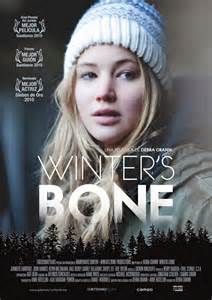
Winter's BoneAs the film Winter’s Bone is based upon a novel, let me be clear— I am discussing the film, not the book. Hubby and I watched it via Amazon Prime, due to seeing it listed as one of the best films available via streaming, and it stars a young (pre Hunger Games) Jennifer Lawrence.

Honestly, it is a haunting movie, but is isn’t a horror story. This film is a polar opposite of a action adventure. Not that it isn’t interesting, because it is, but this is a window into a world that will be foreign to many of us, but maybe not as foreign as we’d like, because drug users, abusers, and dealers are an ever growing aspect of modern America.

Basically, the story follows the efforts of seventeen-year-old Ree Dolly (Lawrence) to find her missing father, after a bail bondsman informs her that if her dad doesn’t show up for his trial, the family home is forfeit. The setting is in the Ozark Mountains, within the past few years, based on the cars. The father manufactures meth, and this is apparently no secret. Jessup Dolly hasn’t been around for a while, and there is little to eat, for the family or their animals. Ree is also burdened with younger siblings who rely upon her, because the mother is a mentally ill mute. As Ree goes from person to person, asking for news of her father, the viewer learns much about the poverty and other issues that inhabitants of this community endure.

When I was a youngster, I remember reading Oliver Twist and thinking that if one more bad thing happened to that kid, I was going to return the book to the library, unfinished. More misfortunes did befall young Oliver, so I didn’t finish the novel. A few years later I saw the musical Oliver on school field trip, so I did finally learn what happened to the characters. And while Winter’s Bone has little in common with Oliver Twist, the relentless despair with only a small germ of hope is similar.

As I do hope readers of Visions and Revisions will take a look at the film, I’m avoiding spoilers. Certainly, Jennifer Lawrence is amazing in this film, but the rest of the cast is excellent, too. The filmmaker did a fabulous job of showing the situation but not telling the viewer what to believe.

I have to agree that Winter’s Bone is an excellent film, and it brings a simple yet sophisticated treatment to the problems associated with the drug culture in rural America.

Air Force One is Down— review and commentary

I was watching Netflix with hubby, and I saw a British mini-series entitled “Alistair McLean’s Air Force One is Down” as an available title, so we spent a couple of evenings with it. Although this film ended up as a recommendation for me because it has Linda Hamilton (of Terminator and Beauty and the Beast fame,) I chose it because it was supposed to be based on a novel by Alistair McLean. He was a favorite writer of mine when I was in my teens and 20s, and yes, I am fully aware that I am dating myself by mentioning that.

Oh, my gosh, how wonderful were those reads. He wrote twenty something novels, several of which were the basis for films (including The Guns of Navarone, Ice Station Zebra, and Breakheart Pass.) My intro to his work was actually his only sequel (Force 10 from Navarone) but it was stood alone well enough that I wanted to read more from the author.

Alas, hubby and I were disappointed by this film. The cinematography, special effects, score, and cast were all pretty good. The problems were, for the most part, in the writing. In part, plot devices that worked in novels in the 50s and 60s just do not work now. For instance, the dastardly villain has captured our hero and his two compatriots. He places the hero character in a deadly situation, and the hero’s two sidekicks are locked into a pit that rapidly fills with water. Of course, the hero manages a super human feat and the all of them survive. Nowadays, the villain would shoot the hero and his sidekicks and be done with it. This doesn’t happen just once in the two part story; it happens over and over. As hubby said, “This thing has major plot holes.” And it does.

After we finished watching the entire film (at my insistence, as hubby would have bailed during part 1) I looked up the novel. According to that scholarly resource Wikipedia, McLean did not write the novel. Instead, he sketched out some plots for a series of novels which bear his name, but other authors wrote the books. In this case, John Denis is the author of the book that the mini-series is supposed to be based upon.

So… the film is sorta interesting, but I really can’t recommend very highly.

Alarm of War— The Other Side of Fear

A while back, I wrote a positive review of Kennedy Hudner’s Alarm of War. Perhaps its greatest downside was that it clearly was intended to have a sequel. For a few months, I checked Amazon, hoping that Hudner had released the second part, but after a while, I quit looking. Then, as I reviewed my “keeper” files, I saw Alarm of War and looked again. Low and behold, Alarm of War, Book II: The Other Side of Fear was published in 2014. Finally, I had the sequel, but alas, it’s really part II of a trilogy. So, I am back to waiting.

However, it would be remiss to not review the second book. So, here’s a true confession: I went back and re-read the Alarm of War because it had been so long that I was certain I needed a refresher. Good plan, as I enjoyed it almost as much the second time. Once I had swiped the last page, I jumped right into The Other Side of Fear, and it wowed me from the opening scene.

While there are some stereotypical situations and characters, there is plenty of depth to Hudner’s ensemble of main characters, who met as they went through basic training during the first novel. My favorite is Emily Tuttle, a former history teacher with a brilliant grasp of military strategy. Other main characters include Grant Skiffington, the favored son of an admiral; Hiram Brill, a geeky guy who instinctively puts together intelligence into workable prophecies; and Marine sergeant Maria Sanchez, who is super gung ho, but reads books and likes to hang out with the nerd, Hiram. These characters all had intertwining adventures in the first book and book two immediately picks up the action.

Rather than write a bunch of spoilers, I will say this: Mr. Hudner’s series reminds me quite a lot of the early works of David Weber, the creator of the great Honor Harrington series. But, by using the ensemble, rather than centering on one character, Hudner is able to bring in various aspects of his universe, but keep the reader’s interest. At times, Weber spends more time explaining his villains than his heroine, and that has always bothered me. As a huge fan of military sci fi in general, and Honor Harrington in particular, it is hard to say this, but, “Move over, Mr. Weber.” Kennedy Hudner is writing some seriously kick-butt military sci-fi. Really.

As of this writing, the first book is a bargain at 99¢, and The Other Side of Fear is $3.99. My gosh, so much entertainment for less than the price of a movie ticket!

Star Wars: The Force Awakens

Since Star Wars The Force Awakens has broken lots of records for attendance, there are no doubt too many audience reviews for mine to matter. There are several elements that make this a film worth watching, and fans are mostly happy with it, at least in part due to the items (in my own order of excellence) enumerated here:

#1 The Score! John Williams’ score was instrumental in turning the original Star Wars from a mere comic book B movie into a box office bonanza. For the other films his compositions have kept the audience entertained, and Williams’ music is just as important here ever. For those not into classical music, the technique he uses is called leitmotif, wherein each character or plot device has it’s own musical theme, all interwoven into the whole. This is an operatic technique that helps the audience be even more emotionally involved the happenings on screen. It’s very cool, and it works beautifully in Episode VII.

#2 The respectful treatment of the aging stars of the original series. Although there is considerable exposition prior to the appearance of the famous trio, each character is given his (or her) moment on screen. The audience has a chance to see what’s happened during the passage of time, and the situation of each is organic in regards to their characters and situation way back when the Jedi returned in Episode VI.

#3 The new characters are interesting. Writing is hard work, and creating characters that readers (and/or viewers) care about can be difficult. In Poe Dameron, Rey, and Finn, the writers have given us a new generation of action characters. Hey, there’s even a cool new droid, BB-8. Compared to the characters in Episodes I, II, and III, these new guys are…oh, let’s be real. There is no comparison with those films. The new kids seem to be worthy successors, however. The actors do an excellent job of bringing them to life, too.

#4 Real “special effects” rather than CGI. Don’t get me wrong, computer generated effects have their place. But when Yoda ceased to be a puppet and became a glowing figure out of a computer game, his personality shifted from cute and quirky to something less interesting. This Star Wars has the look and feel of the original, but with more money. No doubt the prop masters were kept very busy during filming, but there is a difference when the actor is doing lots of stuff against a green screen vs. real props and sets.

#5 Good vs. Evil is central to the story line. For audiences to care, the good guys have to be mostly good, but have enough flaws for us to identify with them. The bad guys should be so bad that even Oprah wouldn’t try to understand them, instead she’d just shoot ’em.

The links are present for those who want to know more about certain aspects of the film, but that’s my take on the new Star Wars movie, which I recently saw with hubby and our young adult son.

Is last year’s best science fiction novel is this year’s best science fiction film?

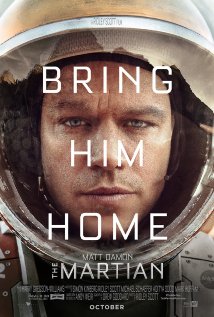
movie poster image of The MartianI think so, but I certainly haven’t seen all of the science fiction films of 2015. However, last night, I saw Ridley Scott’s version of The Martian, and it is really, really good. The guys with me (hubby and our unmarried 22 year-old son) absolutely loved it, and they had not read the book. (I wrote about Weir’s originally self-published novel last year.)

No doubt there are any number of professional and amateur reviews of the film, so I will do a bit of compare and contrast with the book. First, the beginning and the ending are different. Not vastly so, but the visual medium requires a different approach. However, the spirit of the novel, as well as much of the plot, is intact. The film begins with the astronauts on the surface of Mars, taking care of exploring and introducing characters. The action begins quickly, as the storm sets in and the crew aborts the mission. In the book, the back story unfolds as stranded astronaut Mark Watney recovers from his wound, assesses options, and determines each course of action. Either way, the story soon slows a bit, as this modern take on “Robinson Crusoe” unfolds. In order to get the audience out in a timely manner, the events in the film are compressed a bit. However, some things, such as the mission commander’s affection for “disco” music actually work much better in the film, as 80’s hits make up much of the sound track.

The casting is excellent, and the amount of screen time for players other than the central character, Watney, reflect a slightly different approach to the story. In the novel, chapters go by before there is any mention of the characters back on earth, but that, too, is accelerated for the film version. Actually, I like the film’s approach better than the novel, as it ramps up the suspense a bit.

Some folks in my generation have been very, very disappointed in the choices our government has made regarding space exploration. (Or should I say, the lack of space exploration.) The Martian can certainly thrill audiences of many ages, as my son really loved it. But it will especially appeal to those of us who watched NASA missions in our youth, and dreamed of continued exploration. This isn’t space opera— it is fiction based on real science.

At the most basic level, The Martian is good entertainment. It’s not particularly violent, or sexy, but it has plenty of action. The conflicts here are mostly man vs. the environment, and the environment is very believable. Perhaps, however, the younger audience will also ask why our government is so concerned about minutia, such as providing everything from cell phones to farmer’s markets, rather than taking the lead on larger initiatives, such as exploring the solar system.