Going, going, almost gone

TrinitycoversmThe Whiskey Creek Press version of Trinity on Tylos is about to become a bit of a collector’s item. When it was first published, I was mostly pleased, although the final edits were rushed and far too many mistakes made it into the print copy. The paperback was not of the best quality, either. The ebook, at least the one I got from the now defunct Fictionwise, was far worse. What few royalty reports I received indicated low sales, and even lower royalties. At one point, I was getting seventeen cents per ebook sale, and a typical quarterly check was about five bucks.

When the book came out, in 2006, I sought out speaking engagements, author-guest slots at science fiction conventions, and I did quite a bit of internet promotional activity, hoping to help Trinity find an audience, and to do my part to help sell the book for WCP. By 2007, I realized that the sales were not going be as good as my self-published debut novel, so I spent far less time promoting it. But, WCP continued to be a disappointment, too. Just to get Amazon to list it, WCP required that I purchase two copies at full price; then, initially, the title was misspelled on Amazon’s website. Eventually, the print book was listed correctly, and I did have a couple of very good reviews on Amazon, as well as several from other sources. When Amazon’s Kindle format began to take on increasing importance, WCP indicated that eventually all of their titles would be available for the Kindle. While Trinity on Tylos was available for the Nook, it was never converted to Kindle format. My original contract was for two years, but I did not ask for my rights back, in part because I hoped WCP would eventually pay me more royalties, and that they would support the book. And, to be honest, I was very busy with my adjunct instructor job, as well as being mom to teenagers, so I didn’t push either promotion or accountability from WCP.

After years and years of zero communications regarding sales, I can only conclude that either there were no sales or WCP kept all of the royalties. I will never know which. I’ve maintained a website, with promotional materials, links to vendors, and so forth, at my expense, and I finally came to the conclusion that WCP was never going to pay me anything ever again. Anyway, I did ask to have my rights back at the end of last year, via email, and there was no response. I asked again recently, via snail mail, and while I still have not heard a word from WCP, I noticed today that Trinity on Tylos is no longer listed for sale by Whiskey Creek Press nor by Barnes and Noble. Amazon still has it for sale, but they list the one lonely copy, and I do remember that I paid for it in 2006. I’ll bet it is quite shopworn by now!

Fellow WCP authors are in a bit of an uproar, because WCP has been sold to a New York firm, Start Media. Some of those other authors have suggested that I self-publish it, as they are doing with their own books, and I have talked with Booklocker about doing the formatting and cover. Since I don’t have a clean copy of the manuscript, I’ll be doing some editing before doing anything else.

In the meantime, Whiskey Creek Press is going, going, soon to be gone. Various interent sites have chronicled the demise of this small press, and much of the dirt is recorded here. For whatever reasons, I’m sad, which is illogical, because the publisher hasn’t been paying me or even bothering to respond to email. And there is little solace in knowing that I am not the only author that they deemed not worth a simple email.
Bluegrass, Gospel, Pinto Beans and Cornbread


Image

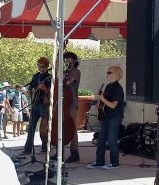
Moore Brothers band at Merlefest

Image

My sister invited me to go with her to an event known as “Merlefest” in North Carolina last weekend. We went, along with about 75K other folks, and it was a really amazing festival. She had told me quite a bit about it, and her pitch to get me to go (apart from a four day visit with her) was that I would learn a lot to help my son, the luthier. I did learn, although not so much about luthiery.

First, I learned that God is not out of fashion in the hills of North Carolina. One forgets how “politically correct” our world has become. At Merlefest, I heard all about God, via old-time gospel music (which I love) and many casual references. Here’s an example: In introducing a love song to “Mary” country super-star Alan Jackson said that his wife’s name is Denise, but that didn’t work in the song, so he figured that maybe she wouldn’t be mad if he used the name of Jesus’ mother. It was off-hand and natural. I liked his explanation as well as the song.

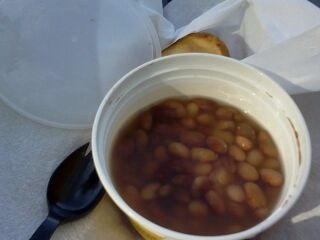
Second, I learned that it is possible to feed thousands efficiently with food that was both economical and reasonably healthy. There are several places for food at the festival, but the main one is the “food tent” across from the main stage. There was a booth that sold pinto beans and cornbread for $4. This meal was delicious and filling, and far better than the funnel cakes that I expected. Later, I ate a plate of grilled veggies and rice from another vendor, which was $5. And, my sister’s favorite was the booth run by the Boy Scouts, where they sold a “wing tray” of BBQ chicken for $4. All of these booths were run by local non-profits, so the food had “home made” flavor, too. Sister got a $5 ice cream at one of the commercial spots, but I preferred the more basic fare.

Third, I learned that some acts I would never have chosen to see were among the best. On the first night, I was looking forward to seeing Alan Jackson, but one of the lead in main stage acts was the Carolina Chocolate Drops. This string band was lead by one of the most gifted vocalists I have heard in years, and their performance was filled with energy and precision. Who would have thought that a trained opera singer would be fronting a bluegrass band? Other stand outs included a band (the Moore Brothers) who were 20, 16, and 11. And, my sister and I both loved the old-time sound of The South Carolina Broadcasters.

Lastly, I learned that the many of the festival folks were more tolerant of discomfort than I am. There was rain on day two, so we scuttled into an auditorium and stayed until the showers passed by, but others just found a tree or a tent for a few moments. On the third day, it was hot, and we left the “hillside” during the opening bars of the “album hour” because we didn’t like being fried. Apparently most of those perched on that steep hill stayed. Perhaps the oddest discomfort came from having the more expensive “reserved” seats. As the evening shows progressed, each group was louder than the one before. On the second night, our ear plugs weren’t enough, so we left early, and on the third night we ended up in folding chairs at the back, leaving our reserved seats empty. Some of the performers were asking people to move up to the reserved seats, so I gathered there was a sea of empty seats, which must have been disconcerting (pun intended) for the performers on stage.

The instrument sales tent was filled, with everything from high-end custom guitars to “vintage” instruments, such as a Silvertone guitar in need of a neck reset. I even met the owner of Deering Banjos, a company about to celebrate 40 years as the premier maker of banjos in this country. As for luthiery, two Virginia guitar makers, Wayne Henderson and his daughter Jane, did a presentation that was pretty darned interesting, especially  when he played his first guitar which sounds pretty good, despite the bullet hole in the back.

A Brief History of Science Fiction, and why a good title is so important.

My Youtube Channel has three videos on it, and I created them for marketing purposes, but mostly because I had taken a class in MovieMaker, and I wanted to practice what I learned. As a Mac user, I made them with iMovie, but the programs are similar.

First, I made a video for my then recently published Trinity on Tylos. That title, although I like it, hasn’t been a winner for me. Some people think it is about religion, due to the first word, and it certainly isn’t. I guess I could have titled the book “Love Triangle in Outer Space” but that has even less of a ring to it. Anyway, after five years, the video has only about 500 views. My second video was for my debut novel, The Gift Horse, and since I didn’t have any nifty space images from NASA to use, I spent about $10 on stock images. While The Gift Horse has sold far better than my second novel, the video lags behind.

My third video was my first attempt at three channel video making: In addition to a music track, I recorded myself reading a script. Then I had to put the video together. For me, that was an arduous task, perhaps because so much time had gone by since I took the class. However, this third video needed a title, and I gave the matter about fifteen seconds of thought and used “A Brief History of Science Fiction.” In my mind this is lazy; I obviously adapted the title of Stephen Hawking’s brilliant work, A Brief History of Time. The title proved to be much more successful than the ones I chose for my books, because this video has been viewed over five thousand times. Of course its success may be because it is a bit more ambitious.

I wanted to be succinct, but I also wanted to incorporate much of what I have learned during years of studying literature, as well as my interest in science fiction, and I spent a bit of time on the script. A few months ago, I noticed that my video was cited in an online article on the history of science fiction. I was impressed that anyone would watch the video enough times to be able to quote it.

For anyone who is interested, here is the script, which is close to the recording. I think I skipped a few sentences in order to match the voiceover with the music track, but it is close.

I love science fiction, in print and on the screen. Here is my very brief history of the genre.:

 • Many literary scholars name Mary Shelley’s Frankenstein as the first science fiction novel.

 • Some of Nathanial Hawthorne’s short stories have science fiction thems, especially those which deal with the problems associated with man interfering with nature. The Birthmark, Dr. Heidegger’s Experiment, and Rappaccini’s Daughter all share that cautionary message.

 • British author H. G. Wells and French author Jules Verne gave us turn of the century classics including The War of the Worlds, The Invisible Man, Journey to the Center of the Earth & Twenty Thousand Leagues under the Sea.

 •Edgar Rice Burroughs produced fantasy and adventure, but his Martian settings help form the under-pinings of later space operas.

 During the first half of the twentieth century, several new magazines became the most important venue for scientific fiction writiers. Amazing Stories and Astounding Science Fiction provided the publishing forum for such writers as Isaac Asimov, Robert A. Heinlein, and Arthur C. Clarke. This period is considered to be the beginning of the Golden Age of science fiction.

 While those authors were producing science based fiction, the less than scientific stories seemed more apt to become the basis for Hollywood “B” movies, and such stories as “The Blob” and “The Day the Earth Stood Still” terrified movie audiences during the decade of the 1950’s.

 Despite some serious efforts in the movie world, it took a television show to bring science fiction into the mainstream. Although it lacked a movie sized budget, Star Trek made travel through space seem more plausible than ever before. The govenment run space program of the 1960’s no doubt helped lend some plausibility to the journeys of the Enterprise, but Trek creator Gene Roddenberry’s futuristic vision entranced a generation.

 While science fiction began to flourish on the screen, in print, it became increasingly channeled into separate genres, with “hard” and “soft” science fiction being the over-arching labels. Works which kept science and the scientific method at the forefront became known as hard science fiction, but stories which concentrated on the human reaction to advancing technology became known as soft science fiction.

 In the following decade, George Lucas kicked space opera into box office bucks with Star Wars. Authur C. Clarke’s 2001 A Space Odyssey and the book based upon it exemplfy the integration of the best of hard and soft science fiction, while the Battlestar Galactica, followed the more popular trend of space operas making the move to the small screen.

 In the past two decades, many of the box office champions have owed much to science fiction. Print publishers have not been able to replicate the success of the movie studios, but science fiction contines to thrive, especially with smaller presses. My own novel, Trinity on Tylos, owes quite a lot to the great writers who created the genre known as science fiction.