I read a lot of digital material these days, and all too often, it is via “Apple News” or some other platform, and thus, I don’t comment or critique it in any way. However, I also enjoy books via the Kindle app, and some of those I have reviewed on Amazon, so here are some of those reviews and/or comments from the last six or seven months.

 I saw this “book” entitled Exercise and Mental Health featured on a site called “Deal News” as a freebie. I am loathe to pan a free book, but it is not really a book at all. Instead, this little 27 page document is like a course outline. While I saw no overt problems, the content might be best as a prompt to do further research, rather than an actual source of information.
After reading it, I did use Galileo, a database of articles available via libraries in Georgia, to do some research, so it was somewhat helpful.


Unfortunately, several aspects of “modern” life have helped create a culture of spoiled and unpleasant children. Hubby and I have spent lots of money on everything from computers and video game consoles to therapists, and our kids are not happy people. That is just plain sad, but it is largely true. So, when I saw this book (at a local discount store) I was intrigued. When the title says that these children are More than Happy, I was thinking that I’d take sorta happy. So, my initial reading began with a question: Can my grandchildren be happier than my own children? Perhaps.
Authors Miller and Stutzman have done a remarkable job of breaking down the core differences between the way that Amish children are brought up and the way that “modern” people rear their children. Occasionally, stories or concepts are repeated, but for the most part this book offers sound wisdom on every page. While there are some religious concepts in the book, it isn’t overly preachy. Instead, it is filled with interesting observations and a very healthy dose of common sense.
Actually, I just ordered two more copies of this book to share with others because I think it is that important and that worthy. Hopefully, the recipients will take the time to read it, because there are a lot of children who can benefit from the suggestions in this practical guide to simpler lives and happier kids.
(I do think this is one of the most important books I’ve read recently, and I really encourage readers to click on the image to buy it.)


I must say that it has been a while since I read Doubt, but I do remember enjoying it. For those who are not “Amazon Prime” members, one of the benefits of that is a program called “Kindle First” which offers a choice of a freebie each month. I picked this one. Here’s what I wrote on Amazon:
The main character is a winner, for sure. Readers enjoy being able to identify with the protagonist, and Caroline’s first job as a lawyer is a successful blend of nerves and hope. Other characters are not as engaging, but work well enough. The plot is good and moves swiftly along.
I really liked this novel, and I hope to read others in the series.


This book does and does not remind me of Robert Heinlein’s Friday, in which the sci fit grand master took on genetic engineering and some of the associated ethical quandaries that will no doubt emerge as that technology matures. But Heinlein had a lot more hope (and occasional humor) in his story. In Black Rain, there is also a distinct distopian slant to the plot, as in the The Hunger Games (Hunger Games Trilogy, Book 1) trilogy. Fans of science fiction, especially near future cautionary takes will really like this tale. It is well written, suspense filled, and the characters are reasonably well drawn. The setting makes great use of New York City, which would make it a sound basis for a film in the Urban Fantasy genre.

 I’m not entirely sure where I first heard of Hugh Howey, but he is one of those independent science fiction authors who is successful without the assistance of a publishing house. I love to support such endeavors, and it is easy to recommend Beacon 23. Here’s my super brief Amazon review:
After being in battle, a war hero just wants to be alone. So he takes the job of minding Beacon 23. Mostly, he is alone with his thoughts. But…with a back story like this protagonist’s, those thoughts are not quiet.
I like psychological novels, and I love sci fi. This serialized novel blends those two remarkably well.
My app of choice for reading ebooks is Kindle. If you like that, too, perhaps you should consider this:
Join Amazon Kindle Unlimited 30-Day Free Trial
 When I was a kid, I read The Heart of a Dog, a collection of short stories by Albert Payson Terhune, over and over. The collection of seven stories is good for adults more so than children. One of the things I did when I first began teaching was to read to my middle school students, and I did read a story, The Meanest Man, from this book to them. Although it was first published in the 1920s, these stories are still very interesting.
 I’m always writing something, but I don’t always publish what I write. Sometimes I write letters (sent and unsent) or emails or fragments. I suppose most people do that. But, I also have manuscripts in progress, and sometimes I get bogged down with those because I truly don’t know if there would be any interest in them. So, I am going to try posting a few excerpts, and if the traffic and/or comments indicate interest, the encouragement might be enough to push me out of procrastination and into finishing mode.
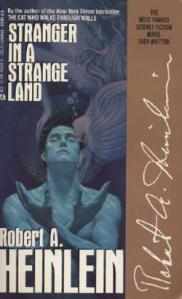 As a youngster, I loved science fiction. From being a little kid watching Fireball XL5 on television to reading the novels of
  at the cinema while in college (gosh, I’m old, right?) I really loved sci-fi. Actually, I still do, but this is a blast from the past post, so here goes.
 is considered a turning point into adult fiction because this novel begins his exploration of themes that appeal to a more mature audience, including libertarian politics. Perhaps modern readers wouldn’t realize it, but the powered body armor in Starship Troopers was one of those prescient inventions that makes reading and watching science fiction so important to the development of technology.
 was published a couple of years after Troopers, and while less “realistic” the novel takes some giant leaps into thematic explorations. The novel deals with the life of one Valentine Michael Smith, the first human born on Mars, and because he was orphaned he was reared by the natives of that planet, and later brought back to earth as a young adult human who knows absolutely nothing about his home planet or its inhabitants, hence the title. This situation is a fabulous set up for what science fiction does best: explore what makes humanity work (or not.) I used to read this novel annually, and I have never tired of it, because there are so many themes. Indeed, while doing a master’s degree in English, I wrote a pretty decent term paper on the topic of how Heinlein uses the world savior theme in the novel, and didn’t get thrown out of my fairly conservative program.


 I saw this “book” entitled Exercise and Mental Health featured on a site called “Deal News” as a freebie. I am loathe to pan a free book, but it is not really a book at all. Instead, this little 27 page document is like a course outline. While I saw no overt problems, the content might be best as a prompt to do further research, rather than an actual source of information.


 trilogy. Fans of science fiction, especially near future cautionary takes will really like this tale. It is well written, suspense filled, and the characters are reasonably well drawn. The setting makes great use of New York City, which would make it a sound basis for a film in the Urban Fantasy genre.
 I’m not entirely sure where I first heard of Hugh Howey, but he is one of those independent science fiction authors who is successful without the assistance of a publishing house. I love to support such endeavors, and it is easy to recommend Beacon 23. Here’s my super brief Amazon review:
 Visions and Revisions