Disaster? Get prepared!

One of my sisters lives in an area that has had several occasions when hurricanes made life difficult for a few days. She recounts a story of a couple who went nine days without utilities, and how her husband (an engineer by trade) took a home generator to the couple’s home and restored basic power. They are still fast friends, and that began with coping with a small scale disaster. My sister has put in a good bit of planning for such times into her current home. For instance, she has a gas cooktop, a propane grill, and she heats with fuel oil that lives in an absolutely huge tank. And, her pantry stays full. I have a full pantry and a swimming pool that I could tap for wash water and that’s about it. So, I wanted to know more about how to be prepared.

Now, I am not advocating being a “prepper” with $4K of freeze dried food stored in the basement. But, sometimes disasters happen, and the government’s recommendation of 72 hours worth of supplies might not be enough. To learn more about practical ways to be prepared, I recently read Tony Nestor’s book on the topic. He is a survival training expert, who makes a living teaching others how to survive in the wilderness or in more urban settings. His short book on this topic is impressive. I read When The Grid Goes Down: Disaster Preparations and Survival Gear For Making Your Home Self-Reliant in a couple of evenings. Nestor does not burden his book with lots of anecdotal tales; instead he gets right to the point and stays there. He discusses the differences between surviving in the city and in the country (not much different, actually) and then takes people’s needs, such as water, food, and shelter, topic by topic, and addresses how to prepare and cope with a disaster, should one occur. There is a bounty of useful information in this book, but I found the lists especially helpful. He also mentions other resources that I intend to purchase, such as a book for times when there is no doctor. Also helpful is the resources section in the back, which lists other books and DVDs, but it also has links to websites to purchase some of the items he recommends. And, no, he does not recommend tubs of food that lasts 25 years in storage. Nestor says he doesn’t eat that way now, and would not be happy eating that way in a disaster. Instead he recommends cans and packages of dry beans and rice that can be rotated for freshness. Oh, and he does recommend a firearm and lots of ammo. But he says that trapping and fishing are more efficient ways of securing animal protein. Again, this is practical advice!

The topics addressed here would be useful for a disaster that lasts from days to weeks. If you want to learn to live off the grid permanently, go read another book.

Butterfly Garden— a review

Trust me, this book will get under your skin and into your memory. I’ve read a lot of books, but this one is haunting.

One of my favorite genres of fiction is what is sometimes termed psychological fiction because the author gets into the minds of the characters. Perhaps it is due to my life experiences, or maybe it is due to my eclectic reading, but I am fascinated by the caretaker/villian. One my first exposures to this genre was the film “The Collector” based on the novel by John Fowles. Later, I read the book, which was also fascinating, but perhaps even more disturbing than the movie, which nicely bridges the gap between suspense and horror.

I think that Dot Hutchinson may have read the same book. That is not to say that her novel, The Butterfly Garden, is a rip-off of The Collector; it is not. However, there are some common aspects, so I will say that my guess is that she was inspired by the Fowles novel. Both novels deal with a warped collector, interested in butterflies, and his hapless series of victims. But, the villain in The Collector had one victim (at a time); in Hutchinson’s novel, the Gardener has a much bigger operation. Hutchinson basically took the plot, then raised the stakes. Her villain is far more villainous, so be forewarned that this novel is really disturbing. There is some bad language, as well as non-graphic rape and other unpleasantness directed toward the female victims.

The Butterfly Garden is modern in tone, pace, and language. But it is more of a “why” novel than a “what novel” as it begins at the end, and the plot unfolds as detectives try to unravel the story of the interactions between our victim (who has 3 names before it is over, so I won’t name her here) and an individual that the main character knows as the Gardener. Our protagonist is more victim than heroine, but she is certainly brave in a multi-layered manner. The novel is well-written and sufficiently suspenseful for me to have read it in a couple of evenings.

There are few parallels between The Butterfly Garden and my own psychological novel, The Gift Horse. However, an exploration of the role of the victim is common to both. If any of you readers enjoyed The Gift Horse, and were not overly offended, then you should try The Butterfly Garden. I really, really enjoyed it. But, I am not am not outraged by villains doing really bad things. That is what makes such characters villains.

Alarm of War— The Other Side of Fear

A while back, I wrote a positive review of Kennedy Hudner’s Alarm of War. Perhaps its greatest downside was that it clearly was intended to have a sequel. For a few months, I checked Amazon, hoping that Hudner had released the second part, but after a while, I quit looking. Then, as I reviewed my “keeper” files, I saw Alarm of War and looked again. Low and behold, Alarm of War, Book II: The Other Side of Fear was published in 2014. Finally, I had the sequel, but alas, it’s really part II of a trilogy. So, I am back to waiting.

However, it would be remiss to not review the second book. So, here’s a true confession: I went back and re-read the Alarm of War because it had been so long that I was certain I needed a refresher. Good plan, as I enjoyed it almost as much the second time. Once I had swiped the last page, I jumped right into The Other Side of Fear, and it wowed me from the opening scene.

While there are some stereotypical situations and characters, there is plenty of depth to Hudner’s ensemble of main characters, who met as they went through basic training during the first novel. My favorite is Emily Tuttle, a former history teacher with a brilliant grasp of military strategy. Other main characters include Grant Skiffington, the favored son of an admiral; Hiram Brill, a geeky guy who instinctively puts together intelligence into workable prophecies; and Marine sergeant Maria Sanchez, who is super gung ho, but reads books and likes to hang out with the nerd, Hiram. These characters all had intertwining adventures in the first book and book two immediately picks up the action.

Rather than write a bunch of spoilers, I will say this: Mr. Hudner’s series reminds me quite a lot of the early works of David Weber, the creator of the great Honor Harrington series. But, by using the ensemble, rather than centering on one character, Hudner is able to bring in various aspects of his universe, but keep the reader’s interest. At times, Weber spends more time explaining his villains than his heroine, and that has always bothered me. As a huge fan of military sci fi in general, and Honor Harrington in particular, it is hard to say this, but, “Move over, Mr. Weber.” Kennedy Hudner is writing some seriously kick-butt military sci-fi. Really.

As of this writing, the first book is a bargain at 99¢, and The Other Side of Fear is $3.99. My gosh, so much entertainment for less than the price of a movie ticket!

Wild Irish Heart— quick review and comments

Irish romanceWhile I don’t often read romance, February is the month to do so, now isn’t it? This novel is a bit of mystery, but with plenty of romance. It is not, however, one where a major sexual encounter happens before a third of the book is over. FYI!

Tricia O’Malley’s Wild Irish Heart (The Mystic Cove Series Book 1) begins the “Mystic Cove Series,” and it is a pleasant read, if not a compelling one. Our heroine, Keelin O’Brien, has been reared in Boston, by her successful real estate agent mother, who left Ireland and Keelin’s dad behind long ago. For reasons that are a bit of a mystery to Keelin, her mother doesn’t talk about the past, especially about Ireland. Soon, the reader learns that Keelin herself is a bit of a mystery, too, because she has a power that most of us don’t have.

When an ancient book arrives with a note which simply says, “It is time,” Keelin decides to go to Ireland, on an extended visit with the family that her mother shunned long ago. Thus begins her dual quest: to learn her past, and to see how her gift fits into her future. There are not many surprises on this journey, but Keelin does struggle to figure out how her attraction to a certain fellow that she meets early on will fit into her new life. Or is she somehow mistaken, and this isn’t the guy for her?

This novel has some supernatural elements, but it is mostly a bit of a mystery wrapped up in romantic garb. And it is a nice read for the month which features Valentine’s Day.

BTW, I read the Kindle version, as it was featured as a freebie a while back, and as of this post, the current price is 0.00. According to Amazon, it is also available in paperback and as an Audible book, if you like that format.

Infinity Lost— a quick review

I’m in the midst of a semester of teaching writing, and I generally read and write less when faced with lots of student papers. However, I did spend a couple of evenings with Infinity Lost by S Harrison. The main character is Finn, the only child of a reclusive industrial tycoon. Finn is an innocent, but as the story unfolds, she is not just a teenage girl. Certainly, science fiction is a favorite genre, and this entry by a new-to-me author is quite interesting.

There are some neat concepts in this story. At times, it was a bit confusing, but mostly, the author does a very good job of describing interesting technology. there is quite a bit of suspense, too. Actually, I began thinking that this novel reads well, but it might be a better screen play than a novel. It is the first entry in a trilogy, and I suppose there might be a film in the making.

Is last year’s best science fiction novel is this year’s best science fiction film?

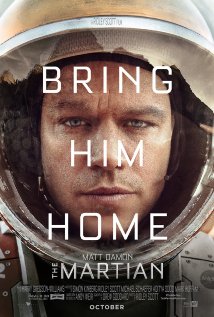
movie poster image of The MartianI think so, but I certainly haven’t seen all of the science fiction films of 2015. However, last night, I saw Ridley Scott’s version of The Martian, and it is really, really good. The guys with me (hubby and our unmarried 22 year-old son) absolutely loved it, and they had not read the book. (I wrote about Weir’s originally self-published novel last year.)

No doubt there are any number of professional and amateur reviews of the film, so I will do a bit of compare and contrast with the book. First, the beginning and the ending are different. Not vastly so, but the visual medium requires a different approach. However, the spirit of the novel, as well as much of the plot, is intact. The film begins with the astronauts on the surface of Mars, taking care of exploring and introducing characters. The action begins quickly, as the storm sets in and the crew aborts the mission. In the book, the back story unfolds as stranded astronaut Mark Watney recovers from his wound, assesses options, and determines each course of action. Either way, the story soon slows a bit, as this modern take on “Robinson Crusoe” unfolds. In order to get the audience out in a timely manner, the events in the film are compressed a bit. However, some things, such as the mission commander’s affection for “disco” music actually work much better in the film, as 80’s hits make up much of the sound track.

The casting is excellent, and the amount of screen time for players other than the central character, Watney, reflect a slightly different approach to the story. In the novel, chapters go by before there is any mention of the characters back on earth, but that, too, is accelerated for the film version. Actually, I like the film’s approach better than the novel, as it ramps up the suspense a bit.

Some folks in my generation have been very, very disappointed in the choices our government has made regarding space exploration. (Or should I say, the lack of space exploration.) The Martian can certainly thrill audiences of many ages, as my son really loved it. But it will especially appeal to those of us who watched NASA missions in our youth, and dreamed of continued exploration. This isn’t space opera— it is fiction based on real science.

At the most basic level, The Martian is good entertainment. It’s not particularly violent, or sexy, but it has plenty of action. The conflicts here are mostly man vs. the environment, and the environment is very believable. Perhaps, however, the younger audience will also ask why our government is so concerned about minutia, such as providing everything from cell phones to farmer’s markets, rather than taking the lead on larger initiatives, such as exploring the solar system.